Thank you for visiting SNEWPapers!
Sign up free
Editorial
June 4, 1816
Alexandria Gazette, Commercial And Political
Alexandria, Virginia
What is this article about?
An anti-war editorial from the Connecticut Courant laments the moral and physical evils of war, highlighting the sudden deaths of soldiers without time for reflection and the undignified exposure of unburied bodies to beasts, contrasting this with universal human reverence for the dead and calling for a peaceful era.
Merged-components note: These two components form a single continuous editorial article spanning adjacent columns on the same page, as indicated by sequential reading order and flowing text content.
Clipping
OCR Quality
75%
Good
Full Text
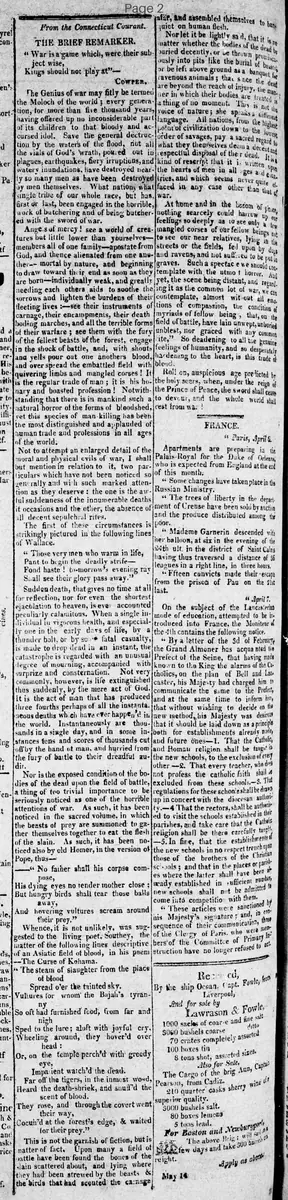
From the Connecticut Courant.
THE BRIEF REMARKER.
"War is a game which, were their subjects wise, Kings should not play at".-Cowper.
The Genius of war may fitly be termed the Moloch of the world; every generation, for more than five thousand years, having offered up no inconsiderable part of its children to that bloody and accursed idol. Save the general destruction by the waters of the flood, not all the vials of God's wrath, poured out in plagues, earthquakes, fiery irruptions, and watery inundations, have destroyed nearly so many men as have been destroyed by men themselves. What nation, what single tribe of our whole race, but has first or last, been engaged in the horrible work of butchering and of being butchered with the sword of war.
Angels of mercy! see a world of creatures but little lower than yourselves- members all of one family-apostate from God, and thence alienated from one another-- mortal by nature, and beginning to draw toward their end as soon as they are born-individually weak, and greatly needing each others aids to soothe the sorrows and lighten the burdens of their fleeting lives :-see their instruments of carnage, their encampments, their death boding marches, and all the terrible forms of their warfare; see them with the fury of the fellest beasts of the forest, engage in the shock of battle, and with shouts and yells pour out one anothers blood, and over spread the embattled field with quivering limbs and mangled corpses! It is the regular trade of man; it is his honary and boasted profession! Notwithstanding that there is in mankind such a natural horror of the forms of bloodshed, yet this species of man-killing has been the most distinguished and applauded of human trade and professions in all ages of the world.
Not to attempt an enlarged detail of the moral and physical evils of war, I shall but mention in relation to it, two particulars which have not been noticed so generally and with such marked attention as they deserve: the one is the awful suddenness of the innumerable deaths it occasions and the other, the absence of all decent sepulchral rites.
The first of these circumstances is strikingly pictured in the following lines of Wallace.
"Those very men who warm in life,
Pant to begin the deadly strife-
Fond haste! to-morrow's evening ray
Shall see their glory pass away."
Sudden death, that gives no time at all for reflection, nor for even the shortest ejaculation to heaven, is ever accounted peculiarly calamitous. When a single individual in vigorous health, and especially one in the early days of life, by a thunder bolt, or by some fatal casualty, is made to drop dead in an instant, the catastrophe is regarded with an unusual degree of mourning, accompanied with surprize and consternation. Not very commonly, however, is life extinguished thus suddenly, by the mere act of God. It is the act of man that has produced three fourths perhaps of all the instantaneous deaths which have ever happen'd in the world. Instantaneously are thousands in a single day, and in some instances tens and scores of thousands cut off by the hand of man, and hurried from the fury of battle to their dreadful audit.
Nor is the exposed condition of the bodies of the dead upon the field of battle, a thing of too trivial importance to be seriously noticed as one of the horrible attendants of war. As such, it has been noticed in the sacred volume, in which the beasts of prey are summoned to gather themselves together to eat the flesh of the slain. As such, it has been noticed also by old Homer, in the version of Pope, thus-
"No father shall his corpse compose,
His dying eyes no tender mother close;
But hungry birds shall tear those balls away,
And hovering vultures scream around their prey."
Whence, it is not unlikely, was suggested to the living poet, Southey, the matter of the following lines descriptive of an Asiatic field of blood, in his poem --The Curse of Kehama.
"The steam of slaughter from the place of blood
Spread o'er the tainted sky.
Vultures for whom' the Bajah's tyranny
So oft had furnished food, from far and nigh
Sped to the lure; aloft with joyful cry.
Wheeling around, they hover'd over head:
Or, on the temple perch'd with greedy eye,
Impatient watch'd the dead.
Far off the tigers, in the inmost wood,
Heard the death-shriek, and snuff'd the scent of blood.
They rose, and through the covert went their way,
Couch'd at the forest's edge, & waited for their prey."
This is not the garnish of fiction, but is matter of fact. Upon many a field of battle have been found the bones of the slain scattered about, and lying where they had been strewed by the beasts & the birds that had scented the carnage afar, and assembled themselves to banquet quietly on human flesh.
Nor let it be lightly said, that it is no matter whether the bodies of the dead be buried decently, or be thrown promiscuously or left in pits, or on the ground, as a banquet to ravenous animals beyond the reach of injury; since the dead care not in what manner their bodies are treated, it is a thing of no moment.
This is not the voice of nature; she speaks a different language. All nations, from the highest order of civilization down to the lowest order of savages, pay a sacred regard to what they themselves deem a decent and respectful disposal of the dead. It is a kind of rescript that is written in the hearts of men in all ages and countries, and which seems never quite effaced in any case other than that of war.
At home and in the bosom of peace, nothing scarcely could harrow up our feelings so deeply as to see mangled corpses of our fellow beings not to see our near relatives, lying in the streets or the fields, fallen upon by dogs and ravens; and not suffered to be put in graves. Such a spectacle we should contemplate with the utmost horror. And yet, the scene being distant, and regarding it as the common lot of war, we can contemplate, almost without all emotions of compassion, the condition of myriads of fellow beings, that, on the field of battle, have lain unwept, unburied unblest, nor graced with any common rite. So deadening to all the genuine feelings of humanity, and so desperately hardening to the heart, is this trade of blood.
Roll on, auspicious age predicted by the holy seers, when, under the reign of the Prince of Peace, the sword shall cease to devour, end the whole world shall rest from war!
THE BRIEF REMARKER.
"War is a game which, were their subjects wise, Kings should not play at".-Cowper.
The Genius of war may fitly be termed the Moloch of the world; every generation, for more than five thousand years, having offered up no inconsiderable part of its children to that bloody and accursed idol. Save the general destruction by the waters of the flood, not all the vials of God's wrath, poured out in plagues, earthquakes, fiery irruptions, and watery inundations, have destroyed nearly so many men as have been destroyed by men themselves. What nation, what single tribe of our whole race, but has first or last, been engaged in the horrible work of butchering and of being butchered with the sword of war.
Angels of mercy! see a world of creatures but little lower than yourselves- members all of one family-apostate from God, and thence alienated from one another-- mortal by nature, and beginning to draw toward their end as soon as they are born-individually weak, and greatly needing each others aids to soothe the sorrows and lighten the burdens of their fleeting lives :-see their instruments of carnage, their encampments, their death boding marches, and all the terrible forms of their warfare; see them with the fury of the fellest beasts of the forest, engage in the shock of battle, and with shouts and yells pour out one anothers blood, and over spread the embattled field with quivering limbs and mangled corpses! It is the regular trade of man; it is his honary and boasted profession! Notwithstanding that there is in mankind such a natural horror of the forms of bloodshed, yet this species of man-killing has been the most distinguished and applauded of human trade and professions in all ages of the world.
Not to attempt an enlarged detail of the moral and physical evils of war, I shall but mention in relation to it, two particulars which have not been noticed so generally and with such marked attention as they deserve: the one is the awful suddenness of the innumerable deaths it occasions and the other, the absence of all decent sepulchral rites.
The first of these circumstances is strikingly pictured in the following lines of Wallace.
"Those very men who warm in life,
Pant to begin the deadly strife-
Fond haste! to-morrow's evening ray
Shall see their glory pass away."
Sudden death, that gives no time at all for reflection, nor for even the shortest ejaculation to heaven, is ever accounted peculiarly calamitous. When a single individual in vigorous health, and especially one in the early days of life, by a thunder bolt, or by some fatal casualty, is made to drop dead in an instant, the catastrophe is regarded with an unusual degree of mourning, accompanied with surprize and consternation. Not very commonly, however, is life extinguished thus suddenly, by the mere act of God. It is the act of man that has produced three fourths perhaps of all the instantaneous deaths which have ever happen'd in the world. Instantaneously are thousands in a single day, and in some instances tens and scores of thousands cut off by the hand of man, and hurried from the fury of battle to their dreadful audit.
Nor is the exposed condition of the bodies of the dead upon the field of battle, a thing of too trivial importance to be seriously noticed as one of the horrible attendants of war. As such, it has been noticed in the sacred volume, in which the beasts of prey are summoned to gather themselves together to eat the flesh of the slain. As such, it has been noticed also by old Homer, in the version of Pope, thus-
"No father shall his corpse compose,
His dying eyes no tender mother close;
But hungry birds shall tear those balls away,
And hovering vultures scream around their prey."
Whence, it is not unlikely, was suggested to the living poet, Southey, the matter of the following lines descriptive of an Asiatic field of blood, in his poem --The Curse of Kehama.
"The steam of slaughter from the place of blood
Spread o'er the tainted sky.
Vultures for whom' the Bajah's tyranny
So oft had furnished food, from far and nigh
Sped to the lure; aloft with joyful cry.
Wheeling around, they hover'd over head:
Or, on the temple perch'd with greedy eye,
Impatient watch'd the dead.
Far off the tigers, in the inmost wood,
Heard the death-shriek, and snuff'd the scent of blood.
They rose, and through the covert went their way,
Couch'd at the forest's edge, & waited for their prey."
This is not the garnish of fiction, but is matter of fact. Upon many a field of battle have been found the bones of the slain scattered about, and lying where they had been strewed by the beasts & the birds that had scented the carnage afar, and assembled themselves to banquet quietly on human flesh.
Nor let it be lightly said, that it is no matter whether the bodies of the dead be buried decently, or be thrown promiscuously or left in pits, or on the ground, as a banquet to ravenous animals beyond the reach of injury; since the dead care not in what manner their bodies are treated, it is a thing of no moment.
This is not the voice of nature; she speaks a different language. All nations, from the highest order of civilization down to the lowest order of savages, pay a sacred regard to what they themselves deem a decent and respectful disposal of the dead. It is a kind of rescript that is written in the hearts of men in all ages and countries, and which seems never quite effaced in any case other than that of war.
At home and in the bosom of peace, nothing scarcely could harrow up our feelings so deeply as to see mangled corpses of our fellow beings not to see our near relatives, lying in the streets or the fields, fallen upon by dogs and ravens; and not suffered to be put in graves. Such a spectacle we should contemplate with the utmost horror. And yet, the scene being distant, and regarding it as the common lot of war, we can contemplate, almost without all emotions of compassion, the condition of myriads of fellow beings, that, on the field of battle, have lain unwept, unburied unblest, nor graced with any common rite. So deadening to all the genuine feelings of humanity, and so desperately hardening to the heart, is this trade of blood.
Roll on, auspicious age predicted by the holy seers, when, under the reign of the Prince of Peace, the sword shall cease to devour, end the whole world shall rest from war!
What sub-type of article is it?
War Or Peace
Moral Or Religious
What keywords are associated?
War Horrors
Sudden Death
Unburied Dead
Moral Evils
Peace Advocacy
What entities or persons were involved?
Kings
Mankind
Prince Of Peace
Cowper
Wallace
Homer
Southey
Editorial Details
Primary Topic
Evils Of War And Call For Peace
Stance / Tone
Strongly Anti War Moral Condemnation
Key Figures
Kings
Mankind
Prince Of Peace
Cowper
Wallace
Homer
Southey
Key Arguments
War Has Caused More Deaths Than Natural Disasters Over Millennia
War Involves Sudden Deaths Without Time For Reflection Or Prayer
Unburied Bodies On Battlefields Are Devoured By Animals, Denying Decent Rites
All Civilizations Respect Proper Burial Of The Dead, Except In War
War Hardens The Heart And Deadens Human Feelings