Thank you for visiting SNEWPapers!
Sign up free
The National Intelligencer And Washington Advertiser
Washington, District Of Columbia
What is this article about?
On October 27, 1803, in the U.S. House of Representatives, debate on implementing the Louisiana Treaty focused on constitutional authority to govern the acquired territory. Mr. Smilie supported flexible governance as a colony before statehood. Mr. Rodney defended the bill's second section using law of nations and constitutional provisions for territories. Mr. Griswold clarified his views on acquisition methods. The motion to strike the section failed 30-aye.
Clipping
OCR Quality
Full Text
HOUSE OF REPRESENTATIVES.
THURSDAY, OCT. 27, 1803.
Debate on the carrying LOUISIANA Treaty into effect.
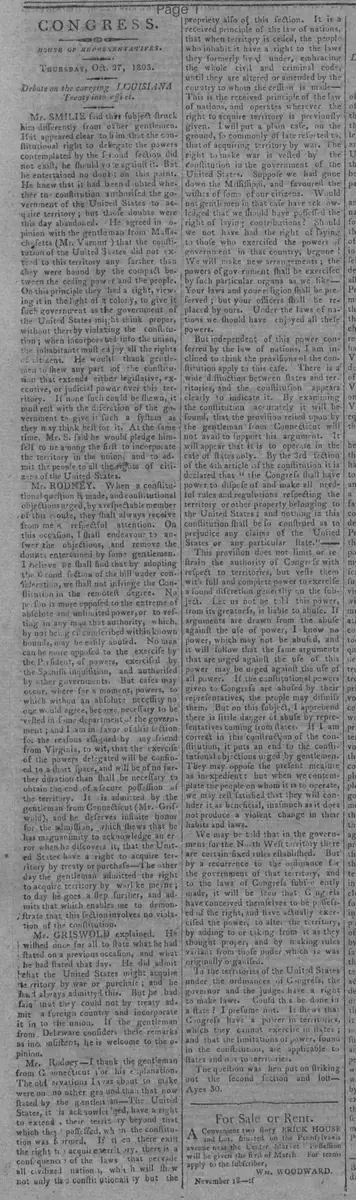
Mr. SMILIE said this subject struck him differently from other gentlemen. If it appeared clear to him that the constitutional right to delegate the powers contemplated by the second section did not exist, he should vote against it. But he entertained no doubt on this point. He knew that it had been doubted whether the constitution authorized the government of the United States to acquire territory; but those doubts were this day abandoned. He agreed in opinion with the gentleman from Massachusetts (Mr. Varnum) that the constitution of the United States did not extend to this territory any further than they were bound by the compact between the ceding power and the people. On this principle they had a right, viewing it in the light of a colony, to give it such government as the government of the United States might think proper, without thereby violating the constitution; when incorporated into the union, the inhabitants must enjoy all the rights of citizens. He would thank gentlemen to show any part of the constitution that extends either legislative, executive, or judicial power over this territory. If none such could be shown, it must rest with the discretion of the government to give it such a system as they may think best for it. At the same time, Mr. S. said he would pledge himself to be among the first to incorporate the territory in the union, and to admit the people to all the rights of citizens of the United States.
Mr. RODNEY. When a constitutional question is made, and constitutional objections urged, by a respectable member of this house, they shall always receive from me a respectful attention. On this occasion, I shall endeavour to answer the objections, and remove the doubts entertained by some gentlemen. I believe we shall find that by adopting the second section of the bill under consideration, we shall not infringe the Constitution in the remotest degree. No person is more opposed to the extreme of absolute and unlimited power, or to vesting in any man that authority, which, by not being circumscribed within known bounds, may be easily abused. No man can be more opposed to the exercise by the President, of powers, exercised by the Spanish inquisition, and authorized by other governments. But cases may occur, where for a moment, powers, to which without an absolute necessity no one would agree, become necessary to be vested in some department of the government; and I am in favor of this section for the reasons urged by my friend from Virginia, to wit, that the exercise of the powers delegated will be confined to a short space, and will be of no further duration than shall be necessary to obtain the end of a secure possession of the territory. It is admitted by the gentleman from Connecticut (Mr. Griswold), and he deserves infinite honor for the admission, which shows that he has magnanimity to acknowledge an error when he discovers it, that the United States have a right to acquire territory by treaty or purchase. The other day the gentleman admitted the right to acquire territory by warlike means; to day he goes a step further, and admits that which enables me to demonstrate that this section involves no violation of the constitution.
Mr. GRISWOLD explained. He wished once for all to state what he had stated on a previous occasion, and what he had stated that day. He did admit that the United States might acquire territory by war or purchase; and he has always admitted this. But he had always argued that they could not by treaty admit a foreign country and incorporate it into the union. If the gentleman from Delaware considers these remarks as inconsistent, he is welcome to the opinion.
Mr. Rodney—I thank the gentleman from Connecticut for his explanation. The observations I was about to make were on no other ground than that now stated by the gentleman—The United States, it is acknowledged, have a right to extend their territory beyond that which they possessed, when the constitution was formed. If then there exists the right to acquire territory, there is a consequence of the laws that pervade all civilized nations, which will show not only this constitutionality but the propriety also of this section. It is a received principle of the law of nations, that when territory is ceded, the people who inhabit it have a right to the laws they formerly lived under, embracing the whole civil and criminal code, until they are altered or amended by the country to whom the cession is made— This is the received principle of the law of nations, and operates wherever the right to acquire territory is previously given. I will put a plain case, on the ground, so commonly of late resorted to, that of acquiring territory by war. The right to make war is vested by the Constitution in the government of the United States. Suppose we had gone down the Mississippi, and favoured the wishes of some of our citizens. Would not gentlemen in that case have acknowledged that we should have possessed the right of laying contributions? Should we not have had the right of saying to those who exercised the powers of government in that country, begone! We will make new arrangements; the powers of government shall be exercised by such particular organs as we like— Your laws and your religion shall be preserved: but your officers shall be replaced by ours. Under the laws of nations we should have enjoyed all these powers. But independent of this power conferred by the law of nations, I am inclined to think the provisions of the constitution apply to this case. There is a wide distinction between states and territories, and the constitution appears clearly to indicate it. By examining the constitution accurately it will be found, that the provision relied upon by the gentleman from Connecticut will not avail to support his argument. It will appear that it is to operate in the case of states only. By the 3rd section of the 4th article of the constitution it is declared that "the Congress shall have power to dispose of and make all needful rules and regulations respecting the territory or other property belonging to the United States; and nothing in this constitution shall be so construed as to prejudice any claims of the United States or any particular state." This provision does not limit or restrain the authority of Congress with respect to territories, but vests them with full and complete power to exercise a sound discretion generally on the subject. Let us not be told this power, from its greatness, is liable to abuse. If arguments are drawn from the abuse against the use of power, I know no power, which may not be abused, and it will follow that the same arguments that are urged against the use of this power may be urged against the use of all power. If the constitutional powers given to Congress are abused by their representatives, the people may dismiss them. But on this subject, I apprehend there is little danger of abuse by representatives coming from states. If I am correct in this construction of the constitution, it puts an end to the constitutional objections urged by gentlemen. They may oppose the present measure as inexpedient: but when we contemplate the people on whom it is to operate, we may rest satisfied that they will consider it as beneficial, inasmuch as it does not produce a violent change in their habits and laws. We may be told that in the government for the North West territory there are certain fixed rules established. But by a recurrence to the ordinance for the government of that territory, and to the laws of Congress subsequently made, it will be seen that Congress have conceived themselves to be possessed of the right, and have actually exercised the power, to alter the territory, by adding to or taking from it as they thought proper, and by making rules variant from those under which it was originally organized. In the territories of the United States under the ordinances of Congress, the governor and the judges have a right to make laws. Could this be done in a state? I presume not. It shows that Congress have a power in territories, which they cannot exercise in states; and that the limitations of power, found in the constitution, are applicable to states and not to territories. The question was then put on striking out the second section and lost Ayes 30.
What sub-type of article is it?
What themes does it cover?
What keywords are associated?
What entities or persons were involved?
Where did it happen?
Story Details
Key Persons
Location
House Of Representatives
Event Date
Thursday, Oct. 27, 1803
Story Details
Debate in the House on the bill to implement the Louisiana Treaty, focusing on the constitutionality of the second section granting temporary powers to govern the territory. Mr. Smilie argues for colonial governance without violating the Constitution, pledging future incorporation. Mr. Rodney defends the section citing the law of nations and Article IV, Section 3, distinguishing territories from states. Mr. Griswold clarifies his admission of acquisition rights but opposition to incorporation by treaty. The motion to strike the section fails with 30 ayes.