Thank you for visiting SNEWPapers!
Sign up free
Literary
August 28, 1835
The Arkansas Advocate
Little Rock, Pulaski County, Arkansas
What is this article about?
In St. Albans, Peverell witnesses the capture of a gypsy-like youth accused of stealing bread from an inn. During examination by the mayor, the thief delivers an eloquent speech revealing he stole to feed his blind, dying father who has starved for days. Moved by compassion, the accuser withdraws the charge, freeing the youth to aid his father.
Clipping
OCR Quality
98%
Excellent
Full Text
From a publication entitled "Five Nights at St Albans."
THE ELOQUENT THIEF.
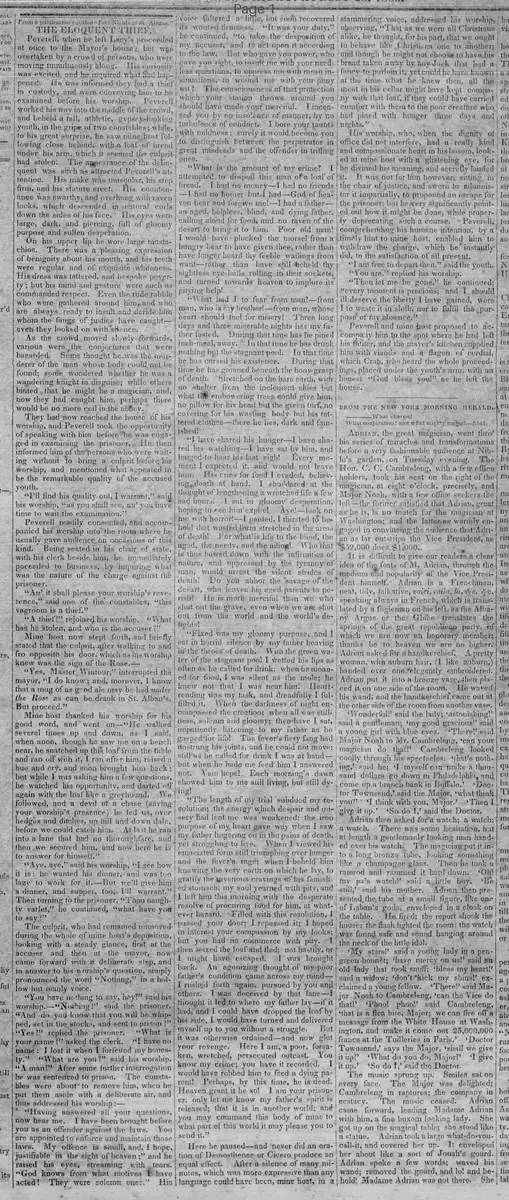
Peverell, when he left Lacy's proceeded at once to the Mayor's house; but was overtaken by a crowd of persons, who were moving tumultuously along. His curiosity was excited, and he inquired what had happened: He was informed they had a thief in custody, and were conveying him to be examined before his worship. Peverell worked his way into the middle of the crowd, and beheld a tall, athletic, gypsey-looking youth, in the gripe of two constables; while, to his great surprise, he saw mine host following close behind, with a loaf of bread under his arm, which it seemed the culprit had stolen. The appearance of the delinquent was such as attracted Peverell's attention. His make was muscular, his step firm, and his stature erect. His countenance was swarthy, and overhung with raven locks, which descended in natural curls down the sides of his face. His eyes were large; dark, and piercing, full of gloomy purpose and sullen desperation. On his upper lip he wore large mustachios. There was a pleasing expression of benignity about his mouth, and his teeth were regular and of exquisite whiteness. His dress was tattered, and bespoke poverty; but his mien and gesture were such as commanded respect. Even the rude rabble who were gathered around him, and who are always ready to insult and deride him whom the fangs of justice have caught—even they looked on with silence.
As the crowd moved slowly forwards, various were the conjectures that were hazarded. Some thought he was the murderer of the man whose body could not be found; some wondered whether he was a wandering knight in disguise; while others hinted that he might be a magician, and, now they had caught him, perhaps there would be no more coil in the abbey.
They had now reached the house of his worship, and Peverell took the opportunity of speaking with him before he was engaged in examining the prisoner. He then informed him of the persons who were waiting without to bring a culprit before his worship, and mentioned what appeared to be the remarkable quality of the accused youth.
"I'll find his quality out, I warrant," said his worship. "as you shall see, an' you have time to wait the examination."
Peverell readily consented, and accompanied his worship into the room where he usually gave audience on occasions of this kind. Being seated in his chair of state, with his clerk beside him, he immediately proceeded to business, by inquiring what was the nature of the charge against the prisoner.
"An' it shall please your worship's reverence," said one of the constables, "this varlet is a thief."
"A thief!" rejoined his worship. "What has he stolen, and who is the accuser?"
Mine host now stept forth, and briefly stated that the culprit, after walking to and fro opposite his door, which as his worship knew was the sign of the Rose.—
"Yes, Master Wintour," interrupted the mayor, "I do know; and, moreover, I know that a mug of as good ale may be had under the Rose as can be drank in St. Alban's. But proceed."
Mine host thanked his worship for his good word, and went on—"He walked several times up and down, as I said, when anon, though he saw me on a bench near, he snatched up this loaf from the table and ran off with it, I ran after him, raised a hue and cry, and soon brought him back; but while I was asking him a few questions, he watched his opportunity, and darted off again with the loaf like a greyhound. We followed, and a devil of a chase (saving your worship's presence) he led us, over hedges and ditches, up hill and down dale, before we could catch him. At last he ran into a lane that had no thoroughfare. and then we secured him, and now here he is to answer for himself."
"Aye, aye," said his worship, "I see how it is: he wanted his dinner, and was too lazy to work for it.—But we'll give him a dinner, and supper, too, I'll warrant."
Then turning to the prisoner, "Thou naughty varlet," he continued, "what have you to say?"
The culprit, who had remained unmoved during the whole of mine host's deposition, looking with a steady glance, first at the accuser and then at the mayor, now came forward with a deliberate step, and in answer to his worship's question, simply pronounced the word "Nothing," in a hollow but manly voice.
"You have nothing to say, hay?" said his worship.—"Nothing!" said the prisoner.
"And do you know that you will be whipped, set in the stocks, and sent to prison?"
"Yes!" replied the prisoner. "What is your name?" asked the clerk. "I have no name : I lost it when I forfeited my honesty." "What are you?" said his worship. "A man!" After some further interrogation be was sentenced to prison. The constables were about to remove him, when he put them aside with a deliberate air, and thus addressed his worship:-
"Having answered all your questions, now hear me. I have been brought before you as an offender against the laws. You are appointed to enforce and maintain those laws. My offence is small, and, I hope, justifiable in the sight of heaven;" and he raised his eyes, streaming with tears. "God knows from what motives I have acted!—They were solemn ones." His voice faltered a little, but soon recovered its wonted firmness. "It was your duty," he continued, "to take the deposition of my accuser, and to act upon it according to the law. But who gave you power, who gave you right, to insult me with your needless questions, to oppress me with mean insinuations, to wound me with your puny wit? The consciousness of that protection which your station throws around you should have made you merciful. I incensed you by no insolence of manner, by no turbulence of conduct. I bore your taunts with mildness : surely it would become you to distinguish between the perpetrator in great misdeeds and the offender in trifling ones.
"What is the amount of my crime? I attempted to despoil this man of a loaf of bread. I had no money—I had no friends -I had no home: but I had—God of heaven hear and forgive me!—I had a father—an aged, helpless, blind, and dying father, calling aloud for food, and no raven of the desert to bring it to him. Poor old man! I would have plucked the morsel from a hungry bear to have given thee, rather than have longer heard thy feeble wailings from want—rather than have still beheld thy sightless eye-balls rolling in their sockets, and turned towards heaven to implore its pitying help!
"What had I to fear from man?—from man, who is my brother!—from man, whose heart should feel for misery! Three long days and three miserable nights has my father fasted. During that time has he pined inch-meal, away. In that time he has drunk nothing but the stagnant pool. In that time he has cursed his existence. During that time he has groaned beneath the bony grasp of death. Stretched on the bare earth, with no shelter from the inclement skies but what the embowering trees could give him, no pillow for his head but the green turf, no covering for his wasting body but his tattered clothes—there he lies, dark and famished!
"I have shared his hunger—I have shared his watching—I have sat by him, and longed to hear his last sigh! Every moment I expected it, and would not leave him. His cries for food I evaded, believing death at hand. I shuddered at the thought of lengthening a wretched life a few sad hours! I sat in gloomy desperation, hoping to see him expire! Aye!—look on me with horror!—I panted, I thirsted to behold that wasted form stretched in the arms of death! For what is life to the blind, the aged, the needy, and the ailing! Who that is thus bowed down with the infirmities of nature, and oppressed by the tyranny of man, would arrest the silent strides of death? Do you abhor the savage of the desert, who leaves his aged parents to perish? He is more merciful than we who shut out the grave, even when we are shut out from the world and the world's delights!
"Fixed was my gloomy purpose, and I sat in horrid silence by my father heaving in the throes of death. With the green water of the stagnant pool I wetted his lips as often as he called for drink: when he moaned for food, I was silent as the mole; he knew not that I was near him. Heart-rending was my task, and dreadfully I fulfilled it. When the darkness of night encompassed the creation; when all was stillness, solemn and gloomy; then have I sat, impatiently listening to my father as he gasped for life! The fever's fiery fang had unstrung his joints, and he could not move: still as he called for drink I was at hand—but when he bade me feed him I answered not. Vain hope! Each morning's dawn showed him to me still living, but still dying!
"The length of my trial subdued my resolution; the energy which despair and misery had lent me was weakened: the iron purpose of my heart gave way when I saw my father lingering on in the pains of death, yet struggling to live. When I viewed his emaciated form still triumphing over hunger and the fever's rage; when I beheld him gnawing the very earth on which he lay, to gratify the ravenous cravings of his famished stomach, my soul yearned with pity, and I left him this morning with the desperate resolve of procuring food for him, at whatever hazard. Filled with this resolution, I passed your door; I repassed it; I hoped to interest your compassion by my looks; but you had no commerce with pity. I then seized the loaf and fled; not hastily, or I might have escaped. I was brought back. An agonizing thought of my poor father's condition came across my mind—I rushed forth again, pursued by you and others. I was deceived by that lane—I thought it led to where my father lay—if it had, and I could have dropped the loaf by his side, I would have turned and delivered myself up to you without a struggle. But it was otherwise ordained—and now glut your revenge. Here I am, a poor, forsaken, wretched, persecuted outcast. You know my crime; you have it recorded. I would have robbed him to feed a dying parent! Perhaps, by this time, he is dead. Heaven grant it be so! I am your prisoner: only let me know my father's spirit is released; that it is in another world; and you may command this body of mine to what part of this world it may please you to send it."
Here he paused—and never did an oration of Demosthenes or Cicero produce an equal effect. After a silence of many minutes, which was more expressive than any language could have been, mine host, in a stammering voice, addressed his worship, observing, "That as we were all Christians alike, he thought, for his part, that we ought to behave like Christians one to another: and though he might not choose to have his bread taken away by any Jack that had a fancy to purloin it, yet could he have known at the time what he knew then, all the meat in his cellar might have kept company with that loaf, if they could have carried comfort with them to the poor creature who had pined with hunger three days and nights."
His worship, who, when the dignity of office did not interfere, had a really kind and compassionate heart in his bosom, looked at mine host with a glistening eye, for he divined his meaning, and secretly lauded it. It was not for him however, sitting in the chair of justice, and sworn to administer it impartially, to propound an escape for the prisoner: but he very significantly pointed out how it might be done, while properly deprecating such a course. Peverell, comprehending his humane intention, by a timely hint to mine host, enabled him to withdraw the charge, which he instantly did, to the satisfaction of all present.
"I am free to depart then," said the youth.
"You are," replied his worship.
"Then let me be gone," he continued: "every moment is precious; and I should ill deserve the liberty I have gained, were I to waste it in sloth, nor to fulfil the purpose of my absence."
Peverell and mine host proposed to accompany him to the spot where he had left his father, and the mayor's kitchen supplied him with viands and a flagon of cordial, which Crab, who heard the whole proceedings, placed under the youth's arm, with an honest "God bless you!" as he left the house.
THE ELOQUENT THIEF.
Peverell, when he left Lacy's proceeded at once to the Mayor's house; but was overtaken by a crowd of persons, who were moving tumultuously along. His curiosity was excited, and he inquired what had happened: He was informed they had a thief in custody, and were conveying him to be examined before his worship. Peverell worked his way into the middle of the crowd, and beheld a tall, athletic, gypsey-looking youth, in the gripe of two constables; while, to his great surprise, he saw mine host following close behind, with a loaf of bread under his arm, which it seemed the culprit had stolen. The appearance of the delinquent was such as attracted Peverell's attention. His make was muscular, his step firm, and his stature erect. His countenance was swarthy, and overhung with raven locks, which descended in natural curls down the sides of his face. His eyes were large; dark, and piercing, full of gloomy purpose and sullen desperation. On his upper lip he wore large mustachios. There was a pleasing expression of benignity about his mouth, and his teeth were regular and of exquisite whiteness. His dress was tattered, and bespoke poverty; but his mien and gesture were such as commanded respect. Even the rude rabble who were gathered around him, and who are always ready to insult and deride him whom the fangs of justice have caught—even they looked on with silence.
As the crowd moved slowly forwards, various were the conjectures that were hazarded. Some thought he was the murderer of the man whose body could not be found; some wondered whether he was a wandering knight in disguise; while others hinted that he might be a magician, and, now they had caught him, perhaps there would be no more coil in the abbey.
They had now reached the house of his worship, and Peverell took the opportunity of speaking with him before he was engaged in examining the prisoner. He then informed him of the persons who were waiting without to bring a culprit before his worship, and mentioned what appeared to be the remarkable quality of the accused youth.
"I'll find his quality out, I warrant," said his worship. "as you shall see, an' you have time to wait the examination."
Peverell readily consented, and accompanied his worship into the room where he usually gave audience on occasions of this kind. Being seated in his chair of state, with his clerk beside him, he immediately proceeded to business, by inquiring what was the nature of the charge against the prisoner.
"An' it shall please your worship's reverence," said one of the constables, "this varlet is a thief."
"A thief!" rejoined his worship. "What has he stolen, and who is the accuser?"
Mine host now stept forth, and briefly stated that the culprit, after walking to and fro opposite his door, which as his worship knew was the sign of the Rose.—
"Yes, Master Wintour," interrupted the mayor, "I do know; and, moreover, I know that a mug of as good ale may be had under the Rose as can be drank in St. Alban's. But proceed."
Mine host thanked his worship for his good word, and went on—"He walked several times up and down, as I said, when anon, though he saw me on a bench near, he snatched up this loaf from the table and ran off with it, I ran after him, raised a hue and cry, and soon brought him back; but while I was asking him a few questions, he watched his opportunity, and darted off again with the loaf like a greyhound. We followed, and a devil of a chase (saving your worship's presence) he led us, over hedges and ditches, up hill and down dale, before we could catch him. At last he ran into a lane that had no thoroughfare. and then we secured him, and now here he is to answer for himself."
"Aye, aye," said his worship, "I see how it is: he wanted his dinner, and was too lazy to work for it.—But we'll give him a dinner, and supper, too, I'll warrant."
Then turning to the prisoner, "Thou naughty varlet," he continued, "what have you to say?"
The culprit, who had remained unmoved during the whole of mine host's deposition, looking with a steady glance, first at the accuser and then at the mayor, now came forward with a deliberate step, and in answer to his worship's question, simply pronounced the word "Nothing," in a hollow but manly voice.
"You have nothing to say, hay?" said his worship.—"Nothing!" said the prisoner.
"And do you know that you will be whipped, set in the stocks, and sent to prison?"
"Yes!" replied the prisoner. "What is your name?" asked the clerk. "I have no name : I lost it when I forfeited my honesty." "What are you?" said his worship. "A man!" After some further interrogation be was sentenced to prison. The constables were about to remove him, when he put them aside with a deliberate air, and thus addressed his worship:-
"Having answered all your questions, now hear me. I have been brought before you as an offender against the laws. You are appointed to enforce and maintain those laws. My offence is small, and, I hope, justifiable in the sight of heaven;" and he raised his eyes, streaming with tears. "God knows from what motives I have acted!—They were solemn ones." His voice faltered a little, but soon recovered its wonted firmness. "It was your duty," he continued, "to take the deposition of my accuser, and to act upon it according to the law. But who gave you power, who gave you right, to insult me with your needless questions, to oppress me with mean insinuations, to wound me with your puny wit? The consciousness of that protection which your station throws around you should have made you merciful. I incensed you by no insolence of manner, by no turbulence of conduct. I bore your taunts with mildness : surely it would become you to distinguish between the perpetrator in great misdeeds and the offender in trifling ones.
"What is the amount of my crime? I attempted to despoil this man of a loaf of bread. I had no money—I had no friends -I had no home: but I had—God of heaven hear and forgive me!—I had a father—an aged, helpless, blind, and dying father, calling aloud for food, and no raven of the desert to bring it to him. Poor old man! I would have plucked the morsel from a hungry bear to have given thee, rather than have longer heard thy feeble wailings from want—rather than have still beheld thy sightless eye-balls rolling in their sockets, and turned towards heaven to implore its pitying help!
"What had I to fear from man?—from man, who is my brother!—from man, whose heart should feel for misery! Three long days and three miserable nights has my father fasted. During that time has he pined inch-meal, away. In that time he has drunk nothing but the stagnant pool. In that time he has cursed his existence. During that time he has groaned beneath the bony grasp of death. Stretched on the bare earth, with no shelter from the inclement skies but what the embowering trees could give him, no pillow for his head but the green turf, no covering for his wasting body but his tattered clothes—there he lies, dark and famished!
"I have shared his hunger—I have shared his watching—I have sat by him, and longed to hear his last sigh! Every moment I expected it, and would not leave him. His cries for food I evaded, believing death at hand. I shuddered at the thought of lengthening a wretched life a few sad hours! I sat in gloomy desperation, hoping to see him expire! Aye!—look on me with horror!—I panted, I thirsted to behold that wasted form stretched in the arms of death! For what is life to the blind, the aged, the needy, and the ailing! Who that is thus bowed down with the infirmities of nature, and oppressed by the tyranny of man, would arrest the silent strides of death? Do you abhor the savage of the desert, who leaves his aged parents to perish? He is more merciful than we who shut out the grave, even when we are shut out from the world and the world's delights!
"Fixed was my gloomy purpose, and I sat in horrid silence by my father heaving in the throes of death. With the green water of the stagnant pool I wetted his lips as often as he called for drink: when he moaned for food, I was silent as the mole; he knew not that I was near him. Heart-rending was my task, and dreadfully I fulfilled it. When the darkness of night encompassed the creation; when all was stillness, solemn and gloomy; then have I sat, impatiently listening to my father as he gasped for life! The fever's fiery fang had unstrung his joints, and he could not move: still as he called for drink I was at hand—but when he bade me feed him I answered not. Vain hope! Each morning's dawn showed him to me still living, but still dying!
"The length of my trial subdued my resolution; the energy which despair and misery had lent me was weakened: the iron purpose of my heart gave way when I saw my father lingering on in the pains of death, yet struggling to live. When I viewed his emaciated form still triumphing over hunger and the fever's rage; when I beheld him gnawing the very earth on which he lay, to gratify the ravenous cravings of his famished stomach, my soul yearned with pity, and I left him this morning with the desperate resolve of procuring food for him, at whatever hazard. Filled with this resolution, I passed your door; I repassed it; I hoped to interest your compassion by my looks; but you had no commerce with pity. I then seized the loaf and fled; not hastily, or I might have escaped. I was brought back. An agonizing thought of my poor father's condition came across my mind—I rushed forth again, pursued by you and others. I was deceived by that lane—I thought it led to where my father lay—if it had, and I could have dropped the loaf by his side, I would have turned and delivered myself up to you without a struggle. But it was otherwise ordained—and now glut your revenge. Here I am, a poor, forsaken, wretched, persecuted outcast. You know my crime; you have it recorded. I would have robbed him to feed a dying parent! Perhaps, by this time, he is dead. Heaven grant it be so! I am your prisoner: only let me know my father's spirit is released; that it is in another world; and you may command this body of mine to what part of this world it may please you to send it."
Here he paused—and never did an oration of Demosthenes or Cicero produce an equal effect. After a silence of many minutes, which was more expressive than any language could have been, mine host, in a stammering voice, addressed his worship, observing, "That as we were all Christians alike, he thought, for his part, that we ought to behave like Christians one to another: and though he might not choose to have his bread taken away by any Jack that had a fancy to purloin it, yet could he have known at the time what he knew then, all the meat in his cellar might have kept company with that loaf, if they could have carried comfort with them to the poor creature who had pined with hunger three days and nights."
His worship, who, when the dignity of office did not interfere, had a really kind and compassionate heart in his bosom, looked at mine host with a glistening eye, for he divined his meaning, and secretly lauded it. It was not for him however, sitting in the chair of justice, and sworn to administer it impartially, to propound an escape for the prisoner: but he very significantly pointed out how it might be done, while properly deprecating such a course. Peverell, comprehending his humane intention, by a timely hint to mine host, enabled him to withdraw the charge, which he instantly did, to the satisfaction of all present.
"I am free to depart then," said the youth.
"You are," replied his worship.
"Then let me be gone," he continued: "every moment is precious; and I should ill deserve the liberty I have gained, were I to waste it in sloth, nor to fulfil the purpose of my absence."
Peverell and mine host proposed to accompany him to the spot where he had left his father, and the mayor's kitchen supplied him with viands and a flagon of cordial, which Crab, who heard the whole proceedings, placed under the youth's arm, with an honest "God bless you!" as he left the house.
What sub-type of article is it?
Prose Fiction
Dialogue
Soliloquy
What themes does it cover?
Moral Virtue
Death Mortality
Social Manners
What keywords are associated?
Eloquent Thief
Dying Father
Stolen Bread
Compassionate Justice
Moral Tale
Poverty
Trial
St Albans
Literary Details
Title
The Eloquent Thief.
Subject
The Trial Of A Thief Who Stole Bread For His Dying Father
Form / Style
Narrative Prose With An Eloquent Dramatic Speech
Key Lines
"I Have No Name : I Lost It When I Forfeited My Honesty." "What Are You?" Said His Worship. "A Man!"
"What Is The Amount Of My Crime? I Attempted To Despoil This Man Of A Loaf Of Bread. I Had No Money—I Had No Friends I Had No Home: But I Had—God Of Heaven Hear And Forgive Me!—I Had A Father—An Aged, Helpless, Blind, And Dying Father, Calling Aloud For Food, And No Raven Of The Desert To Bring It To Him."
"Three Long Days And Three Miserable Nights Has My Father Fasted. During That Time Has He Pined Inch Meal, Away."
"I Would Have Robbed Him To Feed A Dying Parent! Perhaps, By This Time, He Is Dead. Heaven Grant It Be So!"
"That As We Were All Christians Alike, He Thought, For His Part, That We Ought To Behave Like Christians One To Another"