Thank you for visiting SNEWPapers!
Sign up free
Literary
June 7, 1788
The New York Journal, And Daily Patriotic Register
New York, New York County, New York
What is this article about?
An essay from the Worcester Speculator in Thomas's Massachusetts Spy condemns the widespread vice of detraction, where people maliciously criticize others' characters and intentions despite their innocence. It references Horace and Pliny, urges self-reflection and charity, and notes historical punishments for calumny in Rome.
Clipping
OCR Quality
85%
Good
Full Text
MISCELLANY.
From Thomas's Massachusetts Spy, &c.
WORCESTER SPECULATOR.
A Bentem qui ridet Amicum
Que non defendit alio culpante;
Hic niger est;
Hunc tu, Americanus, caveto---
HORACE.
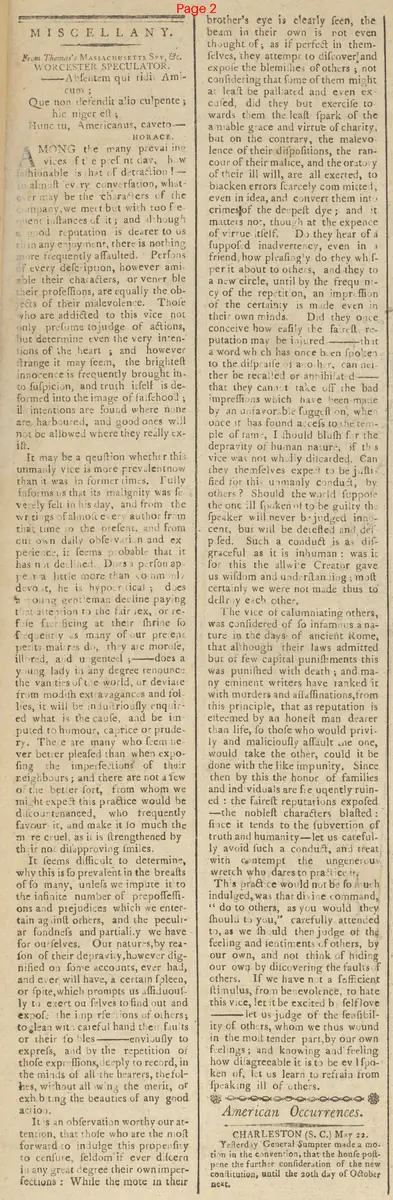
AMONG the many prevailing vices of the present day, how fashionable is that of detraction!
In almost every conversation, whatever may be the characters of the company, we meet but with too frequent instances of it; and although a good reputation is dearer to us than any enjoyment, there is nothing more frequently assailed. Persons of every description, however amiable their characters, or venerable their professions, are equally the objects of their malevolence. Those who are addicted to this vice not only presume to judge of actions, but determine even the very intentions of the heart; and however strange it may seem, the brightest innocence is frequently brought into suspicion, and truth itself is deformed into the image of falsehood: ill intentions are found where none are harboured, and good ones will not be allowed where they really exist.
It may be a question whether this unmanly vice is more prevalent now than it was in former times. Pliny informs us that its malignity was severely felt in his day. and from the writings of almost every author from that time to the present. and from our own daily observation and experience, it seems probable that it has not declined. Does a person appear a little more than commonly devout, he is hypocritical; does a young gentleman decline paying that attention to the fair sex, or refraining from sacrificing at their shrine so frequently as many of our present petits maitres do, they are morose, ill-bred, and ungenteel;—does a young lady in any degree renounce the vanities of the world, or deviate from modish extravagances and follies, it will be inquisitiously enquired what is the cause. and be imputed to humour, caprice or prudery. There are many who seem never better pleased than when exposing the imperfections of their neighbours ; and there are not a few of the better sort. from whom we might expect this practice would be discountenanced. who frequently favour it. and make it so much the more cruel, as it is strengthened by their not disapproving smiles.
It seems difficult to determine, why this is so prevalent in the breasts of so many, unless we impute it to the infinite number of prepossessions and prejudices which we entertain against others, and the peculiar fondness and partiality we have for ourselves. Our natures, by reason of their depravity,however dignified on some accounts, ever had, and ever will have, a certain spleen, or spite, which prompts us assiduously to exert ourselves to find out and expose the imperfections of others: to glean with careful hand their faults or their foibles--enviously to express, and by the repetition of those expressions, deeply to record, in the minds of all the hearers, the follies, without allowing the merit, or exhibiting the beauties of any good action.
It is an observation worthy our attention, that those who are the most forward to indulge this propensity to censure, seldom if ever discern in any great degree their own imperfections : While the mote in their brother's eye is clearly seen, the beam in their own is not even thought of; as if perfect in themselves, they attempt to discover and expose the blemishes of others ; not considering that some of them might at least be palliated and even excused. did they but exercise towards them the least spark of the amiable grace and virtue of charity. But on the contrary, the malevolence of their dispositions, the rancour of their malice, and the oratory of their ill will, are all exerted, to blacken errors scarcely committed, even in idea, and convert them into crimes of the deepest dye; and it matters not, though at the expence of virtue itself. Do they hear of a supposed inadvertency, even in a friend, how pleasing'y do they whisper it about to others, and they to a new circle, until by the frequency of the repetition, an impression of the certainty is made even in their own minds. Did they once conceive how easily the fairest. reputation may be injured.that a word which has once been spoken to the dispraise of another, can neither be recalled or annihilated that they cannot take off the bad impressions which have been made by an unfavourable suggestion, where once it has found access to the temple of fame, I should blush for the depavity of human nature. if this vice was not wholly discarded. Can they themselves expect to be justified for this unmanly conduct, by others ? Should the world suppose the one ill spoken of to be guilty the speaker will never be judged innocent, but will be detested and despised. Such a conduct is as disgraceful as it is inhuman : was it for this the allwise Creator gave us wisdom and understanding ; most certainly we were not made thus to destroy each other.
The vice of calumniating others, was considered of so infamous a nature in the days of ancient Rome, that although their laws admitted but of few capital punishments this was punished with death ; and many eminent writers have ranked it with murders and assassinations, from this principle, that as reputation is esteemed by an honest man dearer than life, so those who would priviledgiously and maliciously assault one, would take the other, could it be done with the like impunity. Since then by this the honor of families and individuals are frequently ruined : the fairest reputations exposed--the noblest characters blasted: since it tends to the subversion of truth and humanity—let us carefully avoid such a conduct, and treat with contempt the ungenerous wretch who dares to practice it.
This practice would not be so much indulged, was that divine command. " do to others, as you would they should do to you," carefully attended to, as we should then judge of the feeling and sentiments of others, by our own, and not think of hiding our own by discovering the faults of others. If we have not a sufficient stimulus, from benevolence. to hate this vice, let it be excited by selflove _ let us judge ofthe sensibility of others, whom we thus wound in the most tender part,by our own feelings; and knowing and feeling how disagreeable it is to be evil spoken of, let us learn to refrain from speaking ill of others.
From Thomas's Massachusetts Spy, &c.
WORCESTER SPECULATOR.
A Bentem qui ridet Amicum
Que non defendit alio culpante;
Hic niger est;
Hunc tu, Americanus, caveto---
HORACE.
AMONG the many prevailing vices of the present day, how fashionable is that of detraction!
In almost every conversation, whatever may be the characters of the company, we meet but with too frequent instances of it; and although a good reputation is dearer to us than any enjoyment, there is nothing more frequently assailed. Persons of every description, however amiable their characters, or venerable their professions, are equally the objects of their malevolence. Those who are addicted to this vice not only presume to judge of actions, but determine even the very intentions of the heart; and however strange it may seem, the brightest innocence is frequently brought into suspicion, and truth itself is deformed into the image of falsehood: ill intentions are found where none are harboured, and good ones will not be allowed where they really exist.
It may be a question whether this unmanly vice is more prevalent now than it was in former times. Pliny informs us that its malignity was severely felt in his day. and from the writings of almost every author from that time to the present. and from our own daily observation and experience, it seems probable that it has not declined. Does a person appear a little more than commonly devout, he is hypocritical; does a young gentleman decline paying that attention to the fair sex, or refraining from sacrificing at their shrine so frequently as many of our present petits maitres do, they are morose, ill-bred, and ungenteel;—does a young lady in any degree renounce the vanities of the world, or deviate from modish extravagances and follies, it will be inquisitiously enquired what is the cause. and be imputed to humour, caprice or prudery. There are many who seem never better pleased than when exposing the imperfections of their neighbours ; and there are not a few of the better sort. from whom we might expect this practice would be discountenanced. who frequently favour it. and make it so much the more cruel, as it is strengthened by their not disapproving smiles.
It seems difficult to determine, why this is so prevalent in the breasts of so many, unless we impute it to the infinite number of prepossessions and prejudices which we entertain against others, and the peculiar fondness and partiality we have for ourselves. Our natures, by reason of their depravity,however dignified on some accounts, ever had, and ever will have, a certain spleen, or spite, which prompts us assiduously to exert ourselves to find out and expose the imperfections of others: to glean with careful hand their faults or their foibles--enviously to express, and by the repetition of those expressions, deeply to record, in the minds of all the hearers, the follies, without allowing the merit, or exhibiting the beauties of any good action.
It is an observation worthy our attention, that those who are the most forward to indulge this propensity to censure, seldom if ever discern in any great degree their own imperfections : While the mote in their brother's eye is clearly seen, the beam in their own is not even thought of; as if perfect in themselves, they attempt to discover and expose the blemishes of others ; not considering that some of them might at least be palliated and even excused. did they but exercise towards them the least spark of the amiable grace and virtue of charity. But on the contrary, the malevolence of their dispositions, the rancour of their malice, and the oratory of their ill will, are all exerted, to blacken errors scarcely committed, even in idea, and convert them into crimes of the deepest dye; and it matters not, though at the expence of virtue itself. Do they hear of a supposed inadvertency, even in a friend, how pleasing'y do they whisper it about to others, and they to a new circle, until by the frequency of the repetition, an impression of the certainty is made even in their own minds. Did they once conceive how easily the fairest. reputation may be injured.that a word which has once been spoken to the dispraise of another, can neither be recalled or annihilated that they cannot take off the bad impressions which have been made by an unfavourable suggestion, where once it has found access to the temple of fame, I should blush for the depavity of human nature. if this vice was not wholly discarded. Can they themselves expect to be justified for this unmanly conduct, by others ? Should the world suppose the one ill spoken of to be guilty the speaker will never be judged innocent, but will be detested and despised. Such a conduct is as disgraceful as it is inhuman : was it for this the allwise Creator gave us wisdom and understanding ; most certainly we were not made thus to destroy each other.
The vice of calumniating others, was considered of so infamous a nature in the days of ancient Rome, that although their laws admitted but of few capital punishments this was punished with death ; and many eminent writers have ranked it with murders and assassinations, from this principle, that as reputation is esteemed by an honest man dearer than life, so those who would priviledgiously and maliciously assault one, would take the other, could it be done with the like impunity. Since then by this the honor of families and individuals are frequently ruined : the fairest reputations exposed--the noblest characters blasted: since it tends to the subversion of truth and humanity—let us carefully avoid such a conduct, and treat with contempt the ungenerous wretch who dares to practice it.
This practice would not be so much indulged, was that divine command. " do to others, as you would they should do to you," carefully attended to, as we should then judge of the feeling and sentiments of others, by our own, and not think of hiding our own by discovering the faults of others. If we have not a sufficient stimulus, from benevolence. to hate this vice, let it be excited by selflove _ let us judge ofthe sensibility of others, whom we thus wound in the most tender part,by our own feelings; and knowing and feeling how disagreeable it is to be evil spoken of, let us learn to refrain from speaking ill of others.
What sub-type of article is it?
Essay
What themes does it cover?
Moral Virtue
Social Manners
What keywords are associated?
Detraction
Calumny
Reputation
Vice
Moral Essay
Censure
Charity
Gossip
Literary Details
Title
Worcester Speculator.
Subject
On The Vice Of Detraction
Key Lines
A Bentem Qui Ridet Amicum
Que Non Defendit Alio Culpante;
Hic Niger Est;
Hunc Tu, Americanus, Caveto
Horace.
Among The Many Prevailing Vices Of The Present Day, How
Fashionable Is That Of Detraction!
It Is An Observation Worthy Our At
Tention, That Those Who Are The Most
Forward To Indulge This Propensity
To Censure, Seldom If Ever Discern
In Any Great Degree Their Ownimper
Fections : While The Mote In Their
Brother's Eye Is Clearly Seen, The
Beam In Their Own Is Not Even
Thought Of;
The Vice Of Calumniating Others,
Was Considered Of So Infamous A Na
Ture In The Days Of Ancient Rome,
That Although Their Laws Admitted
But Of Few Capital Punishments This
Was Punished With Death ;
If We Have Not A Sufficient
Stimulus, From Benevolence. To Hate
This Vice, Let It Be Excited By Selflove
Let Us Judge Ofthe Sensibility
Of Others, Whom We Thus Wound
In The Most Tender Part,By Our Own
Feelings;