Thank you for visiting SNEWPapers!
Sign up free
The New Hampshire Gazette And General Advertiser
Portsmouth, Exeter, Rockingham County, New Hampshire
What is this article about?
Report from Jamaica on British Admiral Rodney's victory over French fleet under de Grasse in the West Indies on April 12, 1782. British captured five ships of the line including Ville de Paris, sank one; French losses over 5,000 men, British under 1,000. Fleet heading to Jamaica.
Clipping
OCR Quality
Full Text
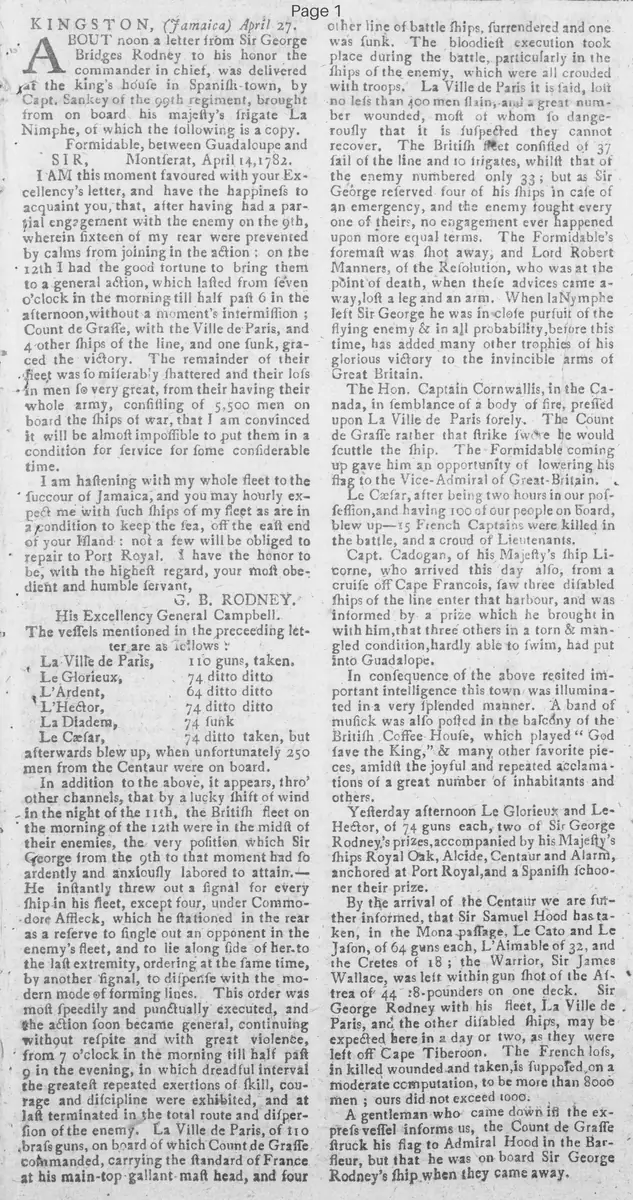
About noon a letter from Sir George Bridges Rodney to his honor the commander in chief, was delivered at the king's house in Spanish-town, by Capt. Sankey of the 59th regiment, brought from on board his majesty's frigate La Nymphe, of which the following is a copy.
Formidable, between Guadaloupe and Montserat, April 14, 1782.
SIR,
I am this moment favoured with your Excellency's letter, and have the happiness to acquaint you, that, after having had a partial engagement with the enemy on the 9th, wherein sixteen of my rear were prevented by calms from joining in the action: on the 12th I had the good fortune to bring them to a general action, which lasted from seven o'clock in the morning till half past 6 in the afternoon, without a moment's intermission;
Count de Grasse, with the Ville de Paris, and 4 other ships of the line, and one sunk, graced the victory. The remainder of their Fleet was so miserably shattered and their loss in men so very great, from their having their whole army, consisting of 5,500 men on board the ships of war, that I am convinced it will be almost impossible to put them in a condition for service for some considerable time.
I am hastening with my whole fleet to the Succour of Jamaica, and you may hourly expect me with such ships of my fleet as are in a condition to keep the sea, off the east end of your Island: not a few will be obliged to repair to Port Royal. I have the honor to be, with the highest regard, your most obedient and humble servant,
G. B. RODNEY
His Excellency General Campbell.
The vessels mentioned in the preceding letter are as follows
La Ville de Paris,
110 guns, taken.
Le Glorieux,
74 ditto ditto
L'Ardent,
64 ditto ditto
L'Hector,
74 ditto ditto
La Diademe,
74 sunk
Le Caesar,
74 ditto taken, but afterwards blew up, when unfortunately 250 men from the Centaur were on board.
In addition to the above, it appears, thro' other channels, that by a lucky shift of wind in the night of the 11th, the British fleet on the morning of the 12th were in the midst of their enemies, the very position which Sir George from the 9th to that moment had so ardently and anxiously labored to attain.
He instantly threw out a signal for every ship in his fleet, except four, under Commodore Affleck, which he stationed in the rear as a reserve to single out an opponent in the enemy's fleet, and to lie along side of her to the last extremity, ordering at the same time, by another signal, to dispense with the modern mode of forming lines. This order was most speedily and punctually executed, and the action soon became general, continuing without respite and with great violence, from 7 o'clock in the morning till half past 9 in the evening, in which dreadful interval the greatest repeated exertions of skill, courage and discipline were exhibited, and at last terminated in the total route and dispersion of the enemy. La Ville de Paris, of 110 guns, on board of which Count de Grasse commanded, carrying the standard of France at his main-top gallant-mast head, and four other line of battle ships, surrendered and one was sunk. The bloodiest execution took place during the battle, particularly in the ships of the enemy, which were all crowded with troops. La Ville de Paris it is said, lost no less than 400 men slain, and a great number wounded, most of whom so dangerously that it is suspected they cannot recover. The British fleet consisted of 37 sail of the line and 5 frigates, whilst that of the enemy numbered only 33; but as Sir George reserved four of his ships in case of an emergency, and the enemy fought every one of theirs, no engagement ever happened upon more equal terms. The Formidable's foremast was shot away, and Lord Robert Manners, of the Resolution, who was at the point of death, when these advices came away, lost a leg and an arm. When La Nymphe left Sir George he was in close pursuit of the flying enemy & in all probability, before this time, has added many other trophies of his glorious victory to the invincible arms of Great Britain.
The Hon. Captain Cornwallis, in the Canada, in semblance of a body of fire, pressed upon La Ville de Paris sorely. The Count de Grasse rather than strike his colours he would scuttle the ship. The Formidable coming up gave him an opportunity of lowering his flag to the Vice-Admiral of Great-Britain, Le Caesar, after being two hours in our possession, and having 100 of our people on board, blew up-15 French Captains were killed in the battle, and a crowd of Lieutenants.
Capt. Cadogan, of his Majesty's ship Lincorne, who arrived this day also, from a cruise off Cape Francois, saw three disabled ships of the line enter that harbour, and was informed by a prize which he brought in with him, that three others in a torn & mangled condition, hardly able to swim, had put into Guadaloupe.
In consequence of the above recited important intelligence this town was illuminated in a very splendid manner. A band of musick was also posted in the balcony of the British Coffee-House, which played "God save the King," & many other favorite pieces, amids the joyful and repeated acclamations of a great number of inhabitants and others.
Yesterday afternoon Le Glorieux and L'Hector, of 74 guns each, two of Sir George Rodney's prizes, accompanied by his Majesty's ships Royal Oak, Alcide, Centaur and Alarm, anchored at Port Royal, and a Spanish schooner their prize.
By the arrival of the Centaur we are further informed, that Sir Samuel Hood has taken, in the Mona passage, Le Cato and Le Jason, of 64 guns each, L'Aimable of 32, and the Ceres of 18: the Warrior, Sir James Wallace, was left within gun shot of the Astree of 44 8-pounders on one deck. Sir George Rodney with his fleet, La Ville de Paris, and the other disabled ships, may be expected here in a day or two, as they were left off Cape Tiburon. The French loss, in killed wounded and taken, is supposed on a moderate computation, to be more than 5000 men; ours did not exceed 1000.
A gentleman who came down in the express vessel informs us, the Count de Grasse struck his flag to Admiral Hood in the Barfleur, but that he was on board Sir George Rodney's ship when they came away.
What sub-type of article is it?
What keywords are associated?
What entities or persons were involved?
Where did it happen?
Foreign News Details
Primary Location
Between Guadaloupe And Montserat
Event Date
April 12, 1782
Key Persons
Outcome
british captured la ville de paris (110 guns), le glorieux (74), l'ardent (64), l'hector (74); la diademe (74) sunk; le caesar (74) taken then blew up with 250 british aboard. french losses over 5,000 killed, wounded, taken; british under 1,000. french fleet shattered, unable to serve soon. additional captures by hood: le cato (64), le jason (64), l'aimable (32), ceres (18).
Event Details
After partial engagement on April 9, British fleet under Rodney engaged French under de Grasse on April 12 from 7 AM to 6:30 PM. Rodney broke line, leading to general action and French defeat. De Grasse captured on Ville de Paris. British fleet of 37 sail vs French 33. Fleet heading to Jamaica; prizes arriving at Port Royal.