Thank you for visiting SNEWPapers!
Sign up free
The Virginia Gazette
Richmond, Williamsburg, Richmond County, Virginia
What is this article about?
Detailed account of the Boston Massacre on March 5, 1770, where British soldiers of the 29th Regiment fired on unarmed civilians in King Street, killing five (including Crispus Attucks and Samuel Gray) and wounding others. Tensions from quartered troops led to public outrage, demands for troop removal, and their eventual relocation to Castle William.
Merged-components note: These two components form a continuous narrative account of the Boston Massacre events on March 5, 1770, including the aftermath, council decisions, and funerals. The label is set to 'story' as it is a full narrative article on a significant local event; changed from 'domestic_news' for the second component.
Clippings
1 of 2
OCR Quality
Full Text
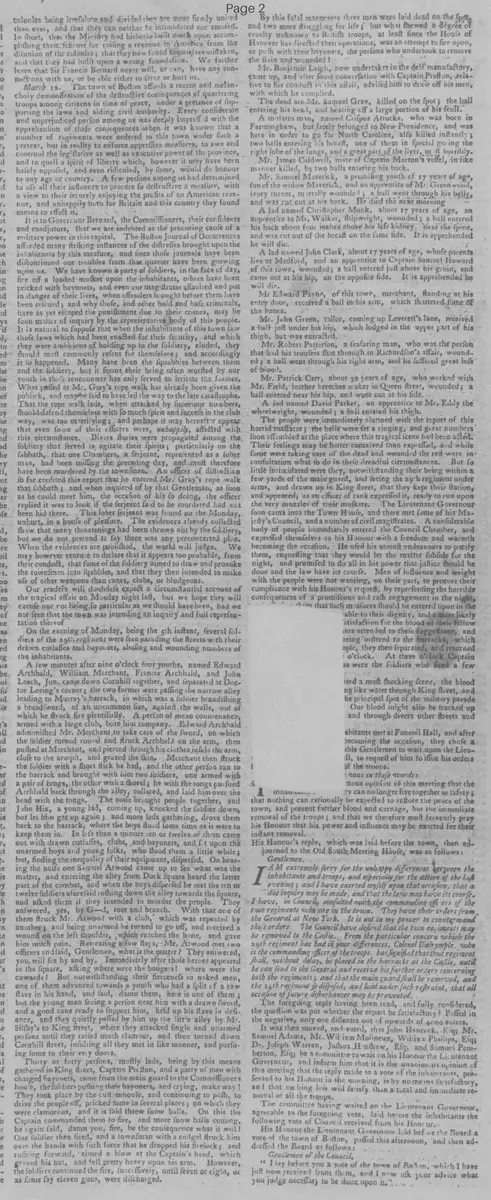
A few persons among us had determined to use all their influence to procure so destructive a measure, with a view to their securely enjoying the profits of an American revenue, and unhappily both for Britain and this country they found means to effect it. It is to Governor Bernard, the Commissioners, their confidents and coadjutors, that we are indebted as the procuring cause of a military power in this capital. The Boston Journal of Occurrences afforded many striking instances of the distresses brought upon the inhabitants by this measure, and since those journals have been discontinued our troubles from that quarter have been growing upon us.
We have known a party of soldiers, in the face of day, fire off a loaded musket upon the inhabitants, others have been pricked with bayonets, and even our magistrates assaulted and put in danger of their lives, when offenders brought before them have been rescued; and why those, and other bold and base criminals, have as yet escaped the punishment due to their crimes, may be soon matter of inquiry by the representative body of this people.
It is natural to suppose that when the inhabitants of this town saw those laws which had been enacted for their security, and which they were ambitious of holding up to the soldiery, eluded, they should most commonly resent for themselves; and accordingly it so happened. Many have been the quarrels between them and the soldiery, but it seems their being often worsted by our youth in the encounters has only served to irritate the former.
What passed at Mr. Gray's rope walk has already been given the public, and may be said to have led the way to the late catastrophe. That the rope walk lads, when attacked by superior numbers, should defend themselves with so much spirit and success in the club way, was too mortifying; and perhaps it may hereafter appear that even some of their officers were, unhappily, affected with this circumstance.
Divers stories were propagated among the soldiery that served to agitate their spirits; particularly on the Sabbath, that one Chambers, a sergeant, represented as a sober man, had been missing the preceding day, and must therefore have been murdered by the townsmen. An officer of distinction so far credited this report that he entered Mr. Gray's rope walk that Sabbath; and when inquired of by that Gentleman, as soon as he could meet him, the occasion of his so doing, the officer replied it was to look if the sergeant said to be murdered had not been hid there. This sober sergeant was found on the Monday, unhurt, in a house of pleasure.
The evidences already collected show that many threatenings had been thrown out by the soldiery but we do not pretend to say there was any preconcerted plan. When the evidences are published, the world will judge. We may however venture to declare that it appears too probable, from their conduct, that some of the soldiery aimed to draw and provoke the townsmen into quarrels, and that they then intended to make use of other weapons than canes, clubs, or bludgeons.
Our readers will doubtless expect a circumstantial account of the tragical affair on Monday night last, but we hope they will excuse our not being so particular as we should have been, had we not seen that the town was intending an inquiry and full representation thereof.
On the evening of Monday, being the 5th instant, Several soldiers of the 29th regiment were seen parading the streets with their drawn cutlasses and bayonets, abusing and wounding numbers of the inhabitants. A few minutes after nine o'clock four youths, named Edward Archbald, William Merchant, Francis Archbald, and John Leech, Jun. came down Cornhill together, and separated at Doctor Loring's corner; the two former were passing the narrow alley leading to Murray's barrack, in which was a soldier brandishing a broadsword, of an uncommon size, against the walls, out of which he struck fire plentifully. A person of mean countenance, armed with a large club, bore him company.
Edward Archbald admonished Mr. Merchant to take care of the sword, on which the soldier turned round and struck Archbald on the arm, then pushed at Merchant, and pierced through his clothes inside the arm, close to the armpit, and grazed the skin, Merchant then struck the soldier with a short stick he had, and the other person ran to the barrack and brought with him two soldiers, one armed with a pair of tongs, the other with a shovel; he with the tongs pursued Archbald back through the alley, collared, and laid him over the head with the tongs, The noise brought people together, and John Hicks, a young lad, coming up, knocked the soldier down but let him get up again; and more lads gathering, drove them back to the barrack, where the boys stood some time as it were to keep them in.
In less than a minute ten or twelve of them came out with drawn cutlasses, clubs, and bayonets, and set upon the unarmed boys and young folks, who stood them a little while; but, finding the inequality of their equipment, dispersed.
On hearing the noise one Samuel Atwood came up to see what was the matter, and entering the alley from Dock square heard the latter part of the combat, and when the boys dispersed he met the ten or twelve soldiers aforesaid rushing down this alley towards the square, and asked them if they intended to murder the people. They answered, yes, by G-d, root and branch. With that one of them struck Mr. Atwood with a club, which was repeated by another; and being unarmed he turned to go off, and received a wound on the left shoulder, which reached the bone, and gave him much pain.
Retreating a few steps, Mr. Atwood met two officers and said, Gentlemen, what is the matter? They answered, you will see by and by. Immediately after those heroes appeared in the square, asking where were the buggers! where were the cowards! But notwithstanding their fierceness to naked men, one of them advanced towards a youth who had a split of a raw stave in his hand, and said, damn them, here is one of them; but the young man seeing a person near him with a drawn sword, and a good cane ready to support him, held up his stave in defence, and they quietly passed by him up the little alley by Mr. Sibbey's to King street, where they attacked single and unarmed persons until they raised much clamour, and then turned down Cornhill Street, insulting all they met in like manner, and pursuing some to their very doors.
Thirty or forty persons, mostly lads, being by this means gathered in King street, Captain Preston, and a party of men with charged Bayonets, came from the main guard to the Commissioners house, the soldiers pushing their bayonets, and crying, make way! They took place by the custom house, and continuing to push, to drive the people off, pricked some in several places; on which they were clamorous, and it is said threw snowballs.
On this the Captain commanded them to fire, and more snow balls coming, he again said, damn you, fire, be the consequence what it will! One Soldier then fired, and a townsman with a cudgel struck him over the hands with such force that he dropped his firelock; and rushing forward, aimed a blow at the Captain's head, which grazed his hat, and fell pretty heavy upon his arm. However, the soldiers continued the fire, successively, until seven or eight, or as some say eleven guns, were discharged.
By this fatal manoeuvre three men were laid dead on the spot, and two more struggling for life; but what showed a degree of cruelty unknown to British troops, at least since the House of Hanover has directed their operations; was an attempt to fire upon, or push with their bayonets, the persons who undertook to remove the slain and wounded! Mr. Benjamin Leigh, now undertaker in the glass manufactory, came up, and after some conversation with Captain Preston, relative to his conduct in this affair, advised him to draw off his men, with which he complied.
The dead are-Mr. Samuel Gray, killed on the spot; the ball entering his head, and beating off a large portion of his skull. A mulatto man, named Crispus Attucks, who was born in Framingham, but lately belonged to New Providence, and was here in order to go for North Carolina, also killed instantly; two balls entering his breast, one of them in special goring the right lobe of the lungs, and a great part of the liver, most horribly. Mr. James Caldwell, mate of Captain Morton's vessel, in like manner killed, by two balls entering his back.
Mr. Samuel Maverick, a promising youth of 17 years of age, son of the widow Maverick, and an apprentice of Mr. Greenwood, ivory turner, mortally wounded; a ball went through his belly, and was cut out at his back. He died the next morning.
A lad named Christopher Monk, about 17 years of age, an apprentice to Mr. Walker, shipwright, wounded; a ball entered his back about four inches above his left kidney, near the spine, and was cut out of the breast on the same side, It is apprehended he will die.
A lad named John Clark, about 17 years of age, whose parents live at Medford, and an apprentice to Captain Samuel Howard of this town, wounded; a ball entered just above his groin, and came out at his hip, on the opposite side. It is apprehended he will die.
Mr Edward Payne, of this town, merchant, standing at his entry door, received a ball in his arm, which shattered some of the bones. Mr. John Green, tailor, coming up Leverett's lane, received a ball just under his hip, which lodged in the upper part of his thigh, but was extracted.
Mr. Robert Patterson, a seafaring man, who was the person that had his trousers shot through in Richardson's affair, wounded; a ball went through his right arm, and he suffered great loss of blood. Mr. Patrick Carr, about 30 years of age, who worked with Mr. Field, leather breeches maker in Queen street, wounded; a ball entered near his hip, and went out at his side.
A lad named David Parker, an apprentice to Mr. Edly the wheelwright, wounded; a ball entered his thigh.
The people were immediately alarmed with the report of this horrid massacre; the bells were set a ringing, and great numbers soon assembled at the place where this tragical scene had been acted. Their feelings may be better conceived than expressed, and while some were taking care of the dead and wounded the rest were in consultation what to do in these dreadful circumstances.
But so little intimidated were they, notwithstanding their being within a few yards of the main guard, and seeing the 29th regiment under arms, and drawn up in King street, that they kept their station, and appeared, as an officer of rank expressed it, ready to run upon the very muzzles of their muskets.
The Lieutenant Governor soon came into the Town House, and there met some of his Majesty's Council, and a number of civil magistrates. A considerable body of people immediately entered the Council Chamber, and expressed themselves to his Honour with a freedom and warmth becoming the occasion. He used his utmost endeavours to pacify them, requesting that they would let the matter abide for the night, and promised to do all in his power that justice should be done and the law have its course.
Men of influence and weight with the people were not wanting, on their part, to procure their compliance with his Honour's request, by representing the horrible consequences of a promiscuous and rash engagement in the night, how that such measures should be entered upon in the day, more able to their dignity, and a more likely satisfaction for the blood of their fellow citizens attended to these suggestions, and the 29th regiment being ordered to the barracks, which they did with some difficulty from the people, they then separated, and returned to their respective dwellings about one o'clock.
At three o'clock Captain Preston as were the soldiers who fired a few hours before were committed a most shocking scene, the blood running like water through King street, and through the principal spot of the military parade. Our blood might also be tracked up and through divers other streets and lanes.
The inhabitants met at Faneuil Hall, and after becoming the occasion, they chose a number of respectable Gentlemen to wait upon the Lieutenant-Governor, to request of him to issue his orders of the removal of the troops. The vote was in these words: It is the unanimous opinion of this meeting that the inhabitants and soldiery can no longer live together in safety; that nothing can rationally be expected to restore the peace of the town, and prevent farther blood and carnage, but the immediate removal of the troops; and that we therefore most fervently pray his Honour that his power and influence may be exerted for their instant removal.
His Honour's reply, which was laid before the town, then adjourned to the Old South, Meeting House, was as follows: Gentlemen, I am extremely sorry for the unhappy differences between the inhabitants and troops, and especially for the action of the last evening; and I have exerted myself upon that occasion, that a due inquiry may be made, and that the law may have its course. I have, in Council, consulted with the commanding officers of the two regiments who are in the town. They have their orders from the General at New York. It is not in my power to countermand those orders The Council have desired that the two regiments may be removed to the Castle. From the particular concern which the 29th regiment has had in your differences, Colonel Dalrymple, who is the commanding officer of the troops, has signified that that regiment shall, without delay, be placed in the barracks at the Castle, until he can send to the General and receive his farther orders concerning both the regiments; and that the main guard shall be removed, and the 14th regiment so disposed, and laid under such restraint, that all occasion of future disturbances may be prevented.
The foregoing reply having been read, and fully considered, the question was put whether the report be satisfactory? Passed in the negative, only one dissenter out of upwards of 4000 voters. It was then moved, and voted, that John Hancock, Esq; Mr. Samuel Adams, Mr. William Molineux, William Phillips, Esq; Dr. Joseph Warren, Joshua Winthrop, Esq; and Samuel Pemberton, Esq; be a committee to wait on his Honour the Lieutenant Governor, and inform him that it is the unanimous opinion of this meeting that the reply made to a vote of the inhabitants, presented to his Honour in the morning, is by no means satisfactory, and that nothing less will satisfy than a total and immediate removal of all the troops.
The committee having waited on the Lieutenant Governor, agreeable to the foregoing vote, laid before the inhabitants the following vote of Council received from his Honour. His Honour the Lieutenant Governor laid before the Board a vote of the town of Boston, passed this afternoon, and then addressed the Board as follows: Gentlemen of the Council, I lay before you a vote of the town of Boston, which I have just now received from them, and I now ask your advice what you judge necessary to be done upon it.
The Council thereupon expelled themselves to be unanimous of opinion "that it was absolutely necessary, for his Majesty's service, the good order of the town, and the peace of the province, that the troops should be immediately removed out of the town of Boston, and thereupon advised his Honor to communicate this advice of the Council to Colonel Dalrymple, and to pray that he would order the troops down to Castle William." The committee also informed the town that Colonel Dalrymple, after having seen the vote of Council, said to the committee, "that he now gave his word of honor that he would begin his preparations in the morning, and that there should be no unnecessary delay until the whole of the two regiments were removed to the Castle."
Upon the above report being read, the inhabitants could not avoid expressing the high satisfaction it afforded them. After measures were taken for the security of the town in the night, by a strong military watch, the meeting was dissolved.
The 29th regiment have already left us, and the 14th regiment are following them, so that we expect the town will soon be clear of all the troops. The wisdom and true policy of his Majesty's Council, and Colonel Dalrymple the commander, appear in this measure. Two regiments in this populous city, and the inhabitants justly incensed, those of the neighbouring towns actually under arms upon the first report of the massacre, and the signal only wanting to bring in a few hours to the gates of this city many thousands of our brave brethren in the country, deeply affected with our sufferings, and to whom we are greatly obliged on this occasion, no one knows where this would have ended, and what important consequences, even to the whole British empire, might have followed, which our moderation and loyalty upon so trying an occasion, and our faith in the commander's assurances, have happily prevented.
Last Thursday, agreeable to a general request of the inhabitants, and by the consent of parents and friends, were carried to their grave, in succession, the bodies of Samuel Gray, Samuel Maverick, James Caldwell, and Crispus Attucks, the unhappy victims who first fell in the bloody massacre of the Monday evening preceding. On this occasion most of the shops in town were shut, all the bells were ordered to toll a solemn peal, as were also those in the neighbouring towns of Charlestown, Roxbury, &c. The procession began to move between the hours of four and five in the afternoon.
Two of the unfortunate sufferers, James Caldwell and Crispus Attucks, who were strangers, were borne from Faneuil Hall, attended by a numerous train of persons of all ranks: and the other two, Samuel Gray, from the house of Mr. Benjamin Gray, his brother, on the north side the Exchange, and Mr. Maverick, from the house of his distressed mother, Mrs. Mary Maverick, in Union Street, each followed by their respective relations and friends, the several hearses forming a junction in King Street, the theatre of that inhuman tragedy, proceeded from thence through the main street, lengthened by an immense concourse of people, so numerous as to be obliged to follow in ranks of six, and brought up by a long train of carriages belonging to the principal gentry of the town. The bodies were deposited in one vault, in the middle burying ground. The aggravated circumstances of their death, the distress and sorrow visible in every countenance, together with the peculiar solemnity with which the whole funeral was conducted, defies description.
A military watch has been kept every night at the town house and prison, in which many of the most respectable gentlemen of the town have appeared as the common soldiers, and night after night have given their attendance.
A servant boy of one Manwaring, the tidewaiter from Quebec, is now in jail, having deposed that himself, by the order and encouragement of his superiors, had discharged a musket several times from one of the windows of the house in King Street hired by the Commissioners and Customhouse officers to do their business in. More than one other person declared, upon oath, that they apprehended several discharges came from that quarter. It is not improbable that we may soon be able to account for the assassination of Mr. Otis, some time past, the message by Wilmot, who came from the same house to the infamous Richardson, before the firing the gun which killed young Snider, and of villainy acted by a dirty banditti, as no one knows where this would have ended.
It is hoped that there must have been more people, from town and country, at the last massacre by the soldiers, than were ever together upon any occasion. A more dreadful tragedy has been acted in the street. Boston, New England, than was in St. George's Fields, London, in October. These serve instead of beacons to both countries. Had those worthy patriots, not only resented the Commissioners as a faction, but as a combination between Britain and the colonies more worthy of contemplation than the preservation of things back to their old foundation, well given then!
Among other matters in the warrant for this day is the following clause: "Whether any measures that a publick monument may be erected where the late tragical scene was acted, of that horrid massacre, and the destructive troops being quartered in a well regulated town."
What sub-type of article is it?
What themes does it cover?
What keywords are associated?
What entities or persons were involved?
Where did it happen?
Story Details
Key Persons
Location
Boston, King Street
Event Date
March 5, 1770
Story Details
British soldiers of the 29th Regiment, provoked by earlier quarrels, fired on a crowd of unarmed civilians in King Street, killing five and wounding six others. The incident escalated from street brawls, leading to public fury, demands for troop removal, and their relocation to Castle William after council intervention.