Thank you for visiting SNEWPapers!
Sign up free
Editorial
January 17, 1845
Alexandria Gazette
Alexandria, Alexandria County, District Of Columbia
What is this article about?
The New York Express editorial sarcastically critiques the Albany Argus for sympathizing with imprisoned Rhode Island rebel Thomas Wilson Dorr while ignoring New York anti-renter Dr. Smith Boughton. It draws parallels between their law-breaking actions, favoring Boughton's land reform principles as more beneficial than Dorr's radical subversion of government.
Clipping
OCR Quality
98%
Excellent
Full Text
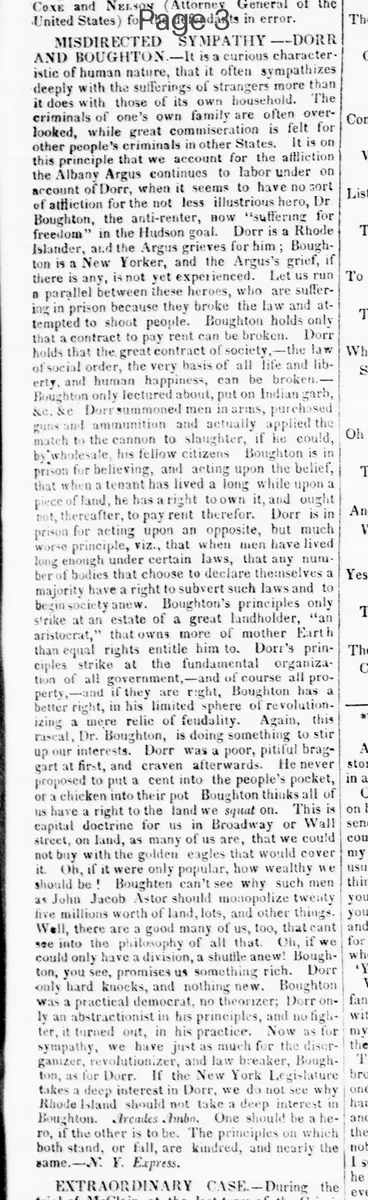
MISDIRECTED SYMPATHY --DORR AND BOUGHTON.--It is a curious characteristic of human nature, that it often sympathizes deeply with the sufferings of strangers more than it does with those of its own household. The criminals of one's own family are often overlooked, while great commiseration is felt for other people's criminals in other States. It is on this principle that we account for the affliction the Albany Argus continues to labor under on account of Dorr, when it seems to have no sort of affliction for the not less illustrious hero, Dr. Boughton, the anti-renter, now "suffering for freedom" in the Hudson jail. Dorr is a Rhode Islander, and the Argus grieves for him; Boughton is a New Yorker, and the Argus's grief, if there is any, is not yet experienced. Let us run a parallel between these heroes, who are suffering in prison because they broke the law and attempted to shoot people. Boughton holds only that a contract to pay rent can be broken. Dorr holds that the great contract of society,--the law of social order, the very basis of all life and liberty, and human happiness, can be broken.-- Boughton only lectured about, put on Indian garb, &c., &c. Dorr summoned men in arms, purchased guns and ammunition and actually applied the match to the cannon to slaughter, if he could, by wholesale, his fellow citizens. Boughton is in prison for believing, and acting upon the belief, that when a tenant has lived a long while upon a piece of land, he has a right to own it, and ought not, thereafter, to pay rent therefor. Dorr is in prison for acting upon an opposite, but much worse principle, viz., that when men have lived long enough under certain laws, that any number of bodies that choose to declare themselves a majority have a right to subvert such laws and to begin society anew. Boughton's principles only strike at an estate of a great landholder, "an aristocrat," that owns more of mother Earth than equal rights entitle him to. Dorr's principles strike at the fundamental organization of all government,--and of course all property,--and if they are right, Boughton has a better right, in his limited sphere of revolutionizing a mere relic of feudality. Again, this rascal, Dr. Boughton, is doing something to stir up our interests. Dorr was a poor, pitiful braggart at first, and craven afterwards. He never proposed to put a cent into the people's pocket, or a chicken into their pot. Boughton thinks all of us have a right to the land we squat on. This is capital doctrine for us in Broadway or Wall street, on land, as many of us are, that we could not buy with the golden eagles that would cover it. Oh, if it were only popular, how wealthy we should be! Boughton can't see why such men as John Jacob Astor should monopolize twenty five millions worth of land, lots, and other things. Well, there are a good many of us, too, that can't see into the philosophy of all that. Oh, if we could only have a division, a shuffle anew! Boughton, you see, promises us something rich. Dorr only hard knocks, and nothing new. Boughton was a practical democrat, no theorizer; Dorr only an abstractionist in his principles, and no higher, it turned out, in his practice. Now as for sympathy, we have just as much for the disorganizer, revolutionizer, and law breaker, Boughton, as for Dorr. If the New York Legislature takes a deep interest in Dorr, we do not see why Rhode Island should not take a deep interest in Boughton. Tit for tat. One should be a hero, if the other is to be. The principles on which both stand, or fall, are kindred, and nearly the same.--N. Y. Express.
What sub-type of article is it?
Satire
Partisan Politics
Crime Or Punishment
What keywords are associated?
Dorr Rebellion
Anti Rent Movement
Boughton Imprisonment
Misdirected Sympathy
Law Breaking
Land Reform
Political Radicals
What entities or persons were involved?
Dorr
Dr. Boughton
Albany Argus
N. Y. Express
John Jacob Astor
Rhode Island
New York
Editorial Details
Primary Topic
Misdirected Sympathy For Dorr Versus Boughton
Stance / Tone
Sarcastic Critique Favoring Boughton Over Dorr
Key Figures
Dorr
Dr. Boughton
Albany Argus
N. Y. Express
John Jacob Astor
Rhode Island
New York
Key Arguments
Human Nature Sympathizes More With Distant Criminals Than Local Ones.
Albany Argus Grieves For Dorr But Ignores Boughton.
Both Are Imprisoned For Breaking Laws And Attempting Violence.
Boughton's Anti Rent Principles Target Land Monopolies Beneficially.
Dorr's Principles Threaten All Government And Property.
Boughton Offers Practical Benefits Like Land Division; Dorr Only Disruption.
Sympathy Should Be Equal; Tit For Tat Between States.