Thank you for visiting SNEWPapers!
Sign up free
Editorial
November 18, 1877
The Daily Astorian
Astoria, Clatsop County, Oregon
What is this article about?
Editorial critiques American tramps as more dangerous than English vagrants due to their gregarious nature and proposes county workhouses offering labor and provisions to deter begging, while decrying public sympathy that sustains them. References Elihu Burritt's views.
Clipping
OCR Quality
98%
Excellent
Full Text
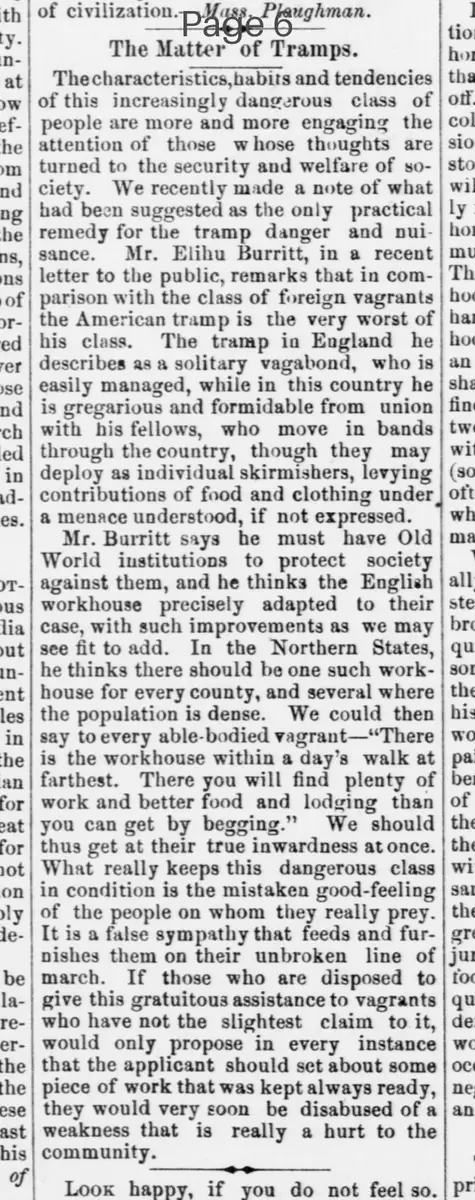
The Matter of Tramps.
The characteristics, habits and tendencies of this increasingly dangerous class of people are more and more engaging the attention of those whose thoughts are turned to the security and welfare of society. We recently made a note of what had been suggested as the only practical remedy for the tramp danger and nuisance.
Mr. Elihu Burritt, in a recent letter to the public, remarks that in comparison with the class of foreign vagrants the American tramp is the very worst of his class. The tramp in England he describes as a solitary vagabond, who is easily managed, while in this country he is gregarious and formidable from union with his fellows, who move in bands through the country, though they may deploy as individual skirmishers, levying contributions of food and clothing under a menace understood, if not expressed.
Mr. Burritt says he must have Old World institutions to protect society against them, and he thinks the English workhouse precisely adapted to their case, with such improvements as we may see fit to add. In the Northern States, he thinks there should be one such workhouse for every county, and several where the population is dense. We could then say to every able-bodied vagrant—"There is the workhouse within a day's walk at farthest. There you will find plenty of work and better food and lodging than you can get by begging." We should thus get at their true inwardness at once. What really keeps this dangerous class in condition is the mistaken good-feeling of the people on whom they really prey. It is a false sympathy that feeds and furnishes them on their unbroken line of march. If those who are disposed to give this gratuitous assistance to vagrants who have not the slightest claim to it, would only propose in every instance that the applicant should set about some piece of work that was kept always ready, they would very soon be disabused of a weakness that is really a hurt to the community.
The characteristics, habits and tendencies of this increasingly dangerous class of people are more and more engaging the attention of those whose thoughts are turned to the security and welfare of society. We recently made a note of what had been suggested as the only practical remedy for the tramp danger and nuisance.
Mr. Elihu Burritt, in a recent letter to the public, remarks that in comparison with the class of foreign vagrants the American tramp is the very worst of his class. The tramp in England he describes as a solitary vagabond, who is easily managed, while in this country he is gregarious and formidable from union with his fellows, who move in bands through the country, though they may deploy as individual skirmishers, levying contributions of food and clothing under a menace understood, if not expressed.
Mr. Burritt says he must have Old World institutions to protect society against them, and he thinks the English workhouse precisely adapted to their case, with such improvements as we may see fit to add. In the Northern States, he thinks there should be one such workhouse for every county, and several where the population is dense. We could then say to every able-bodied vagrant—"There is the workhouse within a day's walk at farthest. There you will find plenty of work and better food and lodging than you can get by begging." We should thus get at their true inwardness at once. What really keeps this dangerous class in condition is the mistaken good-feeling of the people on whom they really prey. It is a false sympathy that feeds and furnishes them on their unbroken line of march. If those who are disposed to give this gratuitous assistance to vagrants who have not the slightest claim to it, would only propose in every instance that the applicant should set about some piece of work that was kept always ready, they would very soon be disabused of a weakness that is really a hurt to the community.
What sub-type of article is it?
Social Reform
Crime Or Punishment
What keywords are associated?
Tramps
Vagrants
Workhouses
Social Reform
False Sympathy
Begging Deterrence
What entities or persons were involved?
Elihu Burritt
American Tramp
English Workhouse
Editorial Details
Primary Topic
Remedy For Tramp Nuisance Via Workhouses
Stance / Tone
Supportive Of Institutional Reform Against Vagrancy, Critical Of Public Sympathy
Key Figures
Elihu Burritt
American Tramp
English Workhouse
Key Arguments
American Tramps Are Worse Than Foreign Vagrants Due To Gregarious Bands
English Workhouses Adapted For Us Counties To Provide Work And Deter Begging
Public Sympathy Enables Vagrants; Require Work For Aid To Expose Motives