Thank you for visiting SNEWPapers!
Sign up free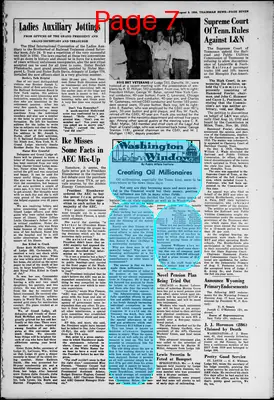
Editorial
August 2, 1954
Trainman News
Indianapolis, Marion County, Indiana
What is this article about?
This editorial critiques the oil depletion allowance, a tax break allowing oil producers to deduct 27% of gross income untaxed, costing the U.S. Treasury $1.5 billion yearly. It highlights how this enriches oil tycoons, who wield political influence, while efforts for middle-class tax relief fail. Examples from Sen. John Williams show massive tax savings for oil firms.
Clipping
OCR Quality
98%
Excellent
Full Text
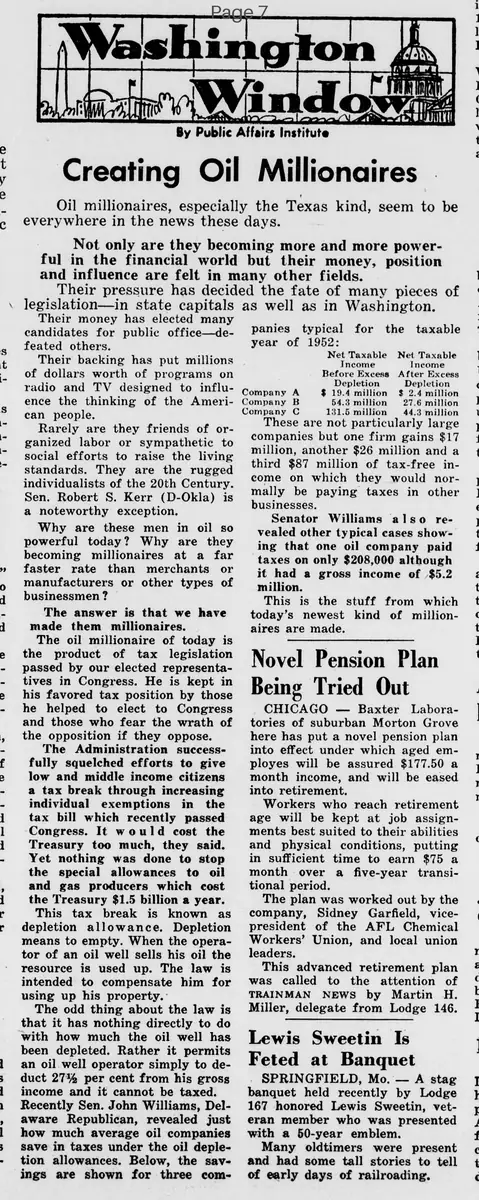
Washington Window
By Public Affairs Institute
Creating Oil Millionaires
Oil millionaires, especially the Texas kind, seem to be everywhere in the news these days.
Not only are they becoming more and more powerful in the financial world but their money, position and influence are felt in many other fields.
Their pressure has decided the fate of many pieces of legislation—in state capitals as well as in Washington.
Their money has elected many candidates for public office—defeated others.
Their backing has put millions of dollars worth of programs on radio and TV designed to influence the thinking of the American people.
Rarely are they friends of organized labor or sympathetic to social efforts to raise the living standards. They are the rugged individualists of the 20th Century.
Sen. Robert S. Kerr (D-Okla) is a noteworthy exception.
Why are these men in oil so powerful today? Why are they becoming millionaires at a far faster rate than merchants or manufacturers or other types of businessmen?
The answer is that we have made them millionaires.
The oil millionaire of today is the product of tax legislation passed by our elected representatives in Congress. He is kept in his favored tax position by those he helped to elect to Congress and those who fear the wrath of the opposition if they oppose.
The Administration successfully squelched efforts to give low and middle income citizens a tax break through increasing individual exemptions in the tax bill which recently passed Congress. It would cost the Treasury too much, they said.
Yet nothing was done to stop the special allowances to oil and gas producers which cost the Treasury $1.5 billion a year.
This tax break is known as depletion allowance. Depletion means to empty. When the operator of an oil well sells his oil the resource is used up. The law is intended to compensate him for using up his property.
The odd thing about the law is that it has nothing directly to do with how much the oil well has been depleted. Rather it permits an oil well operator simply to deduct 27 per cent from his gross income and it cannot be taxed.
Recently Sen. John Williams, Delaware Republican, revealed just how much average oil companies save in taxes under the oil depletion allowances. Below, the savings are shown for three companies typical for the taxable year of 1952:
Net Taxable Income Before Excess Profits Depletion After Excess Profits Depletion
Company A $19.4 million $2.4 million
Company B 54.3 million 27.6 million
Company C 131.5 million 44.3 million
These are not particularly large companies but one firm gains $17 million, another $26 million and a third $87 million of tax-free income on which they would normally be paying taxes in other businesses.
Senator Williams also revealed other typical cases showing that one oil company paid taxes on only $208,000 although it had a gross income of $5.2 million.
This is the stuff from which today's newest kind of millionaires are made.
By Public Affairs Institute
Creating Oil Millionaires
Oil millionaires, especially the Texas kind, seem to be everywhere in the news these days.
Not only are they becoming more and more powerful in the financial world but their money, position and influence are felt in many other fields.
Their pressure has decided the fate of many pieces of legislation—in state capitals as well as in Washington.
Their money has elected many candidates for public office—defeated others.
Their backing has put millions of dollars worth of programs on radio and TV designed to influence the thinking of the American people.
Rarely are they friends of organized labor or sympathetic to social efforts to raise the living standards. They are the rugged individualists of the 20th Century.
Sen. Robert S. Kerr (D-Okla) is a noteworthy exception.
Why are these men in oil so powerful today? Why are they becoming millionaires at a far faster rate than merchants or manufacturers or other types of businessmen?
The answer is that we have made them millionaires.
The oil millionaire of today is the product of tax legislation passed by our elected representatives in Congress. He is kept in his favored tax position by those he helped to elect to Congress and those who fear the wrath of the opposition if they oppose.
The Administration successfully squelched efforts to give low and middle income citizens a tax break through increasing individual exemptions in the tax bill which recently passed Congress. It would cost the Treasury too much, they said.
Yet nothing was done to stop the special allowances to oil and gas producers which cost the Treasury $1.5 billion a year.
This tax break is known as depletion allowance. Depletion means to empty. When the operator of an oil well sells his oil the resource is used up. The law is intended to compensate him for using up his property.
The odd thing about the law is that it has nothing directly to do with how much the oil well has been depleted. Rather it permits an oil well operator simply to deduct 27 per cent from his gross income and it cannot be taxed.
Recently Sen. John Williams, Delaware Republican, revealed just how much average oil companies save in taxes under the oil depletion allowances. Below, the savings are shown for three companies typical for the taxable year of 1952:
Net Taxable Income Before Excess Profits Depletion After Excess Profits Depletion
Company A $19.4 million $2.4 million
Company B 54.3 million 27.6 million
Company C 131.5 million 44.3 million
These are not particularly large companies but one firm gains $17 million, another $26 million and a third $87 million of tax-free income on which they would normally be paying taxes in other businesses.
Senator Williams also revealed other typical cases showing that one oil company paid taxes on only $208,000 although it had a gross income of $5.2 million.
This is the stuff from which today's newest kind of millionaires are made.
What sub-type of article is it?
Taxation
Economic Policy
What keywords are associated?
Oil Depletion Allowance
Tax Breaks
Oil Millionaires
Political Influence
Tax Savings
Congressional Legislation
What entities or persons were involved?
Sen. Robert S. Kerr
Sen. John Williams
Oil Companies
Congress
Administration
Editorial Details
Primary Topic
Critique Of Oil Depletion Allowance
Stance / Tone
Critical Of Tax Favoritism For Oil Industry
Key Figures
Sen. Robert S. Kerr
Sen. John Williams
Oil Companies
Congress
Administration
Key Arguments
Oil Millionaires Gain Power Through Tax Breaks And Influence Legislation And Elections.
Depletion Allowance Costs Treasury $1.5 Billion Annually While Middle Class Tax Relief Is Blocked.
Allowance Allows 27% Deduction From Gross Income Regardless Of Actual Depletion.
Examples Show Companies Saving Millions In Taxes, E.G., Company A Saves $17 Million.
Oil Tycoons Rarely Support Labor Or Social Welfare Efforts.