Thank you for visiting SNEWPapers!
Sign up free
Daily Capital Journal
Salem, Marion County, Oregon
What is this article about?
American troops advance post-armistice, occupying Franco-Belgian-Luxembourg frontier towns like Montmedy, St. Leger, Etalle, Virton, Longwy, and Conflans. Mines found undamaged. New divisions relieve front lines. Prisoner exchanges occur, including 28 Americans for cigarettes. Some fraternization noted.
Clipping
OCR Quality
Full Text
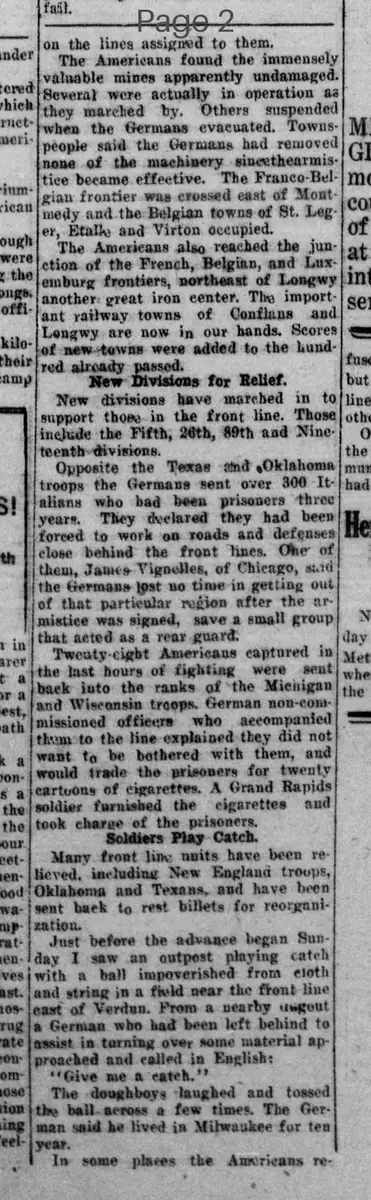
The Americans found the immensely valuable mines apparently undamaged. Several were actually in operation as they marched by. Others suspended when the Germans evacuated. Townspeople said the Germans had removed none of the machinery since the armistice became effective. The Franco-Belgian frontier was crossed east of Montmedy and the Belgian towns of St. Leger, Etalle and Virton occupied.
The Americans also reached the junction of the French, Belgian, and Luxembourg frontiers, northeast of Longwy another great iron center. The important railway towns of Conflans and Longwy are now in our hands. Scores of new towns were added to the hundred already passed.
New Divisions for Relief.
New divisions have marched in to support those in the front line. Those include the Fifth, 26th, 89th and Nineteenth-divisions.
Opposite the Texas and Oklahoma troops the Germans sent over 300 Italians who had been prisoners three years. They declared they had been forced to work on roads and defenses close behind the front lines. One of them, James Vignelles, of Chicago, said the Germans lost no time in getting out of that particular region after the armistice was signed, save a small group that acted as a rear guard.
Twenty-eight Americans captured in the last hours of fighting were sent back into the ranks of the Michigan and Wisconsin troops. German non-commissioned officers who accompanied them to the line explained they did not want to be bothered with them, and would trade the prisoners for twenty cartons of cigarettes. A Grand Rapids soldier furnished the cigarettes and took charge of the prisoners.
Soldiers Play-Catch.
Many front line units have been relieved, including New England troops, Oklahoma and Texans, and have been sent back to rest billets for reorganization.
Just before the advance began Sunday I saw an outpost playing catch with a ball improvised from cloth and string in a field near the front line east of Verdun. From a nearby dugout a German who had been left behind to assist in turning over some material approached and called in English:
"Give me a catch."
The doughboys laughed and tossed the ball across a few times. The German said he lived in Milwaukee for ten years.
In some places the Americans refused to fraternize with the Germans.
What sub-type of article is it?
What keywords are associated?
What entities or persons were involved?
Where did it happen?
Foreign News Details
Primary Location
Franco Belgian Luxembourg Frontier
Key Persons
Outcome
mines undamaged and machinery intact; belgian towns of st. leger, etalle, virton, and railway towns of conflans and longwy occupied; 300 italian prisoners released; 28 american prisoners exchanged for cigarettes
Event Details
American troops crossed the Franco-Belgian frontier east of Montmedy, occupied Belgian towns, reached the French-Belgian-Luxembourg junction northeast of Longwy, found valuable mines undamaged. New divisions including Fifth, 26th, 89th, and Nineteenth relieved front lines. Germans released 300 Italian prisoners to Texas and Oklahoma troops and traded 28 American prisoners for cigarettes to Michigan and Wisconsin troops. Front line units relieved and sent to rest. Some fraternization occurred, including a German playing catch with Americans near Verdun.