Thank you for visiting SNEWPapers!
Sign up free
Literary
January 20, 1776
The Virginia Gazette
Richmond, Williamsburg, Richmond County, Virginia
What is this article about?
Philosophical essay exploring how power and riches can lead to happiness only when used virtuously by enlightened rulers and individuals to benefit others, critiquing indolent or tyrannical monarchs and advocating ethical governance for the common good.
Merged-components note: This is a continuation of the philosophical essay 'Of the Nature and Use of Riches and POWER' that spans from page 1 to page 2; the second part was mislabeled as editorial but fits as literary content.
Clippings
1 of 2
OCR Quality
95%
Excellent
Full Text
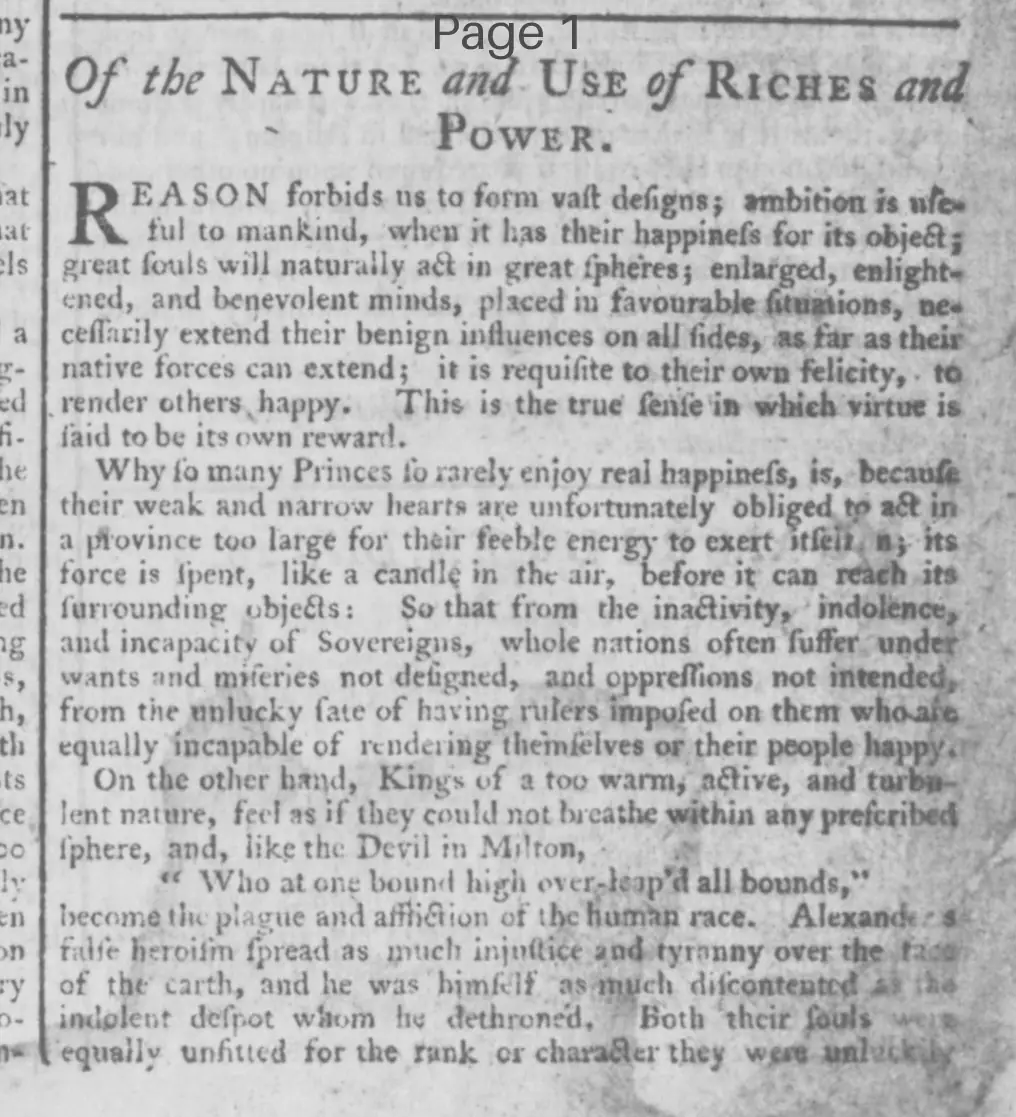
Of the Nature and Use of Riches and POWER.
REASON forbids us to form vast designs; ambition is useful to mankind, when it has their happiness for its object; great souls will naturally act in great spheres; enlarged, enlightened, and benevolent minds, placed in favourable situations, necessarily extend their benign influences on all sides, as far as their native forces can extend; it is requisite to their own felicity, to render others happy. This is the true sense in which virtue is said to be its own reward.
Why so many Princes so rarely enjoy real happiness, is, because their weak and narrow hearts are unfortunately obliged to act in a province too large for their feeble energy to exert itself in; its force is spent, like a candle in the air, before it can reach its surrounding objects: So that from the inactivity, indolence, and incapacity of Sovereigns, whole nations often suffer under wants and miseries not designed, and oppressions not intended, from the unlucky fate of having rulers imposed on them who are equally incapable of rendering themselves or their people happy.
On the other hand, Kings of a too warm, active, and turbulent nature, feel as if they could not breathe within any prescribed sphere, and, like the Devil in Milton,
"Who at one bound high over-leap'd all bounds,"
become the plague and affliction of the human race. Alexander's false heroism spread as much injustice and tyranny over the face of the earth, and he was himself as much discontented as the indolent despot whom he dethroned, Both their souls equally unsuited for the rank or character they were unluckily destined to fill.
placed in. Seneca says, of this warrior, Estuat infelix angusto
limit mundi; post Darium & Indos pauper est Alexander; inveniens
est qui concupisceret ALIQUID POST OMNIA. One would be apt
to imagine, that sovereignty naturally ran into extremes, we so
seldom meet with other Kings than Storks or Logs.
The happiness of mankind can result only from a concordance
between our situations and desires. Universal monarchy itself is
no enjoyment to the possessor, if he knows not how to conduct it
towards his own happiness; it is a real evil, if it renders himself
unhappy; and a detestable abuse of it, if it makes others so. The
greatest Princes are not generally so unhappy, nor their subjects
unfortunate, but because they first possess every means of good,
without making use of them; or because they know only how to
misapply them.
A wise man on a throne, provided he be not so great a fool as
Solomon, must be the happiest mortal breathing. A Monarch
of the greatest power is incapable of procuring superior organs,
or different sensations from the meanest of his subjects; the only
advantages he can boast, arise from the grandeur, the variety, the
multiplicity of the objects which occupy his faculties; and which,
giving a continual action to his mind, prevent it from stagnating,
and becoming a burden to itself. If his soul be great and virtu-
ous, for in such a station it must be both to render the possessor
happy, he must feel his ambition fully completed, in the consci-
iousness of having his own desires corresponding with the wishes
of his subjects; and in the right he has to challenge the admira-
tion and esteem of other nations, from the respect and love he
merits from his own.
Such are the conquests which Nature and Reason have pointed
out to those whom Providence hath destined to empire; and these
objects are sufficiently great to satisfy the most lively imagination,
and most extensive ambition. Potentates are never to be deemed
the happiest of men, but from having it in their power to create
the felicity of a greater number of others; and by these means,
meriting the only eulogy which can render incense to a noble or a
liberal mind :
"All praise is foreign, but of true desert."
These advantages of sovereign power, are enjoyed also by all
those ministers, or favourites, who possess any share in the govern-
ment of nations. Therefore grandeur, rank, and honours, are
desirable objects to those who know how to turn them to the ac-
count of their own happiness; they are useless to others, not
blessed with the faculties or capacity of making them accrue to
their own profit; but become a double misfortune, when in pur-
suit of them we forfeit our own happiness, and sacrifice that of
others. And those are strangely infatuated, who pay a deference
or respect to men who employ the superiority of talents or fortune
to their detriment, which has a claim to honour only when we
share the fruits of it.
Riches, superfluous to the miser, who is but their anxious
gaoler; and destructive to the profligate, whom they but afflict
with diseases, weariness and disgust; are capable of supplying the
virtuous man with numberless accessions to his happiness; it is
madness or folly to desire opulence, without a proper sense and
determined purpose to make a right use of it. Money is but the
representative sign of good; to realize it, we must employ it as
the means of rendering good to others. Gold, by the arbitrary
value fixed upon it among men, is capable of procuring us all the
outward advantages of life; but the internal enjoyment of it must
arise from a more liberal application of it, than any idle vanity or
sensual gratification can possibly afford us.
To have wealth without being capable of using it, is to be in
possession of the key of a palace too weighty to lift; to squander
it, is to throw the key into the river; and to abuse it, is to knock
ourselves down with it. But treasures, in the hands of a person
of sense and virtue, are never any manner of incumbrance to him:
If he has a great and noble soul, they will be but the counters of
his benevolence; and he will relieve himself from the oppression of
their weight, by portioning it upon many shoulders. He will be
abstemious in his pleasures, in order to enjoy them; he will know
that money cannot recruit an exhausted soul, faculties enfeebled
by excess, or a body enervated to premature old age; he will know
that luxury dries up the very source of pleasure, and that all the
riches of the Indies cannot restore a decayed sense.
Nothing, therefore, can be so ridiculous or absurd, as the
declamations of gloomy philosophers against the desire of power,
grandeur, riches, or pleasure. They have been all abused, and
so have health and strength. Why don't such wise heads add
these articles, also, to their catalogue of evils? and then the vir-
sapiens of the Stoics would be a complete old Beggarman indeed.
Those forbidden objects are desirable by us, when our condition
in life will suffer us to pretend to them, and that we have sense
and virtue enough to turn them to our real advantage: Reason
has no right either to condemn or despise them, when we endea-
vour after such emoluments, without invading the properties of
others; and they rise into objects of the highest esteem, when they
are administered toward the happiness of mankind and ourselves.
Pleasure is a good, and it is natural to desire it. Money is the
symbol of most of the goods of life. It becomes a real one itself.
in the hands of those who know how to render it so. Power is
one of the greatest goods, in the possession of men endowed by
nature and education with souls sufficiently great, noble, and
resolute, to extend their benignant influences over whole nations,
which are conquered by benefits, and made subjects in their wills.
Such, and such only, have a claim to empire; the right of one
man to command another, can be founded only in the happiness
or advantage he is able to confer on him. Without such a title,
to assume dominion is an act of violence, an usurpation, a mani-
fest tyranny: Reason or justice admit no other pretence for sove-
reignty, but the good of the community. Nature never made so
partial a distinction as a throne; and the people can never be sup-
posed to have conferred such power and dignity, upon any other
terms but their own safety and happiness.
What an ignorant superstition, then, must it be in men to look
upon Kings in any other light than this! Let them boast their jus
divinum as much as their parasites please, they will hardly presume
to carry this title higher than it is claimed in religion; and our
duty and devotion to Heaven itself are required upon no other con-
ditions, but the past benefits received from nature, and the fu-
ture ones promised by the gospel. The King of Kings exacts our
obedience to his laws for our own advantage only; and shall
"man, proud man, drest in a little brief authority," dare to
challenge a more disinterested homage?
Who declared all to be vanity and vexation of spirit.
Measure for Measure.
REASON forbids us to form vast designs; ambition is useful to mankind, when it has their happiness for its object; great souls will naturally act in great spheres; enlarged, enlightened, and benevolent minds, placed in favourable situations, necessarily extend their benign influences on all sides, as far as their native forces can extend; it is requisite to their own felicity, to render others happy. This is the true sense in which virtue is said to be its own reward.
Why so many Princes so rarely enjoy real happiness, is, because their weak and narrow hearts are unfortunately obliged to act in a province too large for their feeble energy to exert itself in; its force is spent, like a candle in the air, before it can reach its surrounding objects: So that from the inactivity, indolence, and incapacity of Sovereigns, whole nations often suffer under wants and miseries not designed, and oppressions not intended, from the unlucky fate of having rulers imposed on them who are equally incapable of rendering themselves or their people happy.
On the other hand, Kings of a too warm, active, and turbulent nature, feel as if they could not breathe within any prescribed sphere, and, like the Devil in Milton,
"Who at one bound high over-leap'd all bounds,"
become the plague and affliction of the human race. Alexander's false heroism spread as much injustice and tyranny over the face of the earth, and he was himself as much discontented as the indolent despot whom he dethroned, Both their souls equally unsuited for the rank or character they were unluckily destined to fill.
placed in. Seneca says, of this warrior, Estuat infelix angusto
limit mundi; post Darium & Indos pauper est Alexander; inveniens
est qui concupisceret ALIQUID POST OMNIA. One would be apt
to imagine, that sovereignty naturally ran into extremes, we so
seldom meet with other Kings than Storks or Logs.
The happiness of mankind can result only from a concordance
between our situations and desires. Universal monarchy itself is
no enjoyment to the possessor, if he knows not how to conduct it
towards his own happiness; it is a real evil, if it renders himself
unhappy; and a detestable abuse of it, if it makes others so. The
greatest Princes are not generally so unhappy, nor their subjects
unfortunate, but because they first possess every means of good,
without making use of them; or because they know only how to
misapply them.
A wise man on a throne, provided he be not so great a fool as
Solomon, must be the happiest mortal breathing. A Monarch
of the greatest power is incapable of procuring superior organs,
or different sensations from the meanest of his subjects; the only
advantages he can boast, arise from the grandeur, the variety, the
multiplicity of the objects which occupy his faculties; and which,
giving a continual action to his mind, prevent it from stagnating,
and becoming a burden to itself. If his soul be great and virtu-
ous, for in such a station it must be both to render the possessor
happy, he must feel his ambition fully completed, in the consci-
iousness of having his own desires corresponding with the wishes
of his subjects; and in the right he has to challenge the admira-
tion and esteem of other nations, from the respect and love he
merits from his own.
Such are the conquests which Nature and Reason have pointed
out to those whom Providence hath destined to empire; and these
objects are sufficiently great to satisfy the most lively imagination,
and most extensive ambition. Potentates are never to be deemed
the happiest of men, but from having it in their power to create
the felicity of a greater number of others; and by these means,
meriting the only eulogy which can render incense to a noble or a
liberal mind :
"All praise is foreign, but of true desert."
These advantages of sovereign power, are enjoyed also by all
those ministers, or favourites, who possess any share in the govern-
ment of nations. Therefore grandeur, rank, and honours, are
desirable objects to those who know how to turn them to the ac-
count of their own happiness; they are useless to others, not
blessed with the faculties or capacity of making them accrue to
their own profit; but become a double misfortune, when in pur-
suit of them we forfeit our own happiness, and sacrifice that of
others. And those are strangely infatuated, who pay a deference
or respect to men who employ the superiority of talents or fortune
to their detriment, which has a claim to honour only when we
share the fruits of it.
Riches, superfluous to the miser, who is but their anxious
gaoler; and destructive to the profligate, whom they but afflict
with diseases, weariness and disgust; are capable of supplying the
virtuous man with numberless accessions to his happiness; it is
madness or folly to desire opulence, without a proper sense and
determined purpose to make a right use of it. Money is but the
representative sign of good; to realize it, we must employ it as
the means of rendering good to others. Gold, by the arbitrary
value fixed upon it among men, is capable of procuring us all the
outward advantages of life; but the internal enjoyment of it must
arise from a more liberal application of it, than any idle vanity or
sensual gratification can possibly afford us.
To have wealth without being capable of using it, is to be in
possession of the key of a palace too weighty to lift; to squander
it, is to throw the key into the river; and to abuse it, is to knock
ourselves down with it. But treasures, in the hands of a person
of sense and virtue, are never any manner of incumbrance to him:
If he has a great and noble soul, they will be but the counters of
his benevolence; and he will relieve himself from the oppression of
their weight, by portioning it upon many shoulders. He will be
abstemious in his pleasures, in order to enjoy them; he will know
that money cannot recruit an exhausted soul, faculties enfeebled
by excess, or a body enervated to premature old age; he will know
that luxury dries up the very source of pleasure, and that all the
riches of the Indies cannot restore a decayed sense.
Nothing, therefore, can be so ridiculous or absurd, as the
declamations of gloomy philosophers against the desire of power,
grandeur, riches, or pleasure. They have been all abused, and
so have health and strength. Why don't such wise heads add
these articles, also, to their catalogue of evils? and then the vir-
sapiens of the Stoics would be a complete old Beggarman indeed.
Those forbidden objects are desirable by us, when our condition
in life will suffer us to pretend to them, and that we have sense
and virtue enough to turn them to our real advantage: Reason
has no right either to condemn or despise them, when we endea-
vour after such emoluments, without invading the properties of
others; and they rise into objects of the highest esteem, when they
are administered toward the happiness of mankind and ourselves.
Pleasure is a good, and it is natural to desire it. Money is the
symbol of most of the goods of life. It becomes a real one itself.
in the hands of those who know how to render it so. Power is
one of the greatest goods, in the possession of men endowed by
nature and education with souls sufficiently great, noble, and
resolute, to extend their benignant influences over whole nations,
which are conquered by benefits, and made subjects in their wills.
Such, and such only, have a claim to empire; the right of one
man to command another, can be founded only in the happiness
or advantage he is able to confer on him. Without such a title,
to assume dominion is an act of violence, an usurpation, a mani-
fest tyranny: Reason or justice admit no other pretence for sove-
reignty, but the good of the community. Nature never made so
partial a distinction as a throne; and the people can never be sup-
posed to have conferred such power and dignity, upon any other
terms but their own safety and happiness.
What an ignorant superstition, then, must it be in men to look
upon Kings in any other light than this! Let them boast their jus
divinum as much as their parasites please, they will hardly presume
to carry this title higher than it is claimed in religion; and our
duty and devotion to Heaven itself are required upon no other con-
ditions, but the past benefits received from nature, and the fu-
ture ones promised by the gospel. The King of Kings exacts our
obedience to his laws for our own advantage only; and shall
"man, proud man, drest in a little brief authority," dare to
challenge a more disinterested homage?
Who declared all to be vanity and vexation of spirit.
Measure for Measure.
What sub-type of article is it?
Essay
What themes does it cover?
Political
Moral Virtue
What keywords are associated?
Power
Riches
Happiness
Virtue
Monarchy
Sovereignty
Benevolence
Tyranny
Literary Details
Title
Of The Nature And Use Of Riches And Power.
Key Lines
"Who At One Bound High Over Leap'd All Bounds,"
Estuat Infelix Angusto Limit Mundi; Post Darium & Indos Pauper Est Alexander; Inveniens Est Qui Concupisceret Aliquid Post Omnia.
"All Praise Is Foreign, But Of True Desert."
"Man, Proud Man, Drest In A Little Brief Authority,"
Who Declared All To Be Vanity And Vexation Of Spirit.
Measure For Measure.