Thank you for visiting SNEWPapers!
Sign up free
Republican Herald
Providence, Providence County, Rhode Island
What is this article about?
Reports on U.S. Congress proceedings from February 3-6, 1841, including Senate debates on the Bankrupt Law, House discussions and passage of the Treasury Note Bill, and various resolutions on memorials, elections, and infrastructure.
Clipping
OCR Quality
Full Text
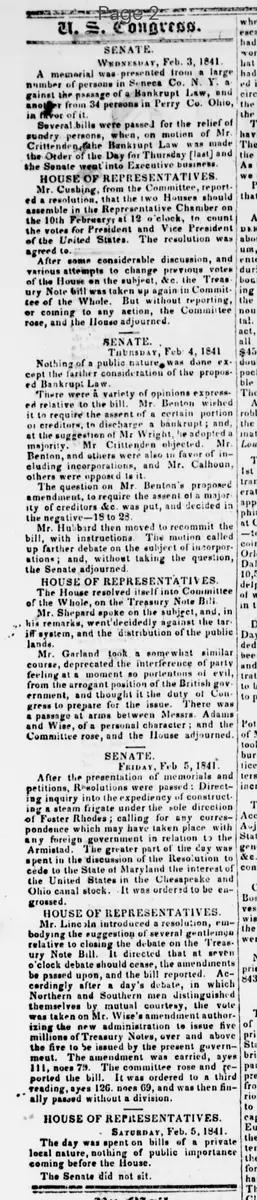
SENATE.
WEDNESDAY, Feb. 3, 1841.
A memorial was presented from a large number of persons in Seneca Co. N. Y. against the passage of a Bankrupt Law, and another from 34 persons in Perry Co. Ohio, in favor of it.
Several bills were passed for the relief of sundry persons, when, on motion of Mr. Crittenden, the Bankrupt Law was made the Order of the Day for Thursday last and the Senate went into Executive business.
HOUSE OF REPRESENTATIVES.
Mr. Cushing, from the Committee, reported a resolution, that the two Houses should assemble in the Representative Chamber on the 10th February at 12 o'clock, to count the votes for President and Vice President of the United States. The resolution was agreed to.
After some considerable discussion, and various attempts to change previous votes of the House on the subject, &c. the Treasury Note bill was taken up again in Committee of the Whole. But without reporting or coming to any action, the Committee rose, and the House adjourned.
SENATE.
THURSDAY, Feb 4, 1841.
Nothing of a public nature was done except the further consideration of the proposed Bankrupt Law.
There were a variety of opinions expressed relative to the bill. Mr. Benton wished it to require the assent of a certain portion of creditors, to discharge a bankrupt: and at the suggestion of Mr. Wright, he adopted a majority. Mr. Crittenden objected. Mr. Benton, and others were also in favor of including incorporations, and Mr. Calhoun, others were opposed to it.
The question on Mr. Benton's proposed amendment, to require the assent of a majority of creditors &c. was put, and decided in the negative—18 to 23.
Mr. Hubbard then moved to recommit the bill, with instructions. The motion called up farther debate on the subject of incorporations; and, without taking the question, the Senate adjourned.
HOUSE OF REPRESENTATIVES.
The House resolved itself into Committee of the Whole, on the Treasury Note Bill.
Mr. Shepard spoke on the subject, and, in his remarks, went decidedly against the tariff system, and the distribution of the public lands.
Mr. Garland took a somewhat similar course, deprecated the interference of party feeling at a moment so portentous of evil, from the arrogant position of the British government, and thought it the duty of Congress to prepare for the issue. There was a passage at arms between Messrs. Adams and Wise, of a personal character; and the Committee rose, and the House adjourned.
SENATE.
FRIDAY, Feb 5. 1841.
After the presentation of memorials and petitions, resolutions were passed: Directing inquiry into the expediency of constructing a steam frigate under the sole direction of Foster Rhodes; calling for any correspondence which may have taken place with any foreign government in relation to the Amistad. The greater part of the day was spent in the discussion of the Resolution to cede to the State of Maryland the interest of the United States in the Chesapeake and Ohio canal stock. It was ordered to be engrossed.
HOUSE OF REPRESENTATIVES.
Mr. Lincoln introduced a resolution, embodying the suggestion of several gentlemen relative to closing the debate on the Treasury Note Bill. It directed that at seven o'clock debate should cease, the amendments be passed upon, and the bill reported. Accordingly after a day's debate, in which Northern and Southern men distinguished themselves by mutual courtesy, the vote was taken on Mr. Wise's amendment authorizing the new administration to issue five millions of Treasury Notes, over and above the five to be issued by the present government. The amendment was carried, ayes 111, noes 79. The committee rose and reported the bill. It was ordered to a third reading, ayes 126, noes 69, and was then finally passed without a division.
HOUSE OF REPRESENTATIVES.
SATURDAY, Feb. 5. 1841.
The day was spent on bills of a private local nature, nothing of public importance coming before the House.
The Senate did not sit.
What sub-type of article is it?
What keywords are associated?
What entities or persons were involved?
Domestic News Details
Event Date
February 3 6, 1841
Key Persons
Outcome
bankrupt law amendment rejected 18-23; treasury note bill passed with amendment (ayes 111-79, then 126-69); resolutions passed on steam frigate inquiry, amistad correspondence, and chesapeake and ohio canal cession; electoral vote counting scheduled for feb 10.
Event Details
Senate and House proceedings included presentations of memorials for and against Bankrupt Law, debates and failed amendments on it, discussions and passage of Treasury Note Bill with provisions for new administration issuance, resolutions on various inquiries and cessions, and minor private bills.