Thank you for visiting SNEWPapers!
Sign up free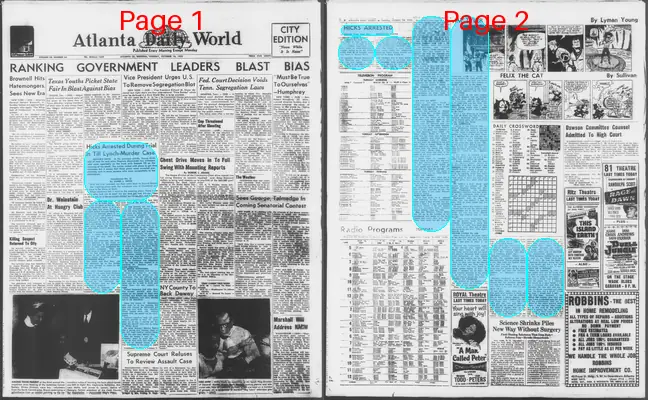
Atlanta Daily World
Atlanta, Fulton County, Georgia
What is this article about?
Journalist James L. Hicks recounts efforts during the Emmett Till murder trial to locate and secure witnesses, interactions with Mississippi authorities, and his arrest on a fabricated traffic charge amid tensions in the case.
Merged-components note: Merged continuation of the Hicks story on the Till lynching-murder case from page 1 (reading order 6) to page 2 (reading order 18).
Clippings
1 of 2
OCR Quality
Full Text
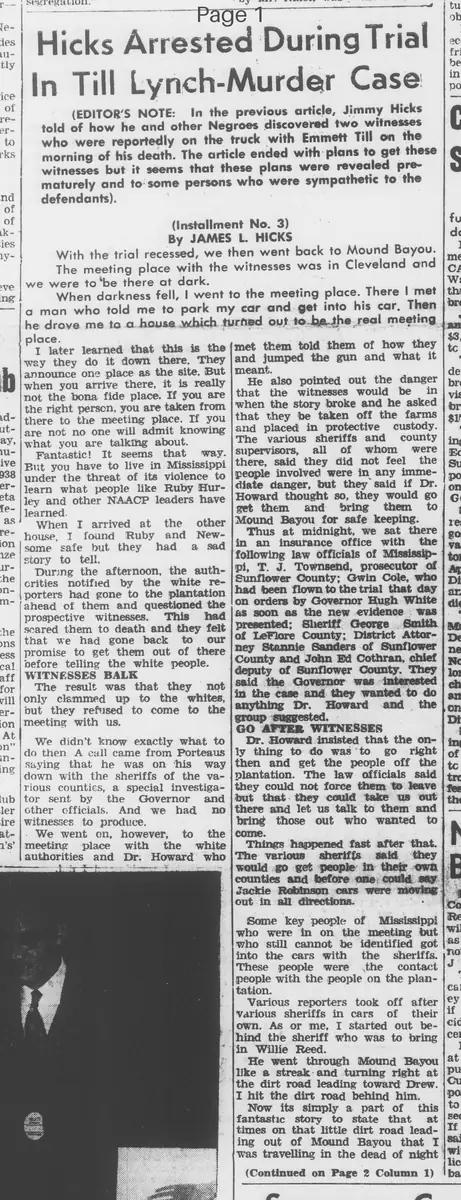
(EDITOR'S NOTE: In the previous article, Jimmy Hicks told of how he and other Negroes discovered two witnesses who were reportedly on the truck with Emmett Till on the morning of his death. The article ended with plans to get these witnesses but it seems that these plans were revealed prematurely and to some persons who were sympathetic to the defendants).
(Installment No. 3)
By JAMES L. HICKS
With the trial recessed, we then went back to Mound Bayou. The meeting place with the witnesses was in Cleveland and we were to be there at dark.
When darkness fell, I went to the meeting place. There I met a man who told me to park my car and get into his car. Then he drove me to a house which turned out to be the real meeting place.
I later learned that this is the way they do it down there. They announce one place as the site. But when you arrive there, it is really not the bona fide place. If you are the right person, you are taken from there to the meeting place. If you are not no one will admit knowing what you are talking about.
Fantastic! It seems that But you have to live in Mississippi way under the threat of its violence to learn what people like Ruby Hurley and other NAACP leaders have learned.
When I arrived at the other house, I found Ruby and Newsome safe but they had a sad story to tell.
During the afternoon, the authorities notified by the white reporters had gone to the plantation ahead of them and questioned the prospective witnesses.
This had scared them to death and they felt that we had gone back on our promise to get them out of there before telling the white people.
WITNESSES BALK
The result was that they not only clammed up to the whites but they refused to come to the meeting with us.
We didn't know exactly what to do then A call came from Porteous Saying that he was on his way down with the sheriffs of the various counties a special investigator sent by the Governor and other officials. And we had no witnesses to produce.
We went on, however. to the meeting place with the white authorities and Dr. Howard who met them told them of how we and jumped the gun and what it meant,
He also pointed out the danger that the witnesses would be in when the story broke and he asked that they be taken off the farms and placed in protective custody.
The various sheriffs and county supervisors, all of whom were there, said they did not feel the people involved were in any immediate danger, but they said if Dr. Howard thought so, they would go get them and bring them to Mound Bayou for safe keeping.
Thus at midnight, we sat there in an insurance office with the following law officials of Mississippi, T. J. Townsend, prosecutor of Sunflower County: Gwin Cole. who had been flown to the trial that day on orders by Governor Hugh White as soon as the new evidence was presented; Sheriff George Smith of LeFlore County: District Attorney Stannie Sanders of Sunflower County and John Ed Cothran, chief deputy of Sunflower County. They said the Governor was interested in the case and they wanted to do anything Dr. Howard and the group suggested.
GO AFTER WITNESSES
Dr. Howard insisted that the only thing to do was 'to go right then and get the people off the plantation. The law officials said they could not force them to leave but that they could take us out there and let us talk to them and bring those out who wanted to come.
Things happened fast after that. The various sheriffs said they would go get people in their own counties and before one could say Jackie Robinson cars were moving out in all directions.
Some key people of Mississippi who were in on the meeting but who still cannot be identified got into the cars with the sheriffs. These people were the contact people with the people on the plantation.
Various reporters took off after various sheriffs in cars of their own. As or me. I started out behind the sheriff who was to bring in Willie Reed.
He went through Mound Bayou like a streak·and turning right at the dirt road leading toward Drew. I hit the dirt road behind him.
Now its simply a part of this fantastic story to state that at times on that little dirt road leading out of Mound Bayou that I was travelling in the dead of night (Continued on Page 2 Column 1)
HICKS ARRESTED
(Continued From Page One)
BRINGS IN YO
at the affair at 70 miles an hour!
It's fantastic but true.
But even at that speed, I lost the sheriff and decided to go on then to County Supervisor Townsend's office at Drew where all the witnesses picked up by the various sheriffs were to be brought before.
Being taken to Mound Bayou
We overtook Simeon Booker and Clark Porteous and Featherston.
They, too, had chased a sheriff and got lost in the Mississippi dirt road. The five of us then went to Townsend's office.
As we arrived there a white woman drove up in a car and a colored man got out. This proved to be Frank Young one of the key witnesses in the case who never testified. The sheriff in that county had simply called the plantation owner on which Young worked and told her to bring Young in.
Dr. Howard was to have followed us to Drew to be there when the witnesses were questioned but for some reason he was delayed and though Young had talked freely before this, he refused to.
We waited a long time and then the white woman, who had brought him in grew tired and she took Young back to the plantation, promising to have him in court the next day. Young never took the witness stand. They told me he came to the court and could not find the courtroom and went back.
I never did get the straight of this.
One of the sheriffs had taken a colored minister with him to get Mandy Bradley. About two o'clock in the morning, they returned without Mandy. Moses Newsome, a reporter who had ridden in the sheriff's car with the minister and the sheriff said the sheriff had driven to the house sent the minister in to talk with Mrs. Bradley and see if she would come to Mound Bayou.
She is said to have told him that she would not. That she did not know anything about the case. But later the same woman did testify in the case and has not left her native Mississippi and is in Chicago. I can only believe that the events of the day and night had frightened her nearly to death.
The various sheriffs talked to other witnesses but were able to get none to come forward that night. Finally in the early hours of the morning, we went back to Mound Bayou over the lonely back road.
I AM PUT ON SPOT
There is one point which I should mention here that I feel had a direct bearing on my future activity with the trial.
During the meeting at Mound Bayou with the various sheriffs, one of them asked Dr. Howard what were the names of the two men who had been seen on the truck with Emmett Till. At this point only, Dr. Howard and the sheriffs were in the room together and reporters were waiting outside.
But at this point, Dr. Howard in a loud booming voice called out 'Send Jimmy Hicks in here.' I went into the room and before all those sheriffs and other officials of Mississippi, many of whom I did not trust, he pointed to me and said, "This is Jimmy Hicks of the Afro-American papers. He has talked with the people who know 'Too Tight.' Hicks what is Too Tight's real name and what is the name of the man who was on that truck with him?"
I didn't want to answer.
I didn't want to enter into the trial that way whatever. But I couldn't let Dr. Howard down before all those people and I knew I was the only one who had the answer. So I said "Too Tight's real name is Leroy Collins and the other man is Henry Lee Loggins."
All their eyes were upon me as I left the room. And I got a funny feeling that the finger might also be on me, too.
Back at the Mound Bayou hotel my colleagues were even more insistent that I lighten up on the type of story I was filing through Western Union.
NEWS GET OUT
From that point on it seemed that everyone in the courthouse knew what I had written the moment I filed it. I am not accusing Western Union. I do not believe that the operators were willfully letting anyone read my copy.
But, the Western Union ticker was set up in the hallway of the courthouse and many of the local people had never seen one work.
Those who could not get into the courtroom, made it a habit to crowd around the open phones and the Western Union desk and listen to reporters call in their stories on special wires set up for them.
It was very easy for them to also look over the shoulder of the Western Union operator and see what he was filing.
The owner of the only colored phone in Sumner told me himself that the white people listened in on everything said on his phone so I ruled that one out with the exception of a few calls to my office during which time I never once said what part I was playing in the trial.
While I was debating on whether to just sit down and tell it all, an incident happened which caused me to finally agree not to file what I was seeing and doing.
I AM ARRESTED
I drove to the trial at nine o'clock Wednesday morning and sat through the trial until it recessed at 1:30. Then I started to my car parked in front of the court house.
As I reached the car with the key in my hand to get a notebook out of the car, a white man stepped off the curb and said to me, "Boy, is this your car." When I answered that it was, he snatched the key from my hand and said, "You come with me down to the Mayor's office."
I was never so shocked in my life, but when I saw his gun I decided that I'd better go along.
I began walking with the man to the "mayor's office," neither of us said a word. But, oh, how I was thinking! I felt at the start that Sheriff Strider, whom I simply do not trust, had got wind of my activity in tracking down Too Tight and I figured that I might be stuck away in some jail and given a good going over until after the trial.
We walked a half block and turned into the offices of the Sumner Sentinel. Inside the door stood Featherston, the Jackson, Mississippi reporter, who had worked on the witnesses with us virtually all night the night before.
Featherston said to me, "Hi Hicks, how you doing?" I said to him, Not so good. Looks like I'm in trouble.
He said "what's the trouble?" and I asked him to ask the deputy who had brought me in. All the deputy would tell him was that Sheriff Strider had ordered him to pick me up.
I never forget Featherston. He told the deputy, Look, I'm from Jackson, Mississippi. I know this boy. He's all right. You must have the wrong man. This boy is down here covering the trial." The deputy ignored him.
EDITOR COMES TO AID
About that time, Simpson, editor of the Sentinel came in. And I was glad that he had been the first man I had gone to when I hit town.
Simpson, like Featherston, greeted me warmly and asked how things were going. I told him I was under arrest but did not know the charges. Simpson then aggressively demanded of the deputy what he was holding me for. When he refused to tell him, he said "Well, by God, let's get the sheriff over here and see. This man is here to cover the trial. Every reporter speaks highly of him because I checked up on him." He then ordered someone in his office to go get the sheriff who was in the courthouse across the street.
THINKS UP CHARGES
But instead of the sheriff coming back, about 40 newsmen hit the door of the Sentinel.
Their nose for news had already sniffed a new story and they were there to check on it and I was glad to see them there.
It was then and only then that the deputy suddenly realized that he knew the charges against me.
He said, "He's charged with passing a standing school bus!"
Simpson exploded. "School bus," he said. 'For goodness sakes' turn that man loose. You're getting ready to give this town the biggest black eye it has ever had."
He then turned to what I later found was the justice of the peace who "tried" my case-the linotype operator in Simpson's printing plant!
Simpson suggested to the linotype operator that he dismiss the charges but the linotype operator who was then talking to his boss, said, "This is my case and I'm going to try it."
I saw then that here was a little man who wanted to show his importance and I was so relieved that it was a traffic charge and nothing else that I buzzed the colored press that I was Ok and could pay the fine and that I think I'd get off better if they left and made it appear that no one was putting any pressure on the little justice of the peace.
They left (and bless them all for having the courage to come) but some of the white reporters remained and continued to ask questions. One picked up a phone on Simpson's desk, called Memphis and began dictating the story to his editor. The story later appeared on the center fold of the Memphis Commercial Appeal.
With Simpson talking to the JP, he said to me "Come back here, boy." I went. He took me back to a linotype machine, wiped the ink off his hands, got out a law book and began reading a law to me.
GIVES ME A "BREAK"
When he finished, he told me that under that law he could fine me $200 or give me six months in jail. But he said he was going to "give you a break" and dismiss the case. He asked me if I thought that would be a good break. I told him I certainly did. And then he dismissed the case and told me to "tell all those reporters out there that we gave you a break." I told him that I would-and I did.
By this time, however, I was getting the general idea that perhaps I was a marked man for during his conversation with me the justice of the peace started telling where I was staying, what time I got to the trial in the morning where I parked my car and who I was going to have lunch with that day. (I was going to eat with a local woman who had promised me some more information. She did not show up).
What sub-type of article is it?
What themes does it cover?
What keywords are associated?
What entities or persons were involved?
Where did it happen?
Story Details
Key Persons
Location
Mississippi (Mound Bayou, Cleveland, Drew, Sumner, Sunflower County, Leflore County)
Event Date
During The Emmett Till Trial, September 1955
Story Details
James L. Hicks describes secretive attempts to meet and secure witnesses for the Emmett Till murder trial, failed due to premature exposure; meetings with authorities leading to failed retrievals; Hicks revealing witness names publicly; subsequent surveillance and his arrest on a false school bus passing charge, which is dismissed after press intervention.