Thank you for visiting SNEWPapers!
Sign up free
Letter to Editor
March 25, 1811
Portland Gazette, And Maine Advertiser
Portland, Cumberland County, Maine
What is this article about?
A letter to Mr. Shirley criticizes the Boston caucus's control over Republican Senate nominations in Massachusetts, denouncing candidates William King and Francis Carr for opportunism and speculation, while advocating for independent alternatives like Moses Carleton to prevent despotic party rule.
Clipping
OCR Quality
92%
Excellent
Full Text
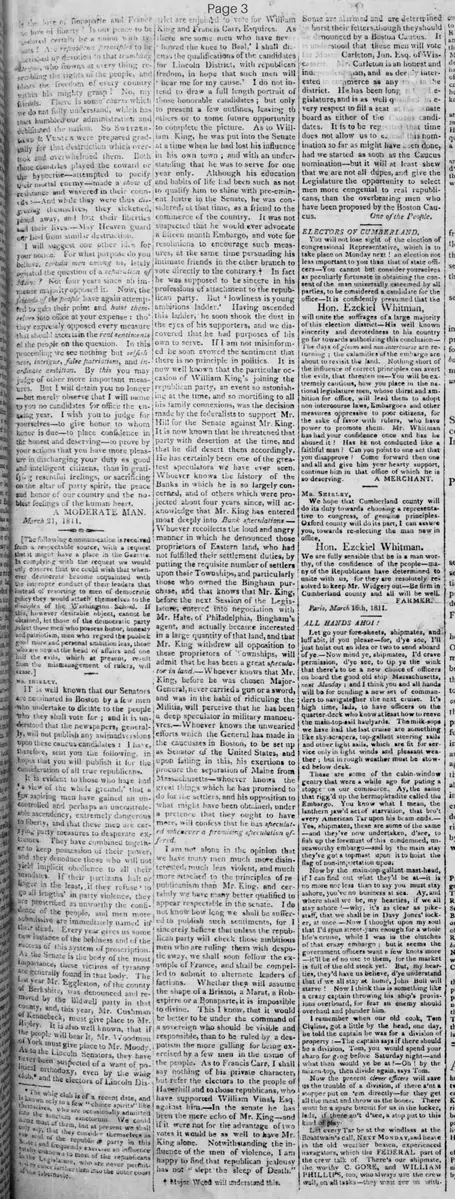
[The following communication is received from a respectable source, with a request that it might have a place in the Gazette. In complying with the request we would only observe that we could wish that whenever democrats become acquainted with the improper conduct of their leaders that instead of resorting to men of democratic policy they would attach themselves to the disciples of the Washington School. If this, however desirable object, cannot be obtained, let those of the democratic party select those men who possess honor, honesty and patriotism, men who regard the public good more and personal ambition less, those who are now at the head of affairs and one half the evils, which at present, result from the mis management of rulers, will cease.]
MR. SHIRLEY,
It is well known that our Senators are nominated in Boston by a few men who undertake to dictate to the people who they shall vote for; and it is understood that the newspapers, generally, will not publish any animadversions upon these caucus candidates: I have, therefore, sent you the following, in hopes that you will publish it for the consideration of all true republicans.
It is evident to those who have had a view of the whole ground, that a few aspiring men have gained an uncontrolled and perhaps an uncontrollable ascendency, extremely dangerous to liberty, and that these men are carrying party measures to desperate extremes. They have combined together to keep possession of their power, and they denounce those who will not yield implicit obedience to all their mandates. If their partisans halt or linger in the least..if they refuse 'to go all lengths' in party violence, they are proscribed as unworthy the confidence of the people, and men more submissive are immediately named in their stead. Every year gives us some new instance of the boldness and of the success of this system of proscription. As the Senate is the body of the most importance, these victims of tyranny are generally found in that body. The last year Mr. Eggleston, of the county of Berkshire, was denounced and removed by the Bidwell party in that county, and, this year, Mr. Cushman of Kennebeck, must give place to Mr. Ripley. It is also well known, that if the people will bear it, Mr. Woodman of York must give place to Mr. Moody. As to the Lincoln Senators, they have never been suspected of a want of political orthodoxy, even by the whig club,* and the electors of Lincoln District are enjoined to vote for William King and Francis Carr, Esquires. As there are some men who have never bowed the knee to Baal,' I shall discuss the qualifications of the candidates for Lincoln District, with republican freedom, in hope that such men will 'hear me for my cause.' I do not intend to draw a full length portrait of those honorable candidates; but only to present a few outlines, leaving to others or to some future opportunity to complete the picture. As to William King, he was put into the Senate at a time when he had lost his influence in his own town; and with an understanding that he was to serve for one year only. Although his education and habits of life had been such as not to qualify him to shine with pre-eminent lustre in the Senate, he was considered, at that time, as a friend to the commerce of the country. It was not suspected that he would ever advocate a fifteen month Embargo, and vote for resolutions to encourage such measures, at the same time persuading his intimate friends in the other branch to vote directly to the contrary. In fact he was supposed to be sincere in his professions of attachment to the republican party. But 'lowliness is young ambition's ladder.' Having ascended this ladder,' he soon shook the dust in the eyes of his supporters, and we discovered that he had purposes of his own to serve. If I am not misinformed he soon avowed the sentiment that there is no principle in politics. It is now well known that the particular occasion of William King's joining the republican party, an event so astonishing at the time, and so mortifying to all his family connexions, was the decision made by the federalists to support Mr. Hill for the Senate against Mr. King. It is now known that he threatened that party with desertion at the time, and that he did desert them accordingly. He has certainly been one of the greatest speculators we have ever seen. Whoever knows the history of the Banks in which he is so largely concerned, and of others which were projected about four years since, will acknowledge that Mr. King has entered most deeply into Bank speculations— Whoever recollects the loud and angry manner in which he denounced those proprietors of Eastern land, who had not fulfilled their settlement duties, by putting the requisite number of settlers upon their Townships, and particularly those who owned the Bingham purchase, and that knows that Mr. King, before the next Session of the Legislature, entered into negotiation with Mr. Hale, of Philadelphia, Bingham's agent, and actually became interested in a large quantity of that land, and that Mr. King withdrew all opposition to these proprietors of Townships, will admit that he has been a great speculator in land.—Whoever knows that Mr. King, before he was chosen Major-General, never carried a gun or a sword, and was in the habit of ridiculing the Militia, will perceive that he has been a deep speculator in military manoeuvres.— Whoever knows the unwearied efforts which the General has made in the caucuses in Boston, to be set up as Senator of the United States, and upon failing in this, his exertions to procure the separation of Maine from Massachusetts—whoever knows the great things which he has promised to do for the settlers, and his opposition to what might have been obtained, under a pretence that they ought to have more, will confess that he has speculated whenever a promising speculation offered.
I am not alone in the opinion that we have many men much more disinterested, much less violent, and much more attached to the principles of republicanism than Mr. King, and certainly we have many better qualified to appear respectable in the senate. I do not know how long we shall be suffered to publish such sentiments, for I sincerely believe that unless the republican party will check those ambitious men who are ruling them with despotic sway, we shall soon follow the example of France, and shall be compelled to submit to alternate leaders of factions. Whether they will assume the shape of a Brissot, a Marat, a Robespierre or a Bonaparte, it is impossible to divine. This I know, that it would be better to be under the command of a sovereign who should be visible and responsible, than to be ruled by a despotism the more galling for being exercised by a few men in the name of the people. As to Francis Carr, I shall say nothing of his private character but refer the electors to the people of Haverhill and to those republicans, who have supported William Vinal, Esq. against him.—In the senate he has been the mere echo of Mr. King—and if it were not for the advantage of two votes it would be as well to have Mr. King alone. Notwithstanding the influence of the men of violence, I am happy to find that republican jealousy has not "slept the sleep of Death."
+ Major Wood will understand this.
*The whig club is of a recent date, and is known only to a few "choice spirits" like themselves, who are occasionally admitted into the sanctum sanctorum. We could name most of them, but at present we shall only touch upon the soul of that they republic consider on frequently exercise undue influence unknown to the Legislature. Most who are the never perfect republicans admitted to enter farther than to the outer court of the tabernacle.
Some are alarmed and are determined to burst their fetters, though they should be denounced by a Boston Caucus. It is understood that these men will vote for Moses Carleton, Jun. Esq. of Wiscasset. Mr. Carleton is an honest and independent man, and as deeply interested in commerce as any man in the district. He has been long in the legislature, and is as well qualified in every respect to fill a seat at the senate board as either of the caucus candidates. It is to be regretted that time does not allow us to extend this nomination so far as might have been done, had we started as soon as the Caucus nomination—but it will at least show that we are not all dupes, and give the Legislature the opportunity to select men more congenial to real republicans, than the overbearing men who have been proposed by the Boston Caucus.
One of the People.
MR. SHIRLEY,
It is well known that our Senators are nominated in Boston by a few men who undertake to dictate to the people who they shall vote for; and it is understood that the newspapers, generally, will not publish any animadversions upon these caucus candidates: I have, therefore, sent you the following, in hopes that you will publish it for the consideration of all true republicans.
It is evident to those who have had a view of the whole ground, that a few aspiring men have gained an uncontrolled and perhaps an uncontrollable ascendency, extremely dangerous to liberty, and that these men are carrying party measures to desperate extremes. They have combined together to keep possession of their power, and they denounce those who will not yield implicit obedience to all their mandates. If their partisans halt or linger in the least..if they refuse 'to go all lengths' in party violence, they are proscribed as unworthy the confidence of the people, and men more submissive are immediately named in their stead. Every year gives us some new instance of the boldness and of the success of this system of proscription. As the Senate is the body of the most importance, these victims of tyranny are generally found in that body. The last year Mr. Eggleston, of the county of Berkshire, was denounced and removed by the Bidwell party in that county, and, this year, Mr. Cushman of Kennebeck, must give place to Mr. Ripley. It is also well known, that if the people will bear it, Mr. Woodman of York must give place to Mr. Moody. As to the Lincoln Senators, they have never been suspected of a want of political orthodoxy, even by the whig club,* and the electors of Lincoln District are enjoined to vote for William King and Francis Carr, Esquires. As there are some men who have never bowed the knee to Baal,' I shall discuss the qualifications of the candidates for Lincoln District, with republican freedom, in hope that such men will 'hear me for my cause.' I do not intend to draw a full length portrait of those honorable candidates; but only to present a few outlines, leaving to others or to some future opportunity to complete the picture. As to William King, he was put into the Senate at a time when he had lost his influence in his own town; and with an understanding that he was to serve for one year only. Although his education and habits of life had been such as not to qualify him to shine with pre-eminent lustre in the Senate, he was considered, at that time, as a friend to the commerce of the country. It was not suspected that he would ever advocate a fifteen month Embargo, and vote for resolutions to encourage such measures, at the same time persuading his intimate friends in the other branch to vote directly to the contrary. In fact he was supposed to be sincere in his professions of attachment to the republican party. But 'lowliness is young ambition's ladder.' Having ascended this ladder,' he soon shook the dust in the eyes of his supporters, and we discovered that he had purposes of his own to serve. If I am not misinformed he soon avowed the sentiment that there is no principle in politics. It is now well known that the particular occasion of William King's joining the republican party, an event so astonishing at the time, and so mortifying to all his family connexions, was the decision made by the federalists to support Mr. Hill for the Senate against Mr. King. It is now known that he threatened that party with desertion at the time, and that he did desert them accordingly. He has certainly been one of the greatest speculators we have ever seen. Whoever knows the history of the Banks in which he is so largely concerned, and of others which were projected about four years since, will acknowledge that Mr. King has entered most deeply into Bank speculations— Whoever recollects the loud and angry manner in which he denounced those proprietors of Eastern land, who had not fulfilled their settlement duties, by putting the requisite number of settlers upon their Townships, and particularly those who owned the Bingham purchase, and that knows that Mr. King, before the next Session of the Legislature, entered into negotiation with Mr. Hale, of Philadelphia, Bingham's agent, and actually became interested in a large quantity of that land, and that Mr. King withdrew all opposition to these proprietors of Townships, will admit that he has been a great speculator in land.—Whoever knows that Mr. King, before he was chosen Major-General, never carried a gun or a sword, and was in the habit of ridiculing the Militia, will perceive that he has been a deep speculator in military manoeuvres.— Whoever knows the unwearied efforts which the General has made in the caucuses in Boston, to be set up as Senator of the United States, and upon failing in this, his exertions to procure the separation of Maine from Massachusetts—whoever knows the great things which he has promised to do for the settlers, and his opposition to what might have been obtained, under a pretence that they ought to have more, will confess that he has speculated whenever a promising speculation offered.
I am not alone in the opinion that we have many men much more disinterested, much less violent, and much more attached to the principles of republicanism than Mr. King, and certainly we have many better qualified to appear respectable in the senate. I do not know how long we shall be suffered to publish such sentiments, for I sincerely believe that unless the republican party will check those ambitious men who are ruling them with despotic sway, we shall soon follow the example of France, and shall be compelled to submit to alternate leaders of factions. Whether they will assume the shape of a Brissot, a Marat, a Robespierre or a Bonaparte, it is impossible to divine. This I know, that it would be better to be under the command of a sovereign who should be visible and responsible, than to be ruled by a despotism the more galling for being exercised by a few men in the name of the people. As to Francis Carr, I shall say nothing of his private character but refer the electors to the people of Haverhill and to those republicans, who have supported William Vinal, Esq. against him.—In the senate he has been the mere echo of Mr. King—and if it were not for the advantage of two votes it would be as well to have Mr. King alone. Notwithstanding the influence of the men of violence, I am happy to find that republican jealousy has not "slept the sleep of Death."
+ Major Wood will understand this.
*The whig club is of a recent date, and is known only to a few "choice spirits" like themselves, who are occasionally admitted into the sanctum sanctorum. We could name most of them, but at present we shall only touch upon the soul of that they republic consider on frequently exercise undue influence unknown to the Legislature. Most who are the never perfect republicans admitted to enter farther than to the outer court of the tabernacle.
Some are alarmed and are determined to burst their fetters, though they should be denounced by a Boston Caucus. It is understood that these men will vote for Moses Carleton, Jun. Esq. of Wiscasset. Mr. Carleton is an honest and independent man, and as deeply interested in commerce as any man in the district. He has been long in the legislature, and is as well qualified in every respect to fill a seat at the senate board as either of the caucus candidates. It is to be regretted that time does not allow us to extend this nomination so far as might have been done, had we started as soon as the Caucus nomination—but it will at least show that we are not all dupes, and give the Legislature the opportunity to select men more congenial to real republicans, than the overbearing men who have been proposed by the Boston Caucus.
One of the People.
What sub-type of article is it?
Political
Persuasive
Provocative
What themes does it cover?
Politics
Constitutional Rights
What keywords are associated?
Boston Caucus
Senate Nominations
William King
Francis Carr
Moses Carleton
Republican Party
Political Speculation
Maine Separation
What entities or persons were involved?
One Of The People
Mr. Shirley
Letter to Editor Details
Author
One Of The People
Recipient
Mr. Shirley
Main Argument
the boston caucus's dictatorial control over republican senate nominations promotes unprincipled speculators like william king and francis carr, endangering liberty; true republicans should support independent candidates like moses carleton to curb this despotism.
Notable Details
Criticism Of William King's Political Opportunism, Bank And Land Speculations, Military Posturing, And Role In Maine Separation
Reference To French Revolution Figures (Brissot, Marat, Robespierre, Bonaparte) As Warning
Examples Of Proscriptions: Eggleston, Cushman, Woodman
Advocacy For Moses Carleton As Honest Alternative