Thank you for visiting SNEWPapers!
Sign up free
Letter to Editor
May 30, 1831
Lynchburg Virginian
Lynchburg, Virginia
What is this article about?
In 1831, J.S. from Nelson County, KY, details 1826 experiments refuting common weevil theories and proposing flies lay eggs on stored wheat, leading to worm infestation; advises exclusion, heat, or cool storage to prevent damage. (198 characters)
Clipping
OCR Quality
95%
Excellent
Full Text
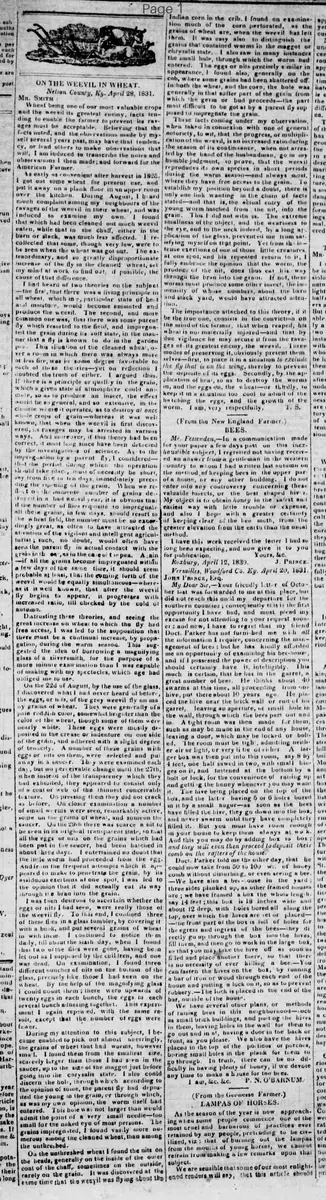
ON THE WEEVIL IN WHEAT.
Nelson County, Ky. April 28, 1831.
MR. SMITH:
Wheat being one of our most valuable crops
and the weevil its greatest enemy, facts tending
to enable the farmer to prevent its ravages
must be acceptable. Believing that the
facts noted, and the observations made by myself
several years past, may have that tendency, or lead
others to make observations that
will, I am induced to transcribe the notes and
observations I then made; and forward for the
American Farmer.
As early as convenient after harvest in 1826,
I got out some wheat for present use, and
put it away on a plank floor in an upper room
over the kitchen. During August, I heard
much complaint among my neighbours of the
ravages of the weevil in their wheat, and was
induced to examine my own. I found
that which had been cleaned out much weevil
eaten, while that in the chaff, either in the
barn or stack, was much less affected. I recollected
that some, though very few, were to
be seen when the wheat was got out. The extraordinary,
and so greatly disproportionate
increase of the fly in the cleaned wheat, set
my mind at work to find out, if possible, the
cause of that difference.
I had heard of two theories on the subject—the
first, that there was a living principle in
all wheat, which in a particular state of heat
and moisture, would become animated and
produce the weevil. The second, and more
common one was, that there was some parent
fly which resorted to the field, and impregnated
the grain during its soft state, in the manner
that a fly is known to do in the garden
pea. This situation of the cleaned wheat, over
a room in which there was always more or
less fire, was in some degree favorable to
each of these theories—yet on reflection I
doubted the truth of either. I argued thus.
If there is a principle or quality in the grain.
which a given state of atmosphere could animate,
so as to produce an insect, the effect
would be so general, and so extensive, in the
climate where it operates, as to destroy all once
whole crops of grain—whereas it was well
known, that when the weevil is first discovered,
its ravages may be arrested in various
ways. And moreover, if this theory had been
correct, it must long since have been detected
by the investigations of science. As to the
impregnation by a parent fly, I considered—that
the period during which the operation
should take place, must of necessity be short,
say from five to ten days, immediately preceding
the ripening of the grain. When we recollect
the immense number of grains destroyed
in a bad weevil year, it is obvious that
if the number of flies requisite to impregnate
all these grains, in few days, should resort to
the wheat field, the number must be so excessively
great, as often to have attracted the
attention of the vigilant and intelligent agriculturist;
such, no doubt, would often have
seen the parent fly in actual contact with the
grain in the field, as in the case of the pea. Again—if
all the grains become impregnated within
a few days of the same time, it should seem
probable at least, that the coming forth of the
weevil would be equally simultaneous—whereas
it is well known, that after the weevil
fly begins to appear, it progresses with
increased ratio, till checked by the cold of
autumn.
Distrusting these theories, and seeing the
great increase on wheat to which the fly had
free access, I was led to the supposition that
there must be a continual increase, by propagation,
during the warm season. This suggested
the idea of borrowing a magnifying
glass of a silversmith, for the purpose of a
more minute examination than I was capable
of making with my spectacles, which age had
obliged me to use.
On the 22d of August, by the use of the glass.
I discovered what I had never heard of before,
the egg, or nits, of the grey weevil fly on many
grains of wheat. These were generally of a
pale reddish color, somewhat brighter than the
color of the wheat, though some of them were
nearly white. These eggs were mostly deposited
in the crease or indenture on one side
of the grain, and adhered with a slight degree
of tenacity. A number of these grains with
eggs or nits on them, were selected and put
away in a saucer. They were examined each
day, but no perceivable change until the 27th,
when instead of the transparency which they
had exhibited, they appeared to consist only
of a coat or web of the thinnest conceivable
texture. On pressing them they did not crack
as before. On closer examination a number
of small worms were seen, remarkably active,
some on the grains of wheat, and some on the
saucer. On the 27th there was scarce a nit to
be seen in its original transparent state, so that
all the eggs or nits on the grains which had
been put in the saucer, had been hatched in
about five days. I entertained no doubt that
the little worm had proceeded from the egg.
And from the frequent attempts which it attempted
to penetrate the grain, by its
assiduous exertions at one spot, I was led to
the opinion that it did actually eat its way
through the bran into the grain.
I was then desirous to ascertain whether the
eggs or nits I had seen, were really those of
the weevil fly. To this end, I confined three
of these flies in a glass tumbler, by covering it
with a book, and put several grains of wheat
in with them. I continued to notice them
daily, till about the sixth day, when I found
that two of the flies were gone, having been
let out as I supposed by the children, and one
was dead. On examination, I found three
different bunches of nits on the bottom of the
glass, precisely like those I had seen on the
wheat. By the help of the magnifying glass
I could count them; there were upwards of
twenty eggs in each bunch, the eggs in each
several bunch adhering together. This experiment
I again repeated, with the same result,
except that the number of eggs were
fewer.
During my attention to this subject, I became
enabled to pick out almost unerringly,
the grains of wheat that had worms, however
small. I found them from the smallest size,
scarcely larger than those I had seen in the
saucer, up to the size of the maggot just before
going into the chrysalis state. I also could
discern the hole, through which according to
the opinion of some, the parent fly had deposited
the young in the grain, or through which,
as was my own opinion, the worm itself had
entered. This hole was not larger than would
admit the point of a very small needle—too
small for the naked eye of most persons. The
grains impregnated, I found vastly more numerous
among the cleaned wheat, than among
the unthreshed.
the heads, generally on the inside of the outer
coat of the chaff, sometimes on the outside
On the unthreshed wheat I found the nits on
rarely on the grain. It was discovered at the
same time that the weevil was flying about the
Indian corn in the crib. I found on examination
much of the corn perforated, as the
grains of wheat are, when the weevil has left
them. It was easy also to distinguish the
grains that contained worms in the maggot or
chrysalis state. I also saw in many instances
the small hole, through which the worm had
entered. The eggs or nits precisely similar in
appearance, I found also, generally on the
cob, where some grains had been scattered off.
In both the wheat, and the corn, the hole was
generally in that softer part of the grain from
which the germ or bud proceeds—the part
most difficult to be got at by a parent fly supposed
to impregnate the grain.
These facts coming under my observation,
when taken in connection with one of general
notoriety, to wit, that the progress, or multiplication
of the weevil, is an increased ratio during
the season of its continuance, when not arrested
by the hand of the husbandman, go in my
humble judgment, to prove, that the weevil
reproduces its own species in short periods
during the warm season—and always most,
where they have free access to the grain. To
establish my position beyond a doubt, there is
only one link wanting in the chain of facts
stated—and that is, the actual entry of the
young worm hatched from the nit, into the
grain. This I did not witness. The extreme
smallness of the object, and the weariness to
the eye, and to the neck indeed, by a long application
of the glass, prevented me from satisfying
myself on that point. Yet from the intense
exertions of one of those little creatures.
at one spot, and his repeated return to it, I
fully embrace the opinion that the worm, the
produce of the nit, does thus eat his way
through the bran into the grain. If not, these
worms must produce some other insect, the immensity
of whose numbers, about the barn
and stack yard, would have attracted attention.
The importance attached to this theory, if it
be the true one, consists in the conviction on
the mind of the farmer, that when reaped, his
wheat is not materially injured—and that by
due vigilance he may secure it from the ravages
of its greatest enemy, the weevil. Three
modes of preserving it, obviously present themselves—first,
to place it in a situation to exclude
the fly that is on the wing, thereby to prevent
the deposit of its eggs. Secondly, by the application
of heat, so as to destroy the worms
in, and the eggs on, the wheat—or thirdly, to
keep it in a situation too cool to admit of the
hatching the eggs, and the growth of the
worm. I am, very respectfully,
J. S.
(From the New England Farmer.)
Nelson County, Ky. April 28, 1831.
MR. SMITH:
Wheat being one of our most valuable crops
and the weevil its greatest enemy, facts tending
to enable the farmer to prevent its ravages
must be acceptable. Believing that the
facts noted, and the observations made by myself
several years past, may have that tendency, or lead
others to make observations that
will, I am induced to transcribe the notes and
observations I then made; and forward for the
American Farmer.
As early as convenient after harvest in 1826,
I got out some wheat for present use, and
put it away on a plank floor in an upper room
over the kitchen. During August, I heard
much complaint among my neighbours of the
ravages of the weevil in their wheat, and was
induced to examine my own. I found
that which had been cleaned out much weevil
eaten, while that in the chaff, either in the
barn or stack, was much less affected. I recollected
that some, though very few, were to
be seen when the wheat was got out. The extraordinary,
and so greatly disproportionate
increase of the fly in the cleaned wheat, set
my mind at work to find out, if possible, the
cause of that difference.
I had heard of two theories on the subject—the
first, that there was a living principle in
all wheat, which in a particular state of heat
and moisture, would become animated and
produce the weevil. The second, and more
common one was, that there was some parent
fly which resorted to the field, and impregnated
the grain during its soft state, in the manner
that a fly is known to do in the garden
pea. This situation of the cleaned wheat, over
a room in which there was always more or
less fire, was in some degree favorable to
each of these theories—yet on reflection I
doubted the truth of either. I argued thus.
If there is a principle or quality in the grain.
which a given state of atmosphere could animate,
so as to produce an insect, the effect
would be so general, and so extensive, in the
climate where it operates, as to destroy all once
whole crops of grain—whereas it was well
known, that when the weevil is first discovered,
its ravages may be arrested in various
ways. And moreover, if this theory had been
correct, it must long since have been detected
by the investigations of science. As to the
impregnation by a parent fly, I considered—that
the period during which the operation
should take place, must of necessity be short,
say from five to ten days, immediately preceding
the ripening of the grain. When we recollect
the immense number of grains destroyed
in a bad weevil year, it is obvious that
if the number of flies requisite to impregnate
all these grains, in few days, should resort to
the wheat field, the number must be so excessively
great, as often to have attracted the
attention of the vigilant and intelligent agriculturist;
such, no doubt, would often have
seen the parent fly in actual contact with the
grain in the field, as in the case of the pea. Again—if
all the grains become impregnated within
a few days of the same time, it should seem
probable at least, that the coming forth of the
weevil would be equally simultaneous—whereas
it is well known, that after the weevil
fly begins to appear, it progresses with
increased ratio, till checked by the cold of
autumn.
Distrusting these theories, and seeing the
great increase on wheat to which the fly had
free access, I was led to the supposition that
there must be a continual increase, by propagation,
during the warm season. This suggested
the idea of borrowing a magnifying
glass of a silversmith, for the purpose of a
more minute examination than I was capable
of making with my spectacles, which age had
obliged me to use.
On the 22d of August, by the use of the glass.
I discovered what I had never heard of before,
the egg, or nits, of the grey weevil fly on many
grains of wheat. These were generally of a
pale reddish color, somewhat brighter than the
color of the wheat, though some of them were
nearly white. These eggs were mostly deposited
in the crease or indenture on one side
of the grain, and adhered with a slight degree
of tenacity. A number of these grains with
eggs or nits on them, were selected and put
away in a saucer. They were examined each
day, but no perceivable change until the 27th,
when instead of the transparency which they
had exhibited, they appeared to consist only
of a coat or web of the thinnest conceivable
texture. On pressing them they did not crack
as before. On closer examination a number
of small worms were seen, remarkably active,
some on the grains of wheat, and some on the
saucer. On the 27th there was scarce a nit to
be seen in its original transparent state, so that
all the eggs or nits on the grains which had
been put in the saucer, had been hatched in
about five days. I entertained no doubt that
the little worm had proceeded from the egg.
And from the frequent attempts which it attempted
to penetrate the grain, by its
assiduous exertions at one spot, I was led to
the opinion that it did actually eat its way
through the bran into the grain.
I was then desirous to ascertain whether the
eggs or nits I had seen, were really those of
the weevil fly. To this end, I confined three
of these flies in a glass tumbler, by covering it
with a book, and put several grains of wheat
in with them. I continued to notice them
daily, till about the sixth day, when I found
that two of the flies were gone, having been
let out as I supposed by the children, and one
was dead. On examination, I found three
different bunches of nits on the bottom of the
glass, precisely like those I had seen on the
wheat. By the help of the magnifying glass
I could count them; there were upwards of
twenty eggs in each bunch, the eggs in each
several bunch adhering together. This experiment
I again repeated, with the same result,
except that the number of eggs were
fewer.
During my attention to this subject, I became
enabled to pick out almost unerringly,
the grains of wheat that had worms, however
small. I found them from the smallest size,
scarcely larger than those I had seen in the
saucer, up to the size of the maggot just before
going into the chrysalis state. I also could
discern the hole, through which according to
the opinion of some, the parent fly had deposited
the young in the grain, or through which,
as was my own opinion, the worm itself had
entered. This hole was not larger than would
admit the point of a very small needle—too
small for the naked eye of most persons. The
grains impregnated, I found vastly more numerous
among the cleaned wheat, than among
the unthreshed.
the heads, generally on the inside of the outer
coat of the chaff, sometimes on the outside
On the unthreshed wheat I found the nits on
rarely on the grain. It was discovered at the
same time that the weevil was flying about the
Indian corn in the crib. I found on examination
much of the corn perforated, as the
grains of wheat are, when the weevil has left
them. It was easy also to distinguish the
grains that contained worms in the maggot or
chrysalis state. I also saw in many instances
the small hole, through which the worm had
entered. The eggs or nits precisely similar in
appearance, I found also, generally on the
cob, where some grains had been scattered off.
In both the wheat, and the corn, the hole was
generally in that softer part of the grain from
which the germ or bud proceeds—the part
most difficult to be got at by a parent fly supposed
to impregnate the grain.
These facts coming under my observation,
when taken in connection with one of general
notoriety, to wit, that the progress, or multiplication
of the weevil, is an increased ratio during
the season of its continuance, when not arrested
by the hand of the husbandman, go in my
humble judgment, to prove, that the weevil
reproduces its own species in short periods
during the warm season—and always most,
where they have free access to the grain. To
establish my position beyond a doubt, there is
only one link wanting in the chain of facts
stated—and that is, the actual entry of the
young worm hatched from the nit, into the
grain. This I did not witness. The extreme
smallness of the object, and the weariness to
the eye, and to the neck indeed, by a long application
of the glass, prevented me from satisfying
myself on that point. Yet from the intense
exertions of one of those little creatures.
at one spot, and his repeated return to it, I
fully embrace the opinion that the worm, the
produce of the nit, does thus eat his way
through the bran into the grain. If not, these
worms must produce some other insect, the immensity
of whose numbers, about the barn
and stack yard, would have attracted attention.
The importance attached to this theory, if it
be the true one, consists in the conviction on
the mind of the farmer, that when reaped, his
wheat is not materially injured—and that by
due vigilance he may secure it from the ravages
of its greatest enemy, the weevil. Three
modes of preserving it, obviously present themselves—first,
to place it in a situation to exclude
the fly that is on the wing, thereby to prevent
the deposit of its eggs. Secondly, by the application
of heat, so as to destroy the worms
in, and the eggs on, the wheat—or thirdly, to
keep it in a situation too cool to admit of the
hatching the eggs, and the growth of the
worm. I am, very respectfully,
J. S.
(From the New England Farmer.)
What sub-type of article is it?
Informative
Investigative
What themes does it cover?
Agriculture
Science Nature
What keywords are associated?
Wheat Weevil
Grain Storage
Insect Reproduction
Farming Observations
Egg Hatching
Prevention Methods
Agricultural Pests
Corn Infestation
What entities or persons were involved?
J. S.
Mr. Smith
Letter to Editor Details
Author
J. S.
Recipient
Mr. Smith
Main Argument
the wheat weevil reproduces by flies laying eggs on stored grains during the warm season, with worms hatching and eating into the grain; this explains disproportionate damage in cleaned wheat and suggests prevention by excluding flies, applying heat, or keeping wheat cool to halt reproduction.
Notable Details
Refutes Theories Of Spontaneous Generation Or Field Impregnation
Describes Experiments Using Magnifying Glass To Observe Eggs, Nits, And Worms
Notes Eggs Deposited In Crease Of Grain, Hatching In About Five Days
Observes Similar Infestation In Indian Corn
Emphasizes Vigilance Post Harvest To Secure Wheat From Weevil Ravages