Thank you for visiting SNEWPapers!
Sign up free
Editorial
March 15, 1932
The Bismarck Tribune
Bismarck, Mandan, Burleigh County, Morton County, North Dakota
What is this article about?
Reprint of New York Times editorial decrying Congress's free wheat distribution without repayment and budget cuts to the Federal Farm Board, arguing for direct liquidation as the board has outlived its usefulness.
Clipping
OCR Quality
98%
Excellent
Full Text
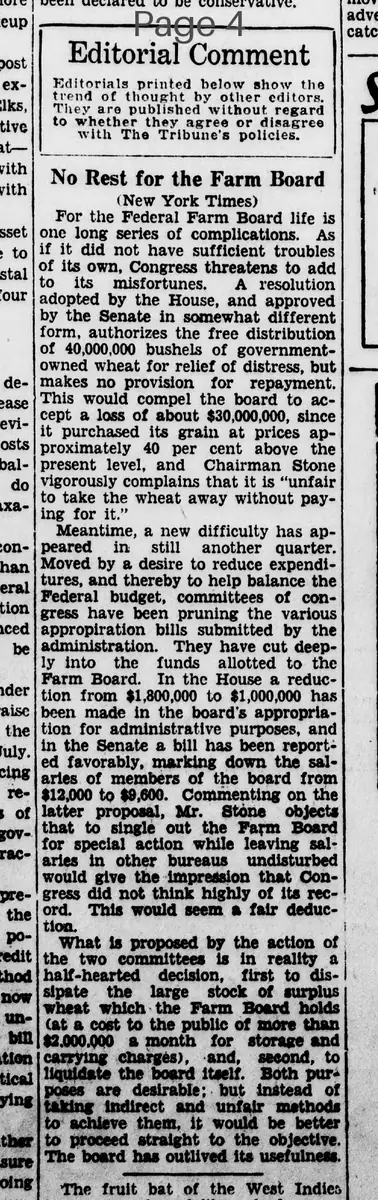
Editorial Comment
Editorials printed below show the trend of thought by other editors. They are published without regard to whether they agree or disagree with The Tribune's policies.
No Rest for the Farm Board
(New York Times)
For the Federal Farm Board life is one long series of complications. As if it did not have sufficient troubles of its own, Congress threatens to add to its misfortunes. A resolution adopted by the House, and approved by the Senate in somewhat different form, authorizes the free distribution of 40,000,000 bushels of government-owned wheat for relief of distress, but makes no provision for repayment. This would compel the board to accept a loss of about $30,000,000, since it purchased its grain at prices approximately 40 per cent above the present level, and Chairman Stone vigorously complains that it is "unfair to take the wheat away without paying for it."
Meantime, a new difficulty has appeared in still another quarter. Moved by a desire to reduce expenditures, and thereby to help balance the Federal budget, committees of congress have been pruning the various appropriation bills submitted by the administration. They have cut deeply into the funds allotted to the Farm Board. In the House a reduction from $1,800,000 to $1,000,000 has been made in the board's appropriation for administrative purposes, and in the Senate a bill has been reported favorably, marking down the salaries of members of the board from $12,000 to $9,600. Commenting on the latter proposal, Mr. Stone objects that to single out the Farm Board for special action while leaving salaries in other bureaus undisturbed would give the impression that Congress did not think highly of its record. This would seem a fair deduction.
What is proposed by the action of the two committees is in reality a half-hearted decision, first to dissipate the large stock of surplus wheat which the Farm Board holds (at a cost to the public of more than $200,000 a month for storage and carrying charges), and, second, to liquidate the board itself. Both purposes are desirable; but instead of taking indirect and unfair methods to achieve them, it would be better to proceed straight to the objective. The board has outlived its usefulness.
Editorials printed below show the trend of thought by other editors. They are published without regard to whether they agree or disagree with The Tribune's policies.
No Rest for the Farm Board
(New York Times)
For the Federal Farm Board life is one long series of complications. As if it did not have sufficient troubles of its own, Congress threatens to add to its misfortunes. A resolution adopted by the House, and approved by the Senate in somewhat different form, authorizes the free distribution of 40,000,000 bushels of government-owned wheat for relief of distress, but makes no provision for repayment. This would compel the board to accept a loss of about $30,000,000, since it purchased its grain at prices approximately 40 per cent above the present level, and Chairman Stone vigorously complains that it is "unfair to take the wheat away without paying for it."
Meantime, a new difficulty has appeared in still another quarter. Moved by a desire to reduce expenditures, and thereby to help balance the Federal budget, committees of congress have been pruning the various appropriation bills submitted by the administration. They have cut deeply into the funds allotted to the Farm Board. In the House a reduction from $1,800,000 to $1,000,000 has been made in the board's appropriation for administrative purposes, and in the Senate a bill has been reported favorably, marking down the salaries of members of the board from $12,000 to $9,600. Commenting on the latter proposal, Mr. Stone objects that to single out the Farm Board for special action while leaving salaries in other bureaus undisturbed would give the impression that Congress did not think highly of its record. This would seem a fair deduction.
What is proposed by the action of the two committees is in reality a half-hearted decision, first to dissipate the large stock of surplus wheat which the Farm Board holds (at a cost to the public of more than $200,000 a month for storage and carrying charges), and, second, to liquidate the board itself. Both purposes are desirable; but instead of taking indirect and unfair methods to achieve them, it would be better to proceed straight to the objective. The board has outlived its usefulness.
What sub-type of article is it?
Agriculture
Economic Policy
What keywords are associated?
Farm Board
Wheat Distribution
Congressional Cuts
Federal Budget
Agricultural Policy
What entities or persons were involved?
Federal Farm Board
Congress
Chairman Stone
New York Times
Editorial Details
Primary Topic
Criticism Of Congressional Actions On The Federal Farm Board
Stance / Tone
Critical Of Indirect And Unfair Methods To Dismantle The Board; Advocates Direct Liquidation
Key Figures
Federal Farm Board
Congress
Chairman Stone
New York Times
Key Arguments
Congress Authorizes Free Distribution Of 40,000,000 Bushels Of Government Wheat Without Repayment, Causing $30,000,000 Loss
Cuts To Farm Board's Administrative Appropriation From $1,800,000 To $1,000,000
Reduction In Board Members' Salaries From $12,000 To $9,600
Indirect Approach To Dissipating Surplus Wheat Stock And Liquidating The Board
Board Has Outlived Its Usefulness