Thank you for visiting SNEWPapers!
Sign up free
Story
April 27, 1855
The Bedford Gazette
Bedford, Bedford County, Pennsylvania
What is this article about?
Editorial from Pittsburgh Union critiques novel Massachusetts legislation allowing jurors to judge law and facts, and Know-Nothing party's intolerant, principle-lacking influence in Pennsylvania legislature, advocating for principled political voting to ensure policy coherence.
Clipping
OCR Quality
95%
Excellent
Full Text
From the Pittsburgh Union.
NOVEL LEGISLATION.
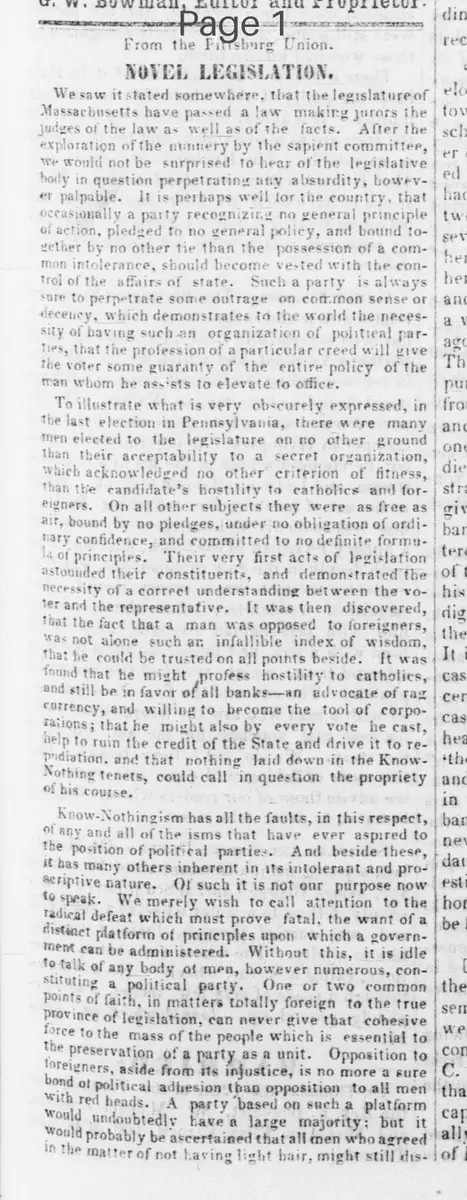
We saw it stated somewhere, that the legislature of Massachusetts have passed a law making jurors the judges of the law as well as of the facts. After the exploration of the nunnery by the sapient committee, we would not be surprised to hear of the legislative body in question perpetrating any absurdity, however palpable. It is perhaps well for the country, that occasionally a party recognizing no general principle of action, pledged to no general policy, and bound together by no other tie than the possession of a common intolerance, should become vested with the control of the affairs of state. Such a party is always sure to perpetrate some outrage on common sense or decency, which demonstrates to the world the necessity of having such an organization of political parties, that the profession of a particular creed will give the voter some guaranty of the entire policy of the man whom he assists to elevate to office.
To illustrate what is very obscurely expressed, in the last election in Pennsylvania, there were many men elected to the legislature on no other ground than their acceptability to a secret organization, which acknowledged no other criterion of fitness, than the candidate's hostility to Catholics and foreigners. On all other subjects they were as free as air, bound by no pledges, under no obligation of ordinary confidence, and committed to no definite formulæ of principles. Their very first acts of legislation astounded their constituents, and demonstrated the necessity of a correct understanding between the voter and the representative. It was then discovered, that the fact that a man was opposed to foreigners, was not alone such an infallible index of wisdom, that he could be trusted on all points beside. It was found that he might profess hostility to Catholics, and still be in favor of all banks—an advocate of rag currency, and willing to become the tool of corporations; that he might also by every vote he cast, help to ruin the credit of the State and drive it to repudiation, and that nothing laid down in the Know-Nothing tenets, could call in question the propriety of his course.
Know-Nothingism has all the faults, in this respect, of any and all of the isms that have ever aspired to the position of political parties. And beside these, it has many others inherent in its intolerant and proscriptive nature. Of such it is not our purpose now to speak. We merely wish to call attention to the radical defect which must prove fatal, the want of a distinct platform of principles upon which a government can be administered. Without this, it is idle to talk of any body of men, however numerous, constituting a political party. One or two common points of faith, in matters totally foreign to the true province of legislation, can never give that cohesive force to the mass of the people which is essential to the preservation of a party as a unit. Opposition to foreigners aside from its injustice is no more sure bond of political adhesion than opposition to all with red heads party based on such platform would undoubtedly have a large majority; but it would probably be ascertained that all men who agreed in the matter of not having light hair, might still disagree in questions of much more importance to the welfare of the country. The contest between the two celebrated parties of big and little Indians, is as fair a satire on some of the issues of the present day, as it was against those at which it was so fatally aimed. A single session of a Legislature composed of men who acknowledge no uniformity of political principle, and who are alike only on a point which gives no guide to the administration either of State or National affairs, exposes the weakness and barrenness of the organization, and we trust will bring the people back to the plain, common, old fashioned test, to know for what and for whom they are voting before they vote. No other system will suit our public.
NOVEL LEGISLATION.
We saw it stated somewhere, that the legislature of Massachusetts have passed a law making jurors the judges of the law as well as of the facts. After the exploration of the nunnery by the sapient committee, we would not be surprised to hear of the legislative body in question perpetrating any absurdity, however palpable. It is perhaps well for the country, that occasionally a party recognizing no general principle of action, pledged to no general policy, and bound together by no other tie than the possession of a common intolerance, should become vested with the control of the affairs of state. Such a party is always sure to perpetrate some outrage on common sense or decency, which demonstrates to the world the necessity of having such an organization of political parties, that the profession of a particular creed will give the voter some guaranty of the entire policy of the man whom he assists to elevate to office.
To illustrate what is very obscurely expressed, in the last election in Pennsylvania, there were many men elected to the legislature on no other ground than their acceptability to a secret organization, which acknowledged no other criterion of fitness, than the candidate's hostility to Catholics and foreigners. On all other subjects they were as free as air, bound by no pledges, under no obligation of ordinary confidence, and committed to no definite formulæ of principles. Their very first acts of legislation astounded their constituents, and demonstrated the necessity of a correct understanding between the voter and the representative. It was then discovered, that the fact that a man was opposed to foreigners, was not alone such an infallible index of wisdom, that he could be trusted on all points beside. It was found that he might profess hostility to Catholics, and still be in favor of all banks—an advocate of rag currency, and willing to become the tool of corporations; that he might also by every vote he cast, help to ruin the credit of the State and drive it to repudiation, and that nothing laid down in the Know-Nothing tenets, could call in question the propriety of his course.
Know-Nothingism has all the faults, in this respect, of any and all of the isms that have ever aspired to the position of political parties. And beside these, it has many others inherent in its intolerant and proscriptive nature. Of such it is not our purpose now to speak. We merely wish to call attention to the radical defect which must prove fatal, the want of a distinct platform of principles upon which a government can be administered. Without this, it is idle to talk of any body of men, however numerous, constituting a political party. One or two common points of faith, in matters totally foreign to the true province of legislation, can never give that cohesive force to the mass of the people which is essential to the preservation of a party as a unit. Opposition to foreigners aside from its injustice is no more sure bond of political adhesion than opposition to all with red heads party based on such platform would undoubtedly have a large majority; but it would probably be ascertained that all men who agreed in the matter of not having light hair, might still disagree in questions of much more importance to the welfare of the country. The contest between the two celebrated parties of big and little Indians, is as fair a satire on some of the issues of the present day, as it was against those at which it was so fatally aimed. A single session of a Legislature composed of men who acknowledge no uniformity of political principle, and who are alike only on a point which gives no guide to the administration either of State or National affairs, exposes the weakness and barrenness of the organization, and we trust will bring the people back to the plain, common, old fashioned test, to know for what and for whom they are voting before they vote. No other system will suit our public.
What sub-type of article is it?
Historical Event
Curiosity
What themes does it cover?
Deception
Justice
Social Manners
What keywords are associated?
Know Nothingism
Political Intolerance
Legislation
Catholics
Foreigners
Party Principles
Voter Guarantees
What entities or persons were involved?
Know Nothings
Where did it happen?
Massachusetts, Pennsylvania
Story Details
Key Persons
Know Nothings
Location
Massachusetts, Pennsylvania
Event Date
Last Election In Pennsylvania
Story Details
Critique of Massachusetts law empowering jurors and Know-Nothing legislators in Pennsylvania who, lacking principles beyond anti-Catholic and anti-foreigner bias, enact absurd policies favoring banks and risking state repudiation, highlighting need for principled parties.