Thank you for visiting SNEWPapers!
Sign up free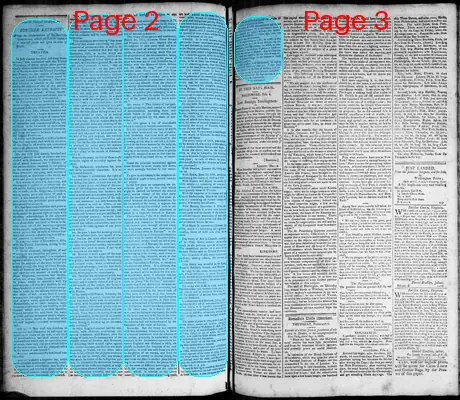
Alexandria Daily Advertiser
Alexandria, Virginia
What is this article about?
Historical examination of British treaties from 1667 to 1786 with United Provinces, Denmark, France, Spain, and others, affirming neutral rights to trade with enemies in non-contraband goods to all places except blockaded ones, including colonies, countering British doctrine on capturing such trade.
Merged-components note: These two components form a single continuous article excerpt from the National Intelligencer on the British doctrine regarding neutral trade and historical treaties, spanning across pages 2 and 3, as evidenced by the sequential reading order and thematic continuity in the text content.
Clippings
1 of 2
OCR Quality
Full Text
FURTHER EXTRACTS
From an examination of the British
Doctrine, which subjects to capture
a neutral trade not open in time of
peace.
TREATIES.
In July sixteen hundred and sixty seven
a treaty was concluded with the United
Provinces, of which article three provision-
ally adopts certain articles from the trea-
ty of Breda, between the United Provinces
and France, on the subject of maritime
commerce; until a fuller treaty could be
perfected between the parties. The arti-
cles adopted in relation to the trade be-
tween the subjects of one of the parties,
and the enemies of the other, declare that
the trade shall extend, without impedi-
ment, to all articles not contraband, and to
all places not besieged or blockaded.
In February sixteen hundred and sixty
seven-eight, the same parties then under a
perpetual defensive alliance by virtue of a
treaty of 21st July, sixteen hundred and
sixty seven, and in a league moreover with
Sweden by the triple league of sixteen hun-
dred and sixty eight, resumed the subject
of maritime and commercial affairs, and
repeated in the 1st article of their treaty,
the precise stipulations adopted provision-
ally from the treaties between France and
the United Provinces.
A treaty with Denmark in 1670, stipulates
that they may trade each with the enemies,
of the other in all articles not contraband
and to all places not blockaded, without a-
ny other exceptions.
On the 11th July sixteen hundred and
seventy, another treaty of alliance was con-
cluded with Denmark, the sixteenth arti-
cle of which declares that "Neither of
the parties shall be impeded in furnishing
to the enemies of the other any merchandises whatever, excepting only articles of
contraband, as described in the treaty, and
ports and places besieged by the other."
It is worthy of notice in this treaty, and
the remark is applicable to others that the
5th article having stipulated a right mutu-
ally to trade, in the kingdoms, provinces,
marts, towns, ports and rivers of each o-
ther, it was immediately provided in the
next article that, prohibited ports and colo-
nies should be excepted.
If it had been conceived that such ports or
colonies of enemies were not to be traded
with, under the general right to trade with
enemies, acknowledged in the sixteenth
article, it is manifest that they would have
been as carefully excepted in this as in the
other case, out of the meaning of general
terms equally comprehending them. This
treaty proves that as early as sixteen hun-
dred and seventy, colonies began to fall un-
der attention in making treaties.
In a marine treaty of December 1, 1674,
with the United Provinces, stating in the
preamble that it was
"To be observed throughout all and
every of the countries and ports of the
world by sea and land," it is stipulated
again in article 1, to be "lawful for all and
every the subjects of the most serene and
mighty prince, the king of Great Britain,
with all freedom and safety to sail, trade,
and exercise any manner of traffic in all
those kingdoms, countries, and estates,
which are or any time hereafter shall be
in peace, amity, or neutrality with his
said majesty; so that they shall not be any
ways hindered or molested in their naviga-
tion or trade, by the military forces nor by
the ships of war, or any kind of vessels
whatsoever, belonging either to the high
and mighty states general of the United
Netherlands, or to their subjects, upon
occasion or pretence of any hostility or dif-
ference which now is or shall hereafter
happen between the said lords the states
general, and any princes or people whatso-
ver, in peace, amity or neutrality with
his said majesty:" --and so reciprocally.
Art. II. "Nor shall this freedom of
navigation and commerce be infringed by
occasion or cause of any war, in any kind
of merchandizes, but shall extend to all
commodities which may be carried in time
of peace, those only excepted which follow
in the next article, and are comprehended
in the name of contraband."
Art. III. enumerates the articles of con-
traband
Art. IV. contains a negative list, which
with all other articles not expressly includ-
ed in the list of contraband, may be freely
transported and carried to places under the
obedience of enemies, except only towns or
places besieged, environed, or invested.
This recital has been made the more
minute, because it is necessary, in order
to understand the whole force of the ex-
planatory declaration between the parties
bearing the same date; a document so pe-
culiarly important in the present discussion,
that its contents will be recited with equal
exactness.
This document, after stating "that some
difficulty had arisen concerning the inter-
pretation of certain articles, as well in the
treaty marine concluded this first day of
December, 1674, as in that which was
concluded the 17th February, 1667--8 be-
tween his majesty of Great Britain on the
one part, and the states general; &c. on the
other part," proceeds to state, "that sir
William Temple &c. on one part, with
eight commissioners on the other, have de-
clared, and do by these presents declare,
that the true meaning and intention of the
said article is, and ought to be, that ships
and vessels belonging to the subjects of
either of the parties, can and might, from
the time that the said articles were con-
cluded, not only pass, traffic and trade,
from a neutral port or place, to a place
in enmity with the other party, or from a
place in enmity to a neutral place, but al-
so from a port or place in enmity to a port
or place in enmity with the other party,
whether the said places belong to one and
the same prince or state, or to several
princes or states, with whom the other
party is in war. And we declare this is the
true and genuine sense and meaning of the
said articles; pursuant whereunto we un-
derstand that the said articles are to be ob-
served and executed on all occasions, on
the part of his said majesty, and the said
states general, and their respective sub-
jects; yet so that this declaration shall not
be alleged by either party for matters
which happened before the conclusion of
the late peace in the month of February,
1674. A.
Prior to the peace, neither of them could
claim the rights of neutrality against the
other.
This declaratory stipulation has been
said to be peculiarly important. It is so
for several reasons.
1st. Because it determines the right of
the neutral party, so far as may depend on
the belligerent party, to trade not only be-
tween its own ports and those of the ene-
mies of the belligerent party, without any
exception of colonies, but between any
other neutral port and enemies ports, with-
out exception of colonial ports of the ene-
my; and moreover, not only between the
ports, colonial as well as others, of one
enemy and another enemy, but between
the different ports of the same enemy; and
consequently between one port and another
of the principal country; between these
and the ports of its colonies; between the
ports of one colony and another, and even
to carry on the coasting trade of any parti-
cular colony.
2d. Because it fixes the meaning not on-
ly of the articles in the two specified trea-
ties; but has the same effect on all other
stipulations by Great Britain expressed in
the same or equivalent terms; one or other
of which are used in most, if not in all
her treaties on this subject.
3d. Because it made a part of the trea-
ties explained, that free ships should make
free goods; and consequently, the coasting
and colonial trade, when combined with
that neutral advantage, was the less likely
to be acknowledged, if not considered as
clearly belonging to the neutral party.
4th. Because the explanatory article was
the result of the solicitation of England
herself, and she actually claimed and enjoy-
ed the benefit of the article, she being at
the time in peace, and the Dutch in war
with France.
In the treaty with France, February 24,
1677, article 1, 2, and 3, import that each
party may trade freely with the enemies of
the other, with the same merchandise as in
time of peace, contraband goods only ex-
cepted, and that all merchandises not con-
traband, "are free to be carried from any
port in neutrality, to the port of an enemy,
and from one port of an enemy to another:
towns besieged, blocked up or invested,
only excepted."
In 1689, England entered into the con-
vention with Holland, prohibiting ALL
neutral commerce with France, then the
enemy of both.--In consequence of the
counter treaty of Sweden and Denmark,
for defending their neutral rights against
this violent measure, satisfaction was made
according to Vattel, for the ships taken
from them; without the slightest evidence,
as far as can be traced, that any attempt
was made by either of the belligerent par-
ties, to introduce the distinction between
such part of the trade interrupted, as might
not have been allowed before the war, and
as was therefore unlawful, and such part
might not lawfully be subject to cap-
ture.
We are now arrived at the treaties of U-
trecht, an epoch so important in the history
of Europe, and so essentially influencing
the conventional law of nations, on the sub-
ject of neutral commerce.
The treaty of navigation and commerce,
March 31, 1713, between Great Britain
and France, article xvii. imports that all
the subjects of each party shall sail with
their ships with all manner of liberty & se-
curity, no distinction being made who are
the proprietors of the merchandizes laden,
thereon, from any port, to the places of
those who now are or shall hereafter be, of
enmity with the Queen of Great Britain
and the Christian king," and "to trade
with the same liberty and security from
the places, ports and havens of those who
are enemies of both or either party, with-
out any opposition or disturbance whatso-
ever, not only directly from the places of
the enemy aforementioned to neutral pla-
ces, but also from one place belonging to an
enemy, to another place belonging to an e-
nemy, whether they be under the jurisdic-
tion of the same prince or under seve-
ral."
Art. xvii. "This liberty of navigation
and commerce, shall extend to all kind
of merchandizes, excepting those only
which follow in the next article, and
which are specified by the name of con-
traband."
Art. xix. gives a list of contraband
which is limited to warlike instruments.
Art. xx. specifies others, many of which
are in other treaties on the list of contra-
band, declaring that these with all other
goods, not in the list of contraband in the
preceding article may be carried and trans-
ported in the freest manner by the subjects
of both confederates, even to places be-
longing to an enemy, such towns or places
being only excepted as are at that time be-
sieged, blocked up round about, or invest-
ed.
Could the principle maintained against
Great Britain be more clearly laid down,
or more strongly fortified by her sanction?
To give to this example the complete ef-
fect which it ought to have, several remarks
are proper.
In the first place on comparing the de-
scription given by the free trade which
might be carried on between the neutral
party, and an enemy of the other party
with the description of the free trade al-
lowed between the parties themselves, by
the 1st article of the treaty, it appears that
in order to except the colonial trade in the
latter case, the freedom stipulated in
article I. is expressly limited to Europe.
The terms are, "that there shall be a re-
ciprocal and entirely perfect liberty of na-
vigation and commerce between the sub-
jects on each part, through all and every
the kingdoms, states, and dominions of
their royal majesties in Europe." In the
stipulation relating to the neutral commerce
of either with the enemy of the other (who,
if a maritime enemy, could not fail to pos-
possess colonies out of Europe) the terms are,
"that all merchandizes, not contraband,
may be carried in the freest manner to pla-
ces belonging to an enemy, such towns or
places only being excepted, as are at that
time besieged, or blockaded, &c," with-
out any limitation to Europe, or exception
of colonies any where. It is obvious, that
the terms here used comprehend all colo-
nies, as much as the terms in the first arti-
cle would have done, if colonies had not
been excepted by limiting the freedom of
trade to places "in Europe;" and conse-
quently that if any distinction between the
colonial and other places of an enemy, had
been contemplated in the neutral trade of
either party with him, as it was contem-
plated between the colonies and European
possessions of the parties, in their com-
merce to be carried on between themselves,
the distinction would have been expressed
in the latter case, as it was in the for-
mer; and not being so expressed, the trade
in the latter case was to be free to the colo-
nies, as would have been in the former, if
the colonies had not been excepted by the
limitation of the trade of Europe.
Secondly. But the treaty not content
with this necessary construction, in favor
of a neutral commerce with the colonies of
an enemy, proceeds, in conformity to the
example in the declaratory convention be-
tween England and Holland in 1674, ex-
plicitly to declare the freedom of the neu-
tral party, to trade not only from any port,
to the places of an enemy, and from the
places of an enemy to neutral places, but
also from one place to another place belong-
ing to an enemy, whether the places be un-
der the same or different sovereigns. Here
both the coasting trade and the colonial
trade, which, in relation to the parent
country, is in the nature of a coasting trade
are both placed on the same footing with
every other branch of commerce, neutral
and belligerent parties although it must
have branches have been generally and
well if known opened to foreigners in all would
be opened in time of war, and for the most
part, on account of the war.
Thirdly. It is well known, that this
particular treaty underwent great opposi-
tion and discussion, both without and with-
in the British parliament; and that it was
for some time under a legislative negative.
Yet it does not appear, either from the pub-
lic debates, or from the discussions of the
press, as far as there has been an oppor-
tunity of consulting them, that the difficulty
arose in the least from this part of the trea-
ty. The contest seems to have turned
wholly on other parts, and
the regulations of the immediate commerce
principally on
between the two nations. This part of the
treaty may be considered, therefore, as
having received the complete sanction of
Great Britain. Had it indeed been other-
wise, the repeated sanctions given to it on
subsequent occasions, would preclude her
from making the least use of any repug-
nance shewn to it on this.
On the 28th November, 1713, a treaty
of peace and another of commerce and na-
vigation, were concluded at Utrecht with
Spain, renewing and inserting the treaty
of May 13th, 1667, the 21st and 26th ar-
ticles of, which have been seen to coincide
with the rules of neutral commerce, estab-
lisbed by the treaty of Utrecht, between
Great Britain and France.
Genoa and Venice were comprehended
in the treaty of Utrecht, between Great
Britain and Spain.
The above treaty of 1713, was confirm-
ed by article 12, of a treaty of December 3,
1715, between Great Britain and Spain.
From the above date to the treaty of
1748, at Aix la Chapelle, the following
treaties between England and other powers
took place; in each of which, the princi-
ples established by her treaties at Utrecht
are reiterated:
With Sweden, January 21, 1720, arti-
cle 18.
With Spain, June 13, 1721, article 2-
confirming the treaty of 1667 and 1713.
With France and Spain, November 9,
1729, article 1: renewing all treaties of
peace, of friendship and of commerce, and
consequently those of Utrecht.
With the emperor of Germany and the
United Netherlands, March 16, 1731, ar-
ticle 1; renewing all former treaties of
peace, friendship and alliance.
With Russia, December 2, 1734; stipu-
lating in article 2, a free trade between
either party and the enemy of the other, in
all articles except munitions of war; and
consequently articles permitted after, tho
not permitted before the war.
With Spain (a convention) January 14,
1739, article 1; reiterating among former
treaties, those of 1667 and 1713, above
cited.
The treaty of Aix la Chapelle, conclud-
ed in 1748, forms another memorable
epoch in the political system of Europe.
The immediate parties to it were Great
Britain, France and the United Provinces.
The 3d article of this treaty renews and
confirms, among others, the treaties of
Utrecht.
This treaty was acceded to by Spain,
Austria, Sardinia, Genoa, and Modena.
In 1763, in the treaty between Great Bri-
tain, France and Spain, to which Portugal ac-
ceded, the first article expressly renews and con-
firms, among other treaties, the treaties of peace
and commerce at Utrecht.
The treaty with Russia in 1766, article ten
tstipulates a free trade between either party, be-
ing neutral, and an enemy of the other, with
the sole exception of military stores, and places
actually blockaded.
explanatory of a list of contraband settled in
In a convention with Denmark, July 4, 1780,
former treaty, it is expressly determined that
merchandise not contraband, may be transported
to places in possession of enemies, without any
other exception than those besieged or block-
aded.
article eleven, renews and confirms, among o-
The treaty of peace in 1783 with France, by
others, the treaties of Westphalia in 1648, of U-
trecht in 1713, of Aix la Chapelle in 1748, and
of Paris, 1763; in all of which the neutral
right, now denied by Great Britain, was formal-
ly sanctioned by her stipulations.
the same confirmation is repeated.
In her treaty of the same date, with Spain
article eighteen of the treaty of 1670,
in 1786, deliberately undertaken in pursuance of
In the treaty of commerce again with France,
are inserted word for word; and thus received
recited from the treaty
anew the most deliberate and formal sanction.
Chalm. vol. 1, p. 350.
in Great Britain it does not appear that the op
this treaty underwent the most violent opposition
It may be here again remarked, that although
The intention was at all directed against the articles on account of disputation, on either side, in several particulars, by a convention bearing the subject of neutral commerce, date August 31, 1787; without any appearance. The treaty of 1786 was explained and altered heretofore usual in the articles of peace, a confirmation proposed on the part of Great Britain, by her articles on neutral commerce, &c. which was opposed by the French negotiation of the treaties of Utrecht, Aix la Chapelle, ambassador, lord Malmesbury, to insert, as here. In the negotiations at Lisle, in 1797, it was tors, for reasons foreign to the articles of those treaties in question. On this occasion, lord Malmesbury, in urging the proposed insertion, observed, "that those memorials had become the law of nations, and that this fact is attested by the negotiations, as published by the British government, if their insertion was omitted it might produce confusion." (To be continued.)
What sub-type of article is it?
What keywords are associated?
What entities or persons were involved?
Where did it happen?
Foreign News Details
Primary Location
Europe
Event Date
1667 1787
Key Persons
Outcome
treaties affirm neutral rights to trade with enemies in non-contraband goods to all places except blockaded or besieged, including colonies; no distinction for colonial trade in neutral commerce; repeated confirmations in subsequent treaties.
Event Details
Extract from examination of British doctrine on neutral trade, detailing treaties from 1667 with United Provinces adopting Breda articles on maritime commerce, allowing trade to enemies except contraband and blockaded places; 1670-1674 treaties with Denmark and United Provinces reiterating freedoms; 1674 explanatory declaration clarifying trade between enemy ports including colonies; 1677 treaty with France; 1713 Utrecht treaties with France and Spain extending liberties without colonial exceptions; subsequent renewals through 1786 confirming these principles.