Thank you for visiting SNEWPapers!
Sign up free
Story
August 2, 1945
Buckeye Valley News And Buckeye Review
Buckeye, Maricopa County, Arizona
What is this article about?
Article describes the discovery of penicillin by Alexander Fleming in 1929 and its value proven in 1940 by Oxford scientists amid WWII efforts. Details the cumbersome production process from mold culture to extracting the scarce yellow-brown powder.
Clipping
OCR Quality
98%
Excellent
Full Text
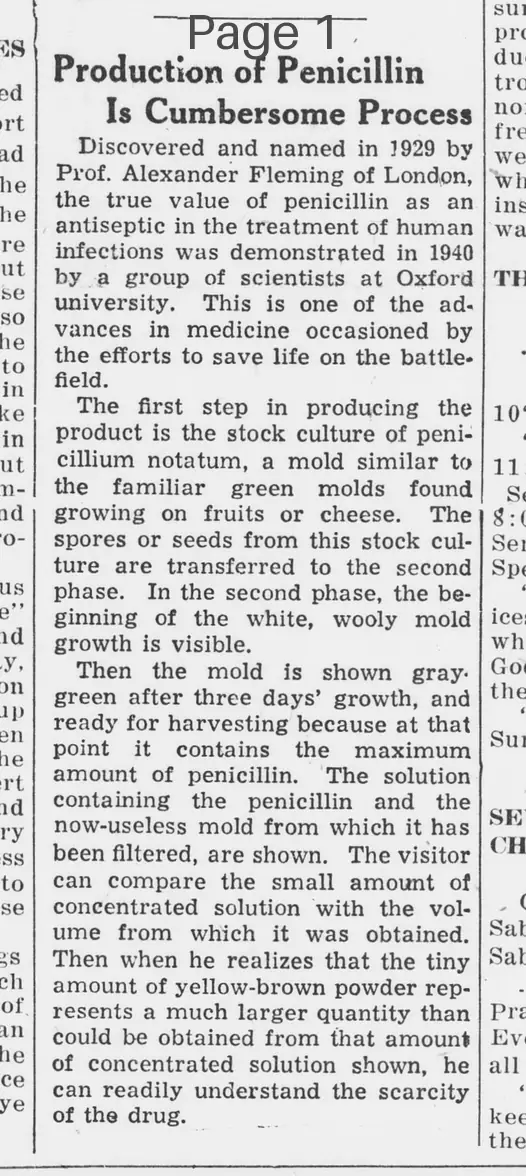
Production of Penicillin Is Cumbersome Process
Discovered and named in 1929 by Prof. Alexander Fleming of London, the true value of penicillin as an antiseptic in the treatment of human infections was demonstrated in 1940 by a group of scientists at Oxford university. This is one of the advances in medicine occasioned by the efforts to save life on the battle field.
The first step in producing the product is the stock culture of penicillium notatum, a mold similar to the familiar green molds found growing on fruits or cheese. The spores or seeds from this stock culture are transferred to the second phase. In the second phase, the beginning of the white, wooly mold growth is visible. Then the mold is shown gray green after three days' growth, and ready for harvesting because at that point it contains the maximum amount of penicillin.
The solution containing the penicillin and the now-useless mold from which it has been filtered, are shown. The visitor can compare the small amount of concentrated solution with the volume from which it was obtained.
Then when he realizes that the tiny amount of yellow-brown powder represents a much larger quantity than could be obtained from that amount of concentrated solution shown, he can readily understand the scarcity of the drug.
Discovered and named in 1929 by Prof. Alexander Fleming of London, the true value of penicillin as an antiseptic in the treatment of human infections was demonstrated in 1940 by a group of scientists at Oxford university. This is one of the advances in medicine occasioned by the efforts to save life on the battle field.
The first step in producing the product is the stock culture of penicillium notatum, a mold similar to the familiar green molds found growing on fruits or cheese. The spores or seeds from this stock culture are transferred to the second phase. In the second phase, the beginning of the white, wooly mold growth is visible. Then the mold is shown gray green after three days' growth, and ready for harvesting because at that point it contains the maximum amount of penicillin.
The solution containing the penicillin and the now-useless mold from which it has been filtered, are shown. The visitor can compare the small amount of concentrated solution with the volume from which it was obtained.
Then when he realizes that the tiny amount of yellow-brown powder represents a much larger quantity than could be obtained from that amount of concentrated solution shown, he can readily understand the scarcity of the drug.
What sub-type of article is it?
Historical Event
Medical Curiosity
What themes does it cover?
Recovery
Triumph
What keywords are associated?
Penicillin Production
Alexander Fleming
Mold Culture
Medical Advance
Wartime Medicine
Drug Scarcity
What entities or persons were involved?
Prof. Alexander Fleming
Group Of Scientists At Oxford University
Where did it happen?
London, Oxford University
Story Details
Key Persons
Prof. Alexander Fleming
Group Of Scientists At Oxford University
Location
London, Oxford University
Event Date
1929, 1940
Story Details
Penicillin discovered by Fleming in 1929; value shown in 1940 by Oxford scientists for battlefield medicine. Production involves culturing penicillium notatum mold, harvesting after three days, filtering to solution, then concentrating to yellow-brown powder, explaining its scarcity.