Thank you for visiting SNEWPapers!
Sign up free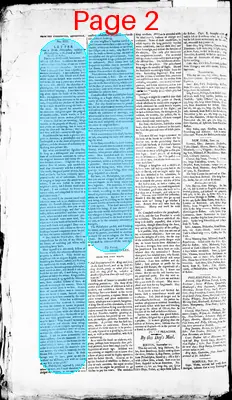
Literary
December 3, 1801
Alexandria Advertiser And Commercial Intelligencer
Alexandria, Virginia
What is this article about?
A Hindu philosopher in Philadelphia writes to his friend El Hassan in Delhi, recounting a conversation with a local thinker who praises republicanism but laments civilized society's restrictions on natural liberty, property laws, and marriage. The narrator defends established laws and social institutions.
Clipping
OCR Quality
95%
Excellent
Full Text
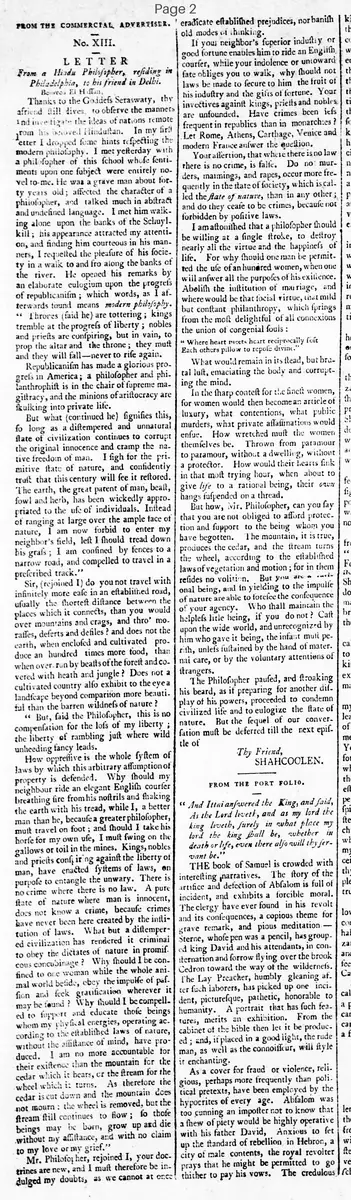
No. XIII.
LETTER
From a Hindu Philosopher, residing in Philadelphia, to his friend in Delhi.
Beloved El Hassan,
Thanks to the Goddess Seraswaty, thy friend still lives, to observe the manners and investigate the ideas of nations remote from his beloved Hindustan. In my first letter I dropped some hints respecting the modern philosophy. I met yesterday with a philosopher of this school whose sentiments upon one subject were entirely novel to me. He was a grave man about forty years old; affected the character of a philosopher, and talked much in abstract and undefined language. I met him walking alone upon the banks of the Schuylkill; his appearance attracted my attention, and finding him courteous in his manners, I requested the pleasure of his society in a walk to and fro along the banks of the river. He opened his remarks by an elaborate eulogium upon the progress of republicanism; which words, as I afterwards found, means modern philosophy.
"Thrones (said he) are tottering; kings tremble at the progress of liberty; nobles and priests are conspiring, but in vain, to prop the altar and the throne; they must and they will fall—never to rise again. Republicanism has made a glorious progress in America; a philosopher and philanthropist is in the chair of supreme magistracy, and the minions of aristocracy are skulking into private life. But what (continued he) signifies this, so long as a distempered and unnatural state of civilization continues to corrupt the original innocence and cramp the native freedom of man. I sigh for the primitive state of nature, and confidently trust that this century will see it restored. The earth, the great parent of man, beast, fowl and herb, has been wickedly appropriated to the use of individuals. Instead of ranging at large over the ample face of nature, I am now forbid to enter my neighbor's field, lest I should tread down his grass; I am confined by fences to a narrow road, and compelled to travel in a prescribed track."
Sir, (rejoined I) do you not travel with infinitely more ease in an established road, than you would usually the shortest distance between the places which it connects, over mountains and crags, and thro' morasses, deserts and defiles? and does not the earth, when enclosed and cultivated produce an hundred times more food, than when over-run by beasts of the forest and covered with heath and jungle? Does not a cultivated country also exhibit to the eye a landscape beyond comparison more beautiful than the barren wilderness of nature?
"But, said the Philosopher, this is no compensation for the loss of my liberty: the liberty of rambling just where wild unheeding fancy leads. How oppressive is the whole system of laws by which this arbitrary assumption of property is defended. Why should my neighbour ride an elegant English courser breathing fire from his nostrils and shaking the earth with his tread, while I, a better man than he, because a greater philosopher, must travel on foot; and should I take his horse for my own use, I must swing on the gallows or toil in the mines. Kings, nobles and priests conspiring against the liberty of man, have enacted systems of laws, on no crime where there is no law. A pure purpose to entangle the unwary. There is a state of nature where man is innocent, does not know a crime, because crimes have never been here created by the institution of laws. What but a distempered civilization has rendered it criminal to obey the dictates of nature in promiscuous concubinage? Why should I be confined to one woman while the whole animal world beside, obey the impulse of passion and seek gratification wherever it may be found? Why should I be compelled to support and educate those beings whom my physical energies, operating according to the established laws of nature, have produced. I am no more accountable for their existence than the mountain for the cedar which it bears, or the stream for the wheel which it turns. As therefore the cedar is cut down and the mountain does not mourn: the wheel is removed, but the stream still continues to flow: so those beings may be born, grow up and die without my assistance, and with no claim to my love or my grief."
Mr. Philosopher, rejoined I, your doctrines are new, and I must therefore be indulged my doubts, as we cannot at once eradicate established prejudices, nor banish old modes of thinking. If your neighbor's superior industry or good fortune enables him to ride an English courser, while your indolence or untoward fate obliges you to walk, why should not laws be made to secure to him the fruit of his industry and the gifts of fortune. Your invectives against kings, priests and nobles are unfounded. Have crimes been less frequent in republics than in monarchies? Let Rome, Athens, Carthage, Venice and modern France answer the question. Your assertion, that where there is no law there is no crime, is false. Do not murders, maimings, and rapes, occur more frequently in the state of society, which is called the state of nature, than in any other; and do they cease to be crimes, because not forbidden by positive laws. I am astonished that a philosopher should be willing at a single stroke, to destroy nearly all the virtue and the happiness of life. For why should one man be permitted the use of an hundred women, when one will answer all the purposes of his existence. Abolish the institution of marriage, and where would be that social virtue, that mild but constant philanthropy, which springs from the most delightful of all connexions the union of congenial souls:
"Where heart meets heart reciprocally soft Each others pillow to repose divine."
What would remain in its stead, but brutal lust, emaciating the body and corrupting the mind. In the sharp contest for the finest women, for women would then become an article of luxury, what contentions, what public murders, what private assassinations would ensue. How wretched must the women themselves be. Thrown from paramour to paramour, without a dwelling, without a protector. How would their hearts sink in that most trying hour, when about to give life to a rational being, their own hangs suspended on a thread. But how, Mr. Philosopher, can you say that you are not obliged to afford protection and support to the being whom you have begotten. The mountain, it is true, produces the cedar, and the stream turns the wheel, according to the established laws of vegetation and motion: for in them resides no volition. But you are a rational being, and in yielding to the impulse of nature are able to foresee the consequence of your agency. Who shall maintain the helpless little being, if you do not? Cast upon the wide world, and unrecognized by him who gave it being, the infant must perish, unless sustained by the hand of maternal care, or by the voluntary attentions of strangers. The Philosopher paused, and stroking his beard, as if preparing for another display of his powers, proceeded to condemn civilized life and to eulogize the state of nature. But the sequel of our conversation must be deferred till the next epistle of
Thy Friend,
SHAHCOOLEN.
LETTER
From a Hindu Philosopher, residing in Philadelphia, to his friend in Delhi.
Beloved El Hassan,
Thanks to the Goddess Seraswaty, thy friend still lives, to observe the manners and investigate the ideas of nations remote from his beloved Hindustan. In my first letter I dropped some hints respecting the modern philosophy. I met yesterday with a philosopher of this school whose sentiments upon one subject were entirely novel to me. He was a grave man about forty years old; affected the character of a philosopher, and talked much in abstract and undefined language. I met him walking alone upon the banks of the Schuylkill; his appearance attracted my attention, and finding him courteous in his manners, I requested the pleasure of his society in a walk to and fro along the banks of the river. He opened his remarks by an elaborate eulogium upon the progress of republicanism; which words, as I afterwards found, means modern philosophy.
"Thrones (said he) are tottering; kings tremble at the progress of liberty; nobles and priests are conspiring, but in vain, to prop the altar and the throne; they must and they will fall—never to rise again. Republicanism has made a glorious progress in America; a philosopher and philanthropist is in the chair of supreme magistracy, and the minions of aristocracy are skulking into private life. But what (continued he) signifies this, so long as a distempered and unnatural state of civilization continues to corrupt the original innocence and cramp the native freedom of man. I sigh for the primitive state of nature, and confidently trust that this century will see it restored. The earth, the great parent of man, beast, fowl and herb, has been wickedly appropriated to the use of individuals. Instead of ranging at large over the ample face of nature, I am now forbid to enter my neighbor's field, lest I should tread down his grass; I am confined by fences to a narrow road, and compelled to travel in a prescribed track."
Sir, (rejoined I) do you not travel with infinitely more ease in an established road, than you would usually the shortest distance between the places which it connects, over mountains and crags, and thro' morasses, deserts and defiles? and does not the earth, when enclosed and cultivated produce an hundred times more food, than when over-run by beasts of the forest and covered with heath and jungle? Does not a cultivated country also exhibit to the eye a landscape beyond comparison more beautiful than the barren wilderness of nature?
"But, said the Philosopher, this is no compensation for the loss of my liberty: the liberty of rambling just where wild unheeding fancy leads. How oppressive is the whole system of laws by which this arbitrary assumption of property is defended. Why should my neighbour ride an elegant English courser breathing fire from his nostrils and shaking the earth with his tread, while I, a better man than he, because a greater philosopher, must travel on foot; and should I take his horse for my own use, I must swing on the gallows or toil in the mines. Kings, nobles and priests conspiring against the liberty of man, have enacted systems of laws, on no crime where there is no law. A pure purpose to entangle the unwary. There is a state of nature where man is innocent, does not know a crime, because crimes have never been here created by the institution of laws. What but a distempered civilization has rendered it criminal to obey the dictates of nature in promiscuous concubinage? Why should I be confined to one woman while the whole animal world beside, obey the impulse of passion and seek gratification wherever it may be found? Why should I be compelled to support and educate those beings whom my physical energies, operating according to the established laws of nature, have produced. I am no more accountable for their existence than the mountain for the cedar which it bears, or the stream for the wheel which it turns. As therefore the cedar is cut down and the mountain does not mourn: the wheel is removed, but the stream still continues to flow: so those beings may be born, grow up and die without my assistance, and with no claim to my love or my grief."
Mr. Philosopher, rejoined I, your doctrines are new, and I must therefore be indulged my doubts, as we cannot at once eradicate established prejudices, nor banish old modes of thinking. If your neighbor's superior industry or good fortune enables him to ride an English courser, while your indolence or untoward fate obliges you to walk, why should not laws be made to secure to him the fruit of his industry and the gifts of fortune. Your invectives against kings, priests and nobles are unfounded. Have crimes been less frequent in republics than in monarchies? Let Rome, Athens, Carthage, Venice and modern France answer the question. Your assertion, that where there is no law there is no crime, is false. Do not murders, maimings, and rapes, occur more frequently in the state of society, which is called the state of nature, than in any other; and do they cease to be crimes, because not forbidden by positive laws. I am astonished that a philosopher should be willing at a single stroke, to destroy nearly all the virtue and the happiness of life. For why should one man be permitted the use of an hundred women, when one will answer all the purposes of his existence. Abolish the institution of marriage, and where would be that social virtue, that mild but constant philanthropy, which springs from the most delightful of all connexions the union of congenial souls:
"Where heart meets heart reciprocally soft Each others pillow to repose divine."
What would remain in its stead, but brutal lust, emaciating the body and corrupting the mind. In the sharp contest for the finest women, for women would then become an article of luxury, what contentions, what public murders, what private assassinations would ensue. How wretched must the women themselves be. Thrown from paramour to paramour, without a dwelling, without a protector. How would their hearts sink in that most trying hour, when about to give life to a rational being, their own hangs suspended on a thread. But how, Mr. Philosopher, can you say that you are not obliged to afford protection and support to the being whom you have begotten. The mountain, it is true, produces the cedar, and the stream turns the wheel, according to the established laws of vegetation and motion: for in them resides no volition. But you are a rational being, and in yielding to the impulse of nature are able to foresee the consequence of your agency. Who shall maintain the helpless little being, if you do not? Cast upon the wide world, and unrecognized by him who gave it being, the infant must perish, unless sustained by the hand of maternal care, or by the voluntary attentions of strangers. The Philosopher paused, and stroking his beard, as if preparing for another display of his powers, proceeded to condemn civilized life and to eulogize the state of nature. But the sequel of our conversation must be deferred till the next epistle of
Thy Friend,
SHAHCOOLEN.
What sub-type of article is it?
Epistolary
Dialogue
Essay
What themes does it cover?
Liberty Freedom
Political
Moral Virtue
What keywords are associated?
Republicanism
State Of Nature
Property Laws
Marriage Institution
Civilization Critique
Philosophical Dialogue
Liberty Progress
What entities or persons were involved?
Shahcoolen
Literary Details
Title
Letter From A Hindu Philosopher, Residing In Philadelphia, To His Friend In Delhi.
Author
Shahcoolen
Subject
Conversation On Modern Philosophy And The State Of Nature
Form / Style
Epistolary Philosophical Dialogue
Key Lines
Thrones (Said He) Are Tottering; Kings Tremble At The Progress Of Liberty; Nobles And Priests Are Conspiring, But In Vain, To Prop The Altar And The Throne; They Must And They Will Fall—Never To Rise Again.
I Sigh For The Primitive State Of Nature, And Confidently Trust That This Century Will See It Restored.
What But A Distempered Civilization Has Rendered It Criminal To Obey The Dictates Of Nature In Promiscuous Concubinage?
"Where Heart Meets Heart Reciprocally Soft Each Others Pillow To Repose Divine."