Thank you for visiting SNEWPapers!
Sign up free
Editorial
July 21, 1809
Virginia Argus
Richmond, Virginia
What is this article about?
This editorial critiques errors in newspaper statistics on European populations, revenues, and militaries, particularly Austria and Spain amid wars, arguing they mislead US public opinion and policy. It traces statistics' history, questions reliability of sources, and urges skepticism toward unproven claims.
Clipping
OCR Quality
95%
Excellent
Full Text
STATISTICS.
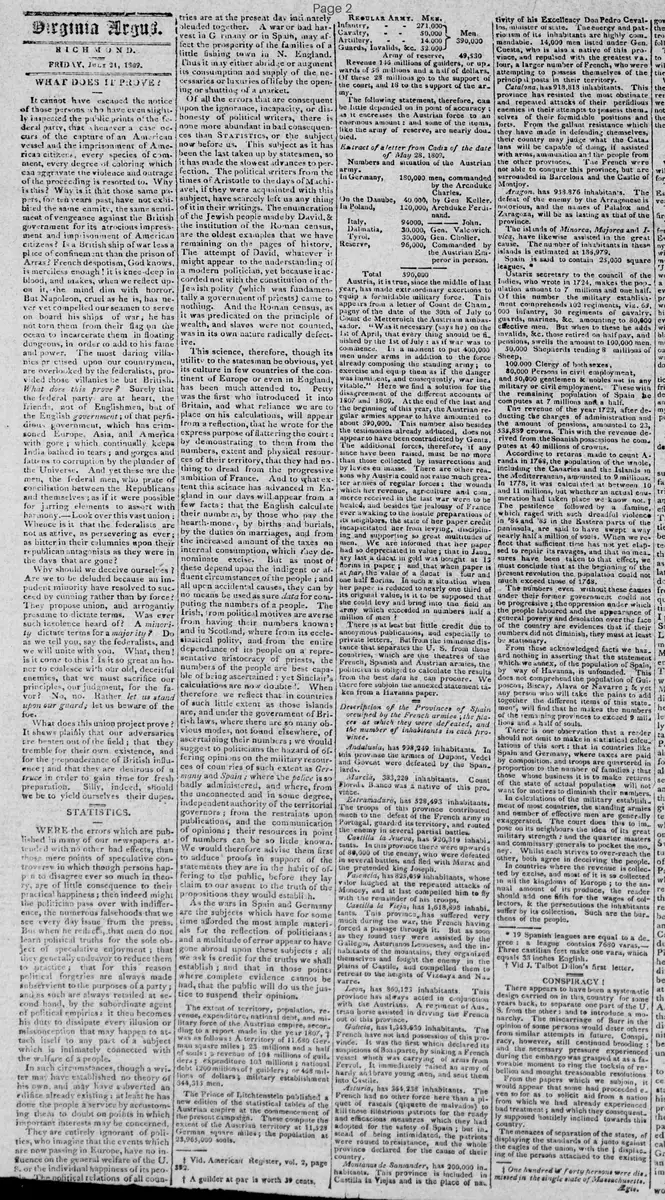
WERE the errors which are published in many of our newspapers attended with no other bad effects, than those mere points of speculative controversy in which though persons happen to disagree ever so much in theory, are of little consequence to their practical happiness; then indeed might the politician pass over with indifference, the numerous falsehoods that we see every day issue from the press. But when he reflects, that men do not learn political truths for the sole object of speculative enjoyment; that they generally endeavor to reduce them to practice; that for this reason political forgeries are always made subservient to the purposes of a party; and as such are always retailed at second hand, by the subordinate agents of political empirics: it then becomes his duty to dissipate every illusion or misconception that may happen to attach itself to any part of a subject which is intimately connected with the welfare of a people. In such circumstances, though a writer may have established no theory of his own, and may have subverted an edifice already existing: at least he has done the people a service by accustoming them to doubt on points in which important interests may be concerned. They are entirely ignorant of politics, who imagine that the events which are now passing in Europe, have no influence on the general welfare of the U. S. or the individual happiness of its people. The political relations of all countries are at the present day intimately included together. A war or bad harvest in Germany or in Spain, may affect the prosperity of the families of a little fishing town in N. England. Thus it may either abridge or augment its consumption and supply of the necessaries or luxuries of life by the opening or shutting of a market. Of all the errors that are consequent upon the ignorance, incapacity, or dishonesty of political writers, there is none more abundant in bad consequences than Statistics, or the subject now before us. This subject as it has been the last taken up by statesmen, so it has made the slowest advances to perfection. The political writers from the times of Aristotle to the days of Machiavelli, if they were acquainted with this subject, have scarcely left us any thing of it in their writings. The enumeration of the Jewish people made by David, & the institution of the Roman census, are the oldest examples that we have remaining on the pages of history. The attempt of David, whatever it might appear to the understanding of a modern politician, yet because it accorded not with the constitution of the Jewish polity (which was fundamentally a government of priests) came to nothing. And the Roman census, as it was predicated on the principle of wealth, and slaves were not counted, was in its own nature radically defective. This science, therefore, though its utility to the statesman be obvious, yet its culture in few countries of the continent of Europe or even in England, has been much attended to. Petty was the first who introduced it into Britain, and what reliance we are to place on his calculations, will appear from a reflection, that he wrote for the express purpose of flattering the court: by demonstrating to them from the numbers, extent and physical resources of their territory, that they had nothing to dread from the progressive ambition of France. And to what extent this science has advanced in England in our days will appear from a few facts: that the English calculate their numbers, by those who pay the hearth-money, by births and burials, by the duties on marriages, and from the increased amount of the taxes on internal consumption, which they denominate excise. But as most of these depend upon the indigent or affluent circumstances of the people; and all upon accidental causes, they can by no means be used as sure data for computing the numbers of a people. The Irish, from political motives are averse from having their numbers known: and in Scotland, where from its ecclesiastical policy, and from the entire dependance of its people on a representative aristocracy of priests, the numbers of the people are best capable of being ascertained: yet Sinclair's calculations are now doubted. When therefore we reflect that in countries of such little extent as those islands are, and under the government of British laws, where there are so many obvious modes, not found elsewhere, of ascertaining their numbers; we would suggest to politicians the hazard of offering opinions on the military resources of countries of such extent as Germany and Spain; where the police is so badly administered, and where, from the unconnected and in some degree, independent authority of the territorial governors; from the restraints upon publications, and the communication of opinions; their resources in point of numbers can be so little known. We would therefore advise them first to adduce proofs in support of the statements they are in the habit of offering to the public, before they lay claim to our assent to the truth of the propositions they would establish. As the wars in Spain and Germany are the subjects which have for some time afforded the most ample materials for the reflection of politicians: and a multitude of error appear to have gone abroad upon these subjects: all we ask is credit for the truths we shall establish: and that in those points where complete evidence cannot be had, that the public will do us the justice to suspend their opinion. The extent of territory, population, revenue, expenditure, national debt, and military force of the Austrian empire, according to a report made in the year 1807, was as follows: A territory of 11,680 German square miles; 23 millions and a half of souls: a revenue of 104 millions of guilders; expenditure 103 millions; national debt 1200 millions of guilders; or 468 millions of dollars; military establishment 344,315 men. The Prince of Liechtenstein published a new edition of the statistical tables of the Austrian empire at the commencement of the present campaign. These compute the extent of the Austrian territory at 11,528 German square miles; the population at 23,965,000 souls. Vid. American Register, vol. 2, page 392. * A guilder at par is worth 39 cents.
REGULAR ARMY.
MEN.
Infantry, 271,000
Cavalry, 50,000
Men.
Artillery, 14,000
390,000
Guards, Invalids, &c. 52,000.
Army of reserve, 49,530
Revenue 146 millions of guilders, or upwards of 56 millions and a half of dollars. Of these 28 millions go to the support of the court, and 18 to the support of the army. The following statement, therefore, can be little depended on in point of accuracy: as it increases the Austrian force to an enormous amount: and some of the items, like the army of reserve, are nearly doubled. Extract of a letter from Cadiz of the date of May 28, 1809. Numbers and situation of the Austrian army. In Germany, 180,000 men, commanded by the Archduke Charles. On the Danube, 40,000, by Gen. Keller. In Poland, 120,000, Archduke Ferdinand. Italy, 94,000, John. Dalmatia, 30,000, Gen. Valeovich. Tyrol, 30,000, Gen. Choller. Reserve, 96,000, Commanded by the Austrian Emperor in person. Total 590,000. Austria, it is true, since the middle of last year, has made extraordinary exertions to equip a formidable military force. This appears from a letter of Count de Champagny of the date of the 30th of July to Count de Metternich the Austrian ambassador. "Was it necessary (says he) on the 1st of April, that every thing should be finished by the 1st of July: as if war was to commence. In a moment to put 400,000 men under arms in addition to the force already composing the standing army; to exercise and equip them as if the danger was imminent, and consequently, war inevitable." Here we find a solution for the disagreement of the different accounts of 1807 and 1809. At the end of the last and the beginning of this year, the Austrian regular armies appear to have amounted to about 390,000. This number also besides the testimonies already adduced, does not appear to have been contradicted by Gentz. The additional forces, therefore, if any since have been raised, must be no more than those collected by insurrections and by levies en masse. There are other reasons why Austria could not raise much greater armies of regular forces: the wounds which her revenue, agriculture and commerce received in the last war were to be healed, and besides the jealousy of France ever awaking to the hostile preparations of its neighbors, the state of her paper credit incapacitated her from levying, disciplining and supporting so great multitudes of men. We are informed that her paper had so depreciated in value; that in January last a ducat in gold was bought at 13 florins in paper; and that when paper is at par, the value of a ducat is four and one half florins. In such a situation when her paper is reduced to nearly one third of its original value, is it to be supposed that she could levy and bring into the field an army which exceeded in numbers half a million of men? There is at best but little credit due to anonymous publications, and especially to private letters. But from the immense distance that separates the U. S. from those countries, which are the theatres of the French, Spanish and Austrian armies, the politician is obliged to calculate the results from the best data he can procure. We therefore subjoin the annexed statement taken from a Havanna paper. Description of the Provinces of Spain occupied by the French armies; the places at which they were defeated, and the number of inhabitants in each province. Andalusia, has 998,249 inhabitants. In this province the armies of Dupont, Vedel and Gobent were defeated by the Spaniards; Murcia, 383,220 inhabitants. Count Floridablanca was a native of this province. Estramadura, has 528,493 inhabitants. The troops of this province contributed much to the defeat of the French army in Portugal, guarded its territory, and routed the enemy in several partial battles. Castilla la Nueva, has 920,310 inhabitants. In this province there were upwards of 80,000 of the enemy, who were defeated in several battles, and fled with Murat and the pretended king Joseph. Valencia, has 825,059 inhabitants, whose valor laughed at the repeated attacks of Moncey, and at last compelled him to fly with the remainder of his troops. Castilla la Vieja, has 1,618,898 inhabitants. This province has suffered very much during the war, the French having forced a passage through it. But as soon as they found they were assisted by the Gallegos, Asturianos Leoneses, and the inhabitants of the mountains, they organized themselves and fought the enemy in the plains of Castile, and compelled them to retreat to the heights of Vizcaya and Navarre. Leon, has 860,123 inhabitants. This province has always acted in Conjunction with the Austrians, A regiment of Austrian horse assisted in driving the French out of this province. Galicia, has 1,343,630 inhabitants. The French have not had possession of this province. It was the first which declared its suspicions of Bonaparte, by sinking, a French vessel which was carrying off arms from Ferrol. It immediately raised an army of hardy and brave young men, and sent them into Castile, Asturia, has 364,238 inhabitants. The French had no other force here than a piquet of rascals (piquete de malvados) to kill those illustrious patriots for the ready and efficacious measures which they had adopted for the safety of Spain; but instead of being intimidated, the patriots were roused to resistance, and the whole province declared for the cause of their country. Montanas de Santander, has 200,000 inhabitants. This province is included in Castilla la Vieja and is the place of nativity of his Excellency Don Pedro Cevallos, minister of state. The energy and patriotism of its inhabitants are highly commendable. 14,000 men enlisted under Gen. Cuesta, who is also a native of this province, and repulsed with the greatest valor, a larger number of French, who were attempting to possess themselves of the principal posts in their territory. Catalona, has 913,818 inhabitants. This province has resisted the most obstinate and repeated attacks of their perfidious enemies in their attempts to possess themselves of their formidable positions and forts. From the gallant resistance which they have made in defending themselves, their country may judge what the Catalans will be capable of doing, if assisted with arms, ammunition and the people from the other provinces. The French were not able to conquer this province, but are surrounded in Barcelona and the Castle of Montjuich. Aragon, has 958,876 inhabitants. The defeat of the enemy by the Aragonese is notorious, and the names of Palafox and Zaragoza, will be as lasting as that of the province. The islands of Minorca, Majorca and Ivica, have likewise assisted in the great cause. The number of inhabitants in these islands is estimated at 180,979. Spain is said to contain 25,000 square leagues. Ustariz secretary to the council of the Indies, who wrote in 1724, makes the population amount to 7 millions and one half. Of this number the military establishment comprehends 102 regiments, viz. 63,000 infantry, 30 regiments of cavalry. guards, marines, &c. amounting to 80,000 effective men. But when to these he adds invalids, &c. those retired on half pay, and pensions, swells the amount to 100,000 men. 50,000 Shepherds tending 8 millions of Sheep, 100,000 Clergy of both sexes, 80,000 Persons in civil employment, and 50,000 gentlemen & nobles not in any military or civil employment. These with the remaining population of Spain he computes at 7 millions and a half. The revenue of the year 1723, after deducting the charges of administration and the amount of pensions, amounted to 23,535,889 crowns. This with the revenue derived from the Spanish possessions he computes at 40 millions of crowns. According to returns made to count Aranda in 1768, the population of the whole, including the Canaries and the Islands in the Mediterranean, amounted to 9 millions. In 1778, it was calculated at between 10 and 11 millions, but whether an actual enumeration had taken place we know not. The pestilence followed by a famine, which raged with such dreadful violence in '84 and '85 in the Eastern parts of the peninsula, are said to have swept away nearly half a million of souls. When we reflect that sufficient time has not yet elapsed to repair its ravages, and that no measures have been taken to that effect, we must conclude that at the beginning of the present revolution the population could not much exceed those of 1768. The numbers even without these causes under their former government could not be progressive; the oppression under which the people laboured and the appearance of general poverty and desolation over the face of the country are evidences that if their numbers did not diminish, they must at least be stationary. From these acknowledged facts we hazard nothing in asserting that the statement which we annex, of the population of Spain, by way of Havanna, is unfounded. This does not comprehend the population of Guipozcoa, Biscay, Alava or Navarre; & yet any person who will take the pains to add together the different items of this statement, will find that he makes the numbers of the remaining provinces to exceed 9 millions and a half of souls. There is one observation that a reader should not omit to make in statistical calculations of this sort: that in countries like Spain and Germany, where taxes are paid by composition, and troops are quartered in proportion to the number of families; that those whose business it is to make returns of the state of actual population will not want for motives to diminish their numbers. In calculations of the military establishment of most countries, the standing armies and number of effective men are generally exaggerated. The court does this to impose on its neighbours the idea of its great military strength: and the quarter masters and commissary generals to pocket the money. Whilst each strives to over-reach the other, both agree in deceiving the people. In countries where the revenue is collected by excise, and most of it is so collected in all the kingdoms of Europe; to the annual amount of its produce, the reader should add one fifth for the wages of collectors, & the persecutions the inhabitants suffer by its collection. Such are the burdens of the people. * 19 Spanish leagues are equal to a degree: a league contains 7680 varas. Three castilian feet make one vara, which equals 33 inches English. Vid J. Talbot Dillon's first letter.
WERE the errors which are published in many of our newspapers attended with no other bad effects, than those mere points of speculative controversy in which though persons happen to disagree ever so much in theory, are of little consequence to their practical happiness; then indeed might the politician pass over with indifference, the numerous falsehoods that we see every day issue from the press. But when he reflects, that men do not learn political truths for the sole object of speculative enjoyment; that they generally endeavor to reduce them to practice; that for this reason political forgeries are always made subservient to the purposes of a party; and as such are always retailed at second hand, by the subordinate agents of political empirics: it then becomes his duty to dissipate every illusion or misconception that may happen to attach itself to any part of a subject which is intimately connected with the welfare of a people. In such circumstances, though a writer may have established no theory of his own, and may have subverted an edifice already existing: at least he has done the people a service by accustoming them to doubt on points in which important interests may be concerned. They are entirely ignorant of politics, who imagine that the events which are now passing in Europe, have no influence on the general welfare of the U. S. or the individual happiness of its people. The political relations of all countries are at the present day intimately included together. A war or bad harvest in Germany or in Spain, may affect the prosperity of the families of a little fishing town in N. England. Thus it may either abridge or augment its consumption and supply of the necessaries or luxuries of life by the opening or shutting of a market. Of all the errors that are consequent upon the ignorance, incapacity, or dishonesty of political writers, there is none more abundant in bad consequences than Statistics, or the subject now before us. This subject as it has been the last taken up by statesmen, so it has made the slowest advances to perfection. The political writers from the times of Aristotle to the days of Machiavelli, if they were acquainted with this subject, have scarcely left us any thing of it in their writings. The enumeration of the Jewish people made by David, & the institution of the Roman census, are the oldest examples that we have remaining on the pages of history. The attempt of David, whatever it might appear to the understanding of a modern politician, yet because it accorded not with the constitution of the Jewish polity (which was fundamentally a government of priests) came to nothing. And the Roman census, as it was predicated on the principle of wealth, and slaves were not counted, was in its own nature radically defective. This science, therefore, though its utility to the statesman be obvious, yet its culture in few countries of the continent of Europe or even in England, has been much attended to. Petty was the first who introduced it into Britain, and what reliance we are to place on his calculations, will appear from a reflection, that he wrote for the express purpose of flattering the court: by demonstrating to them from the numbers, extent and physical resources of their territory, that they had nothing to dread from the progressive ambition of France. And to what extent this science has advanced in England in our days will appear from a few facts: that the English calculate their numbers, by those who pay the hearth-money, by births and burials, by the duties on marriages, and from the increased amount of the taxes on internal consumption, which they denominate excise. But as most of these depend upon the indigent or affluent circumstances of the people; and all upon accidental causes, they can by no means be used as sure data for computing the numbers of a people. The Irish, from political motives are averse from having their numbers known: and in Scotland, where from its ecclesiastical policy, and from the entire dependance of its people on a representative aristocracy of priests, the numbers of the people are best capable of being ascertained: yet Sinclair's calculations are now doubted. When therefore we reflect that in countries of such little extent as those islands are, and under the government of British laws, where there are so many obvious modes, not found elsewhere, of ascertaining their numbers; we would suggest to politicians the hazard of offering opinions on the military resources of countries of such extent as Germany and Spain; where the police is so badly administered, and where, from the unconnected and in some degree, independent authority of the territorial governors; from the restraints upon publications, and the communication of opinions; their resources in point of numbers can be so little known. We would therefore advise them first to adduce proofs in support of the statements they are in the habit of offering to the public, before they lay claim to our assent to the truth of the propositions they would establish. As the wars in Spain and Germany are the subjects which have for some time afforded the most ample materials for the reflection of politicians: and a multitude of error appear to have gone abroad upon these subjects: all we ask is credit for the truths we shall establish: and that in those points where complete evidence cannot be had, that the public will do us the justice to suspend their opinion. The extent of territory, population, revenue, expenditure, national debt, and military force of the Austrian empire, according to a report made in the year 1807, was as follows: A territory of 11,680 German square miles; 23 millions and a half of souls: a revenue of 104 millions of guilders; expenditure 103 millions; national debt 1200 millions of guilders; or 468 millions of dollars; military establishment 344,315 men. The Prince of Liechtenstein published a new edition of the statistical tables of the Austrian empire at the commencement of the present campaign. These compute the extent of the Austrian territory at 11,528 German square miles; the population at 23,965,000 souls. Vid. American Register, vol. 2, page 392. * A guilder at par is worth 39 cents.
REGULAR ARMY.
MEN.
Infantry, 271,000
Cavalry, 50,000
Men.
Artillery, 14,000
390,000
Guards, Invalids, &c. 52,000.
Army of reserve, 49,530
Revenue 146 millions of guilders, or upwards of 56 millions and a half of dollars. Of these 28 millions go to the support of the court, and 18 to the support of the army. The following statement, therefore, can be little depended on in point of accuracy: as it increases the Austrian force to an enormous amount: and some of the items, like the army of reserve, are nearly doubled. Extract of a letter from Cadiz of the date of May 28, 1809. Numbers and situation of the Austrian army. In Germany, 180,000 men, commanded by the Archduke Charles. On the Danube, 40,000, by Gen. Keller. In Poland, 120,000, Archduke Ferdinand. Italy, 94,000, John. Dalmatia, 30,000, Gen. Valeovich. Tyrol, 30,000, Gen. Choller. Reserve, 96,000, Commanded by the Austrian Emperor in person. Total 590,000. Austria, it is true, since the middle of last year, has made extraordinary exertions to equip a formidable military force. This appears from a letter of Count de Champagny of the date of the 30th of July to Count de Metternich the Austrian ambassador. "Was it necessary (says he) on the 1st of April, that every thing should be finished by the 1st of July: as if war was to commence. In a moment to put 400,000 men under arms in addition to the force already composing the standing army; to exercise and equip them as if the danger was imminent, and consequently, war inevitable." Here we find a solution for the disagreement of the different accounts of 1807 and 1809. At the end of the last and the beginning of this year, the Austrian regular armies appear to have amounted to about 390,000. This number also besides the testimonies already adduced, does not appear to have been contradicted by Gentz. The additional forces, therefore, if any since have been raised, must be no more than those collected by insurrections and by levies en masse. There are other reasons why Austria could not raise much greater armies of regular forces: the wounds which her revenue, agriculture and commerce received in the last war were to be healed, and besides the jealousy of France ever awaking to the hostile preparations of its neighbors, the state of her paper credit incapacitated her from levying, disciplining and supporting so great multitudes of men. We are informed that her paper had so depreciated in value; that in January last a ducat in gold was bought at 13 florins in paper; and that when paper is at par, the value of a ducat is four and one half florins. In such a situation when her paper is reduced to nearly one third of its original value, is it to be supposed that she could levy and bring into the field an army which exceeded in numbers half a million of men? There is at best but little credit due to anonymous publications, and especially to private letters. But from the immense distance that separates the U. S. from those countries, which are the theatres of the French, Spanish and Austrian armies, the politician is obliged to calculate the results from the best data he can procure. We therefore subjoin the annexed statement taken from a Havanna paper. Description of the Provinces of Spain occupied by the French armies; the places at which they were defeated, and the number of inhabitants in each province. Andalusia, has 998,249 inhabitants. In this province the armies of Dupont, Vedel and Gobent were defeated by the Spaniards; Murcia, 383,220 inhabitants. Count Floridablanca was a native of this province. Estramadura, has 528,493 inhabitants. The troops of this province contributed much to the defeat of the French army in Portugal, guarded its territory, and routed the enemy in several partial battles. Castilla la Nueva, has 920,310 inhabitants. In this province there were upwards of 80,000 of the enemy, who were defeated in several battles, and fled with Murat and the pretended king Joseph. Valencia, has 825,059 inhabitants, whose valor laughed at the repeated attacks of Moncey, and at last compelled him to fly with the remainder of his troops. Castilla la Vieja, has 1,618,898 inhabitants. This province has suffered very much during the war, the French having forced a passage through it. But as soon as they found they were assisted by the Gallegos, Asturianos Leoneses, and the inhabitants of the mountains, they organized themselves and fought the enemy in the plains of Castile, and compelled them to retreat to the heights of Vizcaya and Navarre. Leon, has 860,123 inhabitants. This province has always acted in Conjunction with the Austrians, A regiment of Austrian horse assisted in driving the French out of this province. Galicia, has 1,343,630 inhabitants. The French have not had possession of this province. It was the first which declared its suspicions of Bonaparte, by sinking, a French vessel which was carrying off arms from Ferrol. It immediately raised an army of hardy and brave young men, and sent them into Castile, Asturia, has 364,238 inhabitants. The French had no other force here than a piquet of rascals (piquete de malvados) to kill those illustrious patriots for the ready and efficacious measures which they had adopted for the safety of Spain; but instead of being intimidated, the patriots were roused to resistance, and the whole province declared for the cause of their country. Montanas de Santander, has 200,000 inhabitants. This province is included in Castilla la Vieja and is the place of nativity of his Excellency Don Pedro Cevallos, minister of state. The energy and patriotism of its inhabitants are highly commendable. 14,000 men enlisted under Gen. Cuesta, who is also a native of this province, and repulsed with the greatest valor, a larger number of French, who were attempting to possess themselves of the principal posts in their territory. Catalona, has 913,818 inhabitants. This province has resisted the most obstinate and repeated attacks of their perfidious enemies in their attempts to possess themselves of their formidable positions and forts. From the gallant resistance which they have made in defending themselves, their country may judge what the Catalans will be capable of doing, if assisted with arms, ammunition and the people from the other provinces. The French were not able to conquer this province, but are surrounded in Barcelona and the Castle of Montjuich. Aragon, has 958,876 inhabitants. The defeat of the enemy by the Aragonese is notorious, and the names of Palafox and Zaragoza, will be as lasting as that of the province. The islands of Minorca, Majorca and Ivica, have likewise assisted in the great cause. The number of inhabitants in these islands is estimated at 180,979. Spain is said to contain 25,000 square leagues. Ustariz secretary to the council of the Indies, who wrote in 1724, makes the population amount to 7 millions and one half. Of this number the military establishment comprehends 102 regiments, viz. 63,000 infantry, 30 regiments of cavalry. guards, marines, &c. amounting to 80,000 effective men. But when to these he adds invalids, &c. those retired on half pay, and pensions, swells the amount to 100,000 men. 50,000 Shepherds tending 8 millions of Sheep, 100,000 Clergy of both sexes, 80,000 Persons in civil employment, and 50,000 gentlemen & nobles not in any military or civil employment. These with the remaining population of Spain he computes at 7 millions and a half. The revenue of the year 1723, after deducting the charges of administration and the amount of pensions, amounted to 23,535,889 crowns. This with the revenue derived from the Spanish possessions he computes at 40 millions of crowns. According to returns made to count Aranda in 1768, the population of the whole, including the Canaries and the Islands in the Mediterranean, amounted to 9 millions. In 1778, it was calculated at between 10 and 11 millions, but whether an actual enumeration had taken place we know not. The pestilence followed by a famine, which raged with such dreadful violence in '84 and '85 in the Eastern parts of the peninsula, are said to have swept away nearly half a million of souls. When we reflect that sufficient time has not yet elapsed to repair its ravages, and that no measures have been taken to that effect, we must conclude that at the beginning of the present revolution the population could not much exceed those of 1768. The numbers even without these causes under their former government could not be progressive; the oppression under which the people laboured and the appearance of general poverty and desolation over the face of the country are evidences that if their numbers did not diminish, they must at least be stationary. From these acknowledged facts we hazard nothing in asserting that the statement which we annex, of the population of Spain, by way of Havanna, is unfounded. This does not comprehend the population of Guipozcoa, Biscay, Alava or Navarre; & yet any person who will take the pains to add together the different items of this statement, will find that he makes the numbers of the remaining provinces to exceed 9 millions and a half of souls. There is one observation that a reader should not omit to make in statistical calculations of this sort: that in countries like Spain and Germany, where taxes are paid by composition, and troops are quartered in proportion to the number of families; that those whose business it is to make returns of the state of actual population will not want for motives to diminish their numbers. In calculations of the military establishment of most countries, the standing armies and number of effective men are generally exaggerated. The court does this to impose on its neighbours the idea of its great military strength: and the quarter masters and commissary generals to pocket the money. Whilst each strives to over-reach the other, both agree in deceiving the people. In countries where the revenue is collected by excise, and most of it is so collected in all the kingdoms of Europe; to the annual amount of its produce, the reader should add one fifth for the wages of collectors, & the persecutions the inhabitants suffer by its collection. Such are the burdens of the people. * 19 Spanish leagues are equal to a degree: a league contains 7680 varas. Three castilian feet make one vara, which equals 33 inches English. Vid J. Talbot Dillon's first letter.
What sub-type of article is it?
Foreign Affairs
War Or Peace
Economic Policy
What keywords are associated?
Statistics Errors
European Wars
Austrian Military
Spanish Population
Press Falsehoods
Political Forgeries
What entities or persons were involved?
Austrian Empire
Spain
France
United States
Archduke Charles
Napoleon Bonaparte
Prince Of Liechtenstein
Count De Champagny
Count De Metternich
Editorial Details
Primary Topic
Critique Of Unreliable Statistics On European Populations And Militaries During Wars
Stance / Tone
Skeptical And Cautionary Against Press Falsehoods
Key Figures
Austrian Empire
Spain
France
United States
Archduke Charles
Napoleon Bonaparte
Prince Of Liechtenstein
Count De Champagny
Count De Metternich
Key Arguments
Newspaper Errors In Statistics Mislead Public And Affect Practical Politics
European Events Directly Impact Us Welfare
Statistics As A Science Has Slow And Imperfect Development Historically
Austrian Military Figures Exaggerated Beyond Reliable 390,000 Regulars
Spanish Population Estimates From Havana Paper Exceed Credible Totals
Motives Exist To Underreport Or Overreport Numbers For Taxes, Military, Or Deception
Urge Suspension Of Judgment Without Evidence On War Resources