Thank you for visiting SNEWPapers!
Sign up free
Alexandria Advertiser And Commercial Intelligencer
Alexandria, Virginia
What is this article about?
French Foreign Minister Talleyrand's note to British Ambassador Lord Whitworth details the breakdown of negotiations over the Treaty of Amiens, focusing on Malta's status, British demands for retention and Lampedusa, French counter-proposals involving guarantees by Russia, Austria, or Prussia, and Whitworth's departure from Paris amid escalating tensions leading to war.
Clipping
OCR Quality
Full Text
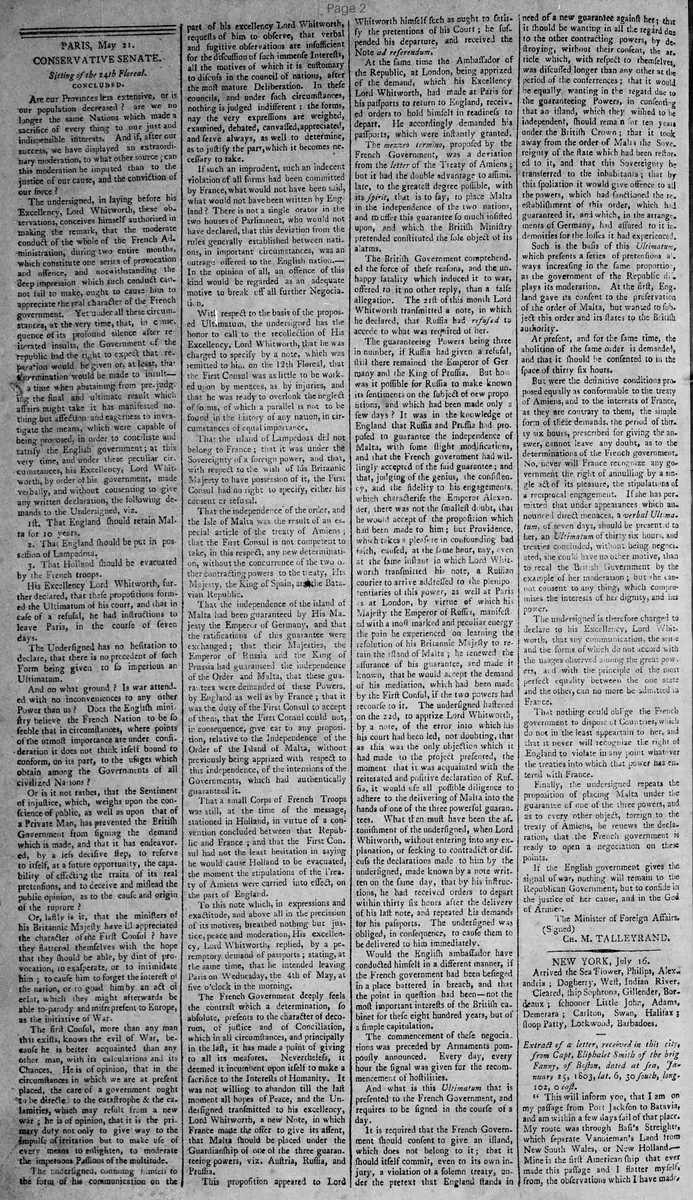
CONSERVATIVE SENATE.
Sitting of the 28th Floreal.
CONCLUSION.
Are our Provinces less extensive, or is our population decreased? are we no longer the same Nations which made a sacrifice of every thing to our just and indispensible interests. And if, after our success, we have displayed an extraordinary moderation, to what other source can this moderation be imputed than to the justice of our cause, and the conviction of our force?
The undersigned, in laying before his Excellency, Lord Whitworth, these observations, conceives himself authorised in making the remark, that the moderate conduct of the whole of the French Administration, during two entire months, which constitute one series of provocation and offence, and notwithstanding the deep impression which such conduct can not fail to make, ought to cause him to appreciate the real character of the French government. Yet under all these circumstances, at the very time, that, in consequence of its profound silence after repeated insults, the Government of the republic had the right to expect that reparation would be given or, at least, that termination would be made to insult- a time when abstaining from prejudging the final and ultimate result which affairs might take it has manifested nothing but affection and eagerness to investigate the means, which were capable of being proposed, in order to conciliate and satisfy the English government; at this very time, and under these peculiar circumstances, his Excellency, Lord Whitworth, by order of his government, made verbally, and without consenting to give any written declaration, the following demands to the Undersigned, viz.
1. That England should retain Malta for 10 years.
2. That England should be put in possession of Lampedosa.
3. That Holland Should be evacuated by the French troops.
His Excellency Lord Whitworth, further declared, that these propositions formed the Ultimatum of his court, and that in case of a refusal, he had instructions to leave Paris, in the course of eight days.
The Underigned has no hesitation to declare, that there is no precedent of such form being given to so imperious an Ultimatum.
And on what ground? Is war attended with no inconveniences to any other Power than us? Does the English ministry believe the French Nation to be so feeble that in circumstances, where points of the utmost importance are under consideration it does not think itself bound to conform, on its part, to the usages which obtain among the Governments of all civilized Nations?
Or is it not rather, that the Sentiment of injustice, which, weighs upon the conscience of public, as well as upon that of a Private Man, has prevented the British Government from signing the demand which is made, and that it has endeavored, by a less decisive step, to reserve to itself, at a future opportunity, the capability of effecting the traits of its real pretensions, and to deceive and mislead the public opinion, as to the cause and origin of the rupture?
Or, lastly is it, that the ministers of his Britannic Majesty have ill appreciated the character of the First Consul? have they flattered themselves with the hope that they should be able, by dint of provocation, to exasperate, or to intimidate him: to cause him to forget the interest of the nation, or to goad him by an act of eclat, which they might afterwards be able to parody and misrepresent to Europe, as the initiative of War.
The First Consul, more than any man that exists, knows the evil of War, because he is better acquainted than any other man, with its calculations and its Chances. He is of opinion, that in the circumstances in which we are at present placed, the care of a government ought to be directed to the catastrophe & the calamities, which may result from a new war; he is of opinion, that it is the primary duty not only to give way to the impulse of irritation but to make use of every means to enlighten, to moderate the impetuous Passions of the multitude.
The undersigned, confining himself to the form of his communication on the part of his excellency Lord Whitworth, requests of him to observe, that verbal and fugitive observations are insufficient for the discussion of such immense Interests, all the motives of which it is customary to discuss in the council of nations, after the most mature Deliberation. In these councils, and under such circumstances, nothing is judged indifferent: the forms, nay the very expressions are weighed, examined, debated, canvassed, appreciated, and serve always, as well to determine, as to justify the part, which it becomes necessary to take.
If such an imprudent, such an indecent violation of all forms had been committed by France, what would not have been said, what would not have been written by England? There is not a single orator in the two houses of Parliament, who would not have declared, that this deviation from the rules generally established between nations, in important circumstances, was an outrage offered to the English nation.-- In the opinion of all, an offence of this kind would be regarded as an adequate motive to break off all further Negotiation.
With respect to the basis of the proposed Ultimatum, the undersigned has the honor to call to the recollection of His Excellency, Lord Whitworth, that he was charged to specify by a note, which was remitted to him on the 12th Floreal, that the First Consul was as little to be worked upon by menaces, as by injuries, and that he was ready to overlook the neglect of forms, of which a parallel is not to be found in the history of any nation, in circumstances of equal importance.
That the island of Lampedosa did not belong to France; that it was under the Sovereignty of a foreign power, and that, with respect to the wish of his Britannic Majesty to have possession of it, the First Consul had no right to specify, either his Consent or refusal.
That the independence of the order, and the Isle of Malta was the result of an especial article of the treaty of Amiens; that the First Consul is not competent to take, in this respect, any new determination, without the concurrence of the two other contracting powers to the treaty, His Majesty, the King of Spain, and the Batavian Republic.
That the independence of the island of Malta had been guaranteed by His Majesty the Emperor of Germany, and that the ratifications of this guarantee were exchanged; that their Majesties, the Emperor of Russia and the King of Prussia had guaranteed the independence of the Order and Malta, that these guarantees were demanded of these Powers, by England as well as by France; that it was the duty of the First Consul to accept of them, that the First Consul could not, in consequence, give ear to any proposition, relative to the Independence of the Order of the Island of Malta, without previously being apprized with respect to this independence, of the intentions of the Governments, which had authentically guaranteed it.
That a small Corps of French Troops was still, at the time of the message, stationed in Holland, in virtue of a convention concluded between that Republic and France: and that the First Consul had not the least hesitation in saying he would cause Holland to be evacuated. the moment the stipulations of the Treaty of Amiens were carried into effect, on the part of England.
To this note which, in expressions and exactitude, and above all in the precision of its motives, breathed nothing but justice, peace and moderation, His excellency, Lord Whitworth, replied, by a peremptory demand of passports; stating, at the same time, that he intended leaving Paris on Wednesday, the 4th of May, at five o'clock in the morning.
The French Government deeply feels the contrast which a determination, so absolute, presents to the character of decorum, of justice and of Conciliation, which in all circumstances, and principally in the last, it has made a point of giving to all its measures. Nevertheless, it deemed it incumbent upon itself to make a sacrifice to the Interests of Humanity. It was not willing to abandon till the last moment all hopes of Peace, and the Underigned transmitted to his excellency, Lord Whitworth, a new Note, in which France made the offer to give its assent, that Malta should be placed under the Guardianship of one of the three guaranteeing powers, viz. Austria, Russia, and Prussia.
This proposition appeared to Lord Whitworth himself such as ought to satisfy the pretensions of his Court; he suspended his departure, and received the Note ad referendum.
At the same time the Ambassador of the Republic, at London, being apprized of the demand, which his Excellency Lord Whitworth, had made at Paris for his passports to return to England, received orders to hold himself in readiness to depart. He accordingly demanded his passports, which were instantly granted.
The mezzo termino, proposed by the French Government, was a deviation from the letter of the Treaty of Amiens; but it had the double advantage to assimilate, to the greatest degree possible, with its Spirit, that is to say, to place Malta in the independence of the two nations, and to offer this guarantee so much insisted upon, and which the British Ministry pretended constituted the sole object of its alarms.
The British Government comprehended the force of these reasons, and the unhappy fatality which induced it to war, offered to it no other reply, than a false allegation. The 22d of this month Lord Whitworth transmitted a note, in which he declared, that Russia had refused to accede to what was required of her.
The guaranteeing Powers being three in number, if Russia had given a refusal, still there remained the Emperor of Germany and the King of Prussia. But how was it possible for Russia to make known its sentiments on the subject of new propositions, and which had been made only a few days? It was in the knowledge of England that Russia and Prussia had proposed to guarantee the independence of Malta, with some slight modifications, and that the French government had willingly accepted of the said guarantee; and that, judging of the genius, the consistency, and the fidelity to his engagements, which characterize the Emperor Alexander, there was not the smallest doubt, that he would accept of the proposition which had been made to him; but Providence, which takes a pleasure in confounding bad faith, caused, at the same hour, nay, even at the same instant in which Lord Whitworth transmitted his note, a Russian courier to arrive addressed to the plenipotentiaries of this power, as well at Paris as at London, by virtue of which his Majesty the Emperor of Russia, manifested with a most marked and peculiar energy the pain he experienced on learning the resolution of his Britannic Majesty to retain the island of Malta; he renewed the assurance of his guarantee, and made it known. that he would accept the demand of his mediation, which had been made by the First Consul, if the two powers had recourse to it. The underigned hastened on the 22d, to apprize Lord Whitworth, by a note, of the error into which his his court had been led, not doubting, that as this was the only objection which it had made to the project presented, the moment that it was acquainted with the reiterated and positive declaration of Russia, it would use all possible diligence to adhere to the delivering of Malta into the hands of one of the three powerful guarantees. What then must have been the astonishment of the underigned, when Lord Whitworth, without entering into any explanation, or seeking to contradict or discuss the declarations made to him by the underigned, made known by a note written on the same day, that by his instructions, he had received orders to depart within thirty six hours after the delivery of his last note, and repeated his demands for his passports. The underigned was obliged, in consequence, to cause them to be delivered to him immediately.
Would the English ambassador have conducted himself in a different manner, if the French government had been besieged in a place battered in breach, and that the point in question had been--not the most important interests of the British cabinet for these eight hundred years, but of a simple capitulation.
The commencement of these negotiations was preceded by Armaments pompously announced. Every day, every hour the signal was given for the recommencement of hostilities.
And what is this Ultimatum that is presented to the French Government, and requires to be signed in the course of a day.
It is required that the French Government should consent to give an island, which does not belong to it; that it should itself commit, even to its own injury, a violation of a solemn treaty, under the pretext that England stands in need of a new guarantee against her; that it should be wanting in all the regard due to the other contracting powers, by destroying, without their consent, the article which, with respect to themselves, was discussed longer than any other at the period of the conferences; that it would be equally wanting in the regard due to the guaranteeing Powers, in consenting that an island, which they wished to be independent, Should remain for ten years under the British Crown; that it took away from the order of Malta the Sovereignty of the state which had been restored to it, and that this Sovereignty be transferred to the inhabitants; that by this partition it would give offence to all the powers, which had sanctioned the reestablishment of this order, which had guaranteed it, and which, in the arrangements of Germany, had assured to it indemnities for the loss it had experienced.
Such is the basis of this Ultimatum, which presents a series of pretensions always increasing in the same proportion, as the government of the Republic displays its moderation. At the first, England gave its consent to the preservation of the order of Malta, but wanted to subject this order and its states to the British authority.
At present, and for the same time, the abolition of the same order is demanded. and that it should be consented to in the space of thirty six hours.
But were the definitive conditions proposed equally as conformable to the treaty of Amiens, and to the interests of France, as they are contrary to them, the simple form of these demands, the period of thirty six hours, prescribed for giving the answer, cannot leave any doubt, as to the determinations of the French government.
No, never will France recognize any government the right of annulling by a single act of its pleasure, the stipulations of a reciprocal engagement. If she has permitted that under appearances which announced direct menaces, a verbal Ultimatum, of seven days, should be presented to her, an Ultimatum of thirty six hours, and treaties concluded, without being negotiated, she could have no other motive, than to recall the British Government by the example of her moderation; but she can not consent to any thing, which compromises the interests of her dignity, and her power.
The undersigned is therefore charged to declare to his Excellency, Lord Whitworth, that any communication, the sense and the forms of which do not accord with the usages observed among the great powers, and with the principle of the most perfect equality between the one state and the other, can no more be admitted in France.
That nothing could oblige the French government to dispose of Countries, which do not in the least appertain to her, and that it never will recognize the right of England to violate in any point whatever the treaties into which that power has entered with France.
Finally, the undersigned repeats the proposition of placing Malta under the guarantee of one of the three powers, and as to every other object, foreign to the treaty of Amiens, he renews the declaration, that the French government is ready to open a negotiation on these points.
If the English government gives the signal of war, nothing will remain to the Republican Government, but to confide in the justice of her cause, and in the God of Armies.
The Minister of Foreign Affairs.
(Signed)
CH. M. TALLEYRAND.
What sub-type of article is it?
What keywords are associated?
What entities or persons were involved?
Where did it happen?
Foreign News Details
Primary Location
Paris
Event Date
Sitting Of The 28th Floreal
Key Persons
Outcome
breakdown of negotiations; british ambassador lord whitworth demands and receives passports to leave paris within 36 hours; french counter-proposal for malta under guarantee of austria, russia, or prussia rejected; escalation towards war.
Event Details
Talleyrand's note to Lord Whitworth criticizes British verbal ultimatum demanding retention of Malta for 10 years, possession of Lampedusa, and evacuation of French troops from Holland. France refuses, citing Treaty of Amiens and guarantees by other powers. French propose placing Malta under one of three guaranteeing powers; Britain falsely claims Russian refusal, ignores correction, and Whitworth departs Paris.