Thank you for visiting SNEWPapers!
Sign up free
National Gazette
Philadelphia, Philadelphia County, Pennsylvania
What is this article about?
A letter to the National Gazette defends the French Revolution against aristocratic attacks, arguing that aristocrats are more oppressive than atheists or deists. It criticizes tyrants, priests, and religious superstition, contrasting European oppression with ancient Chinese society's lack of temples and crimes.
Merged-components note: Continuation of the same letter to the editor discussing the French revolution and atheism, split across pages with matching text flow.
Clippings
1 of 2
OCR Quality
Full Text
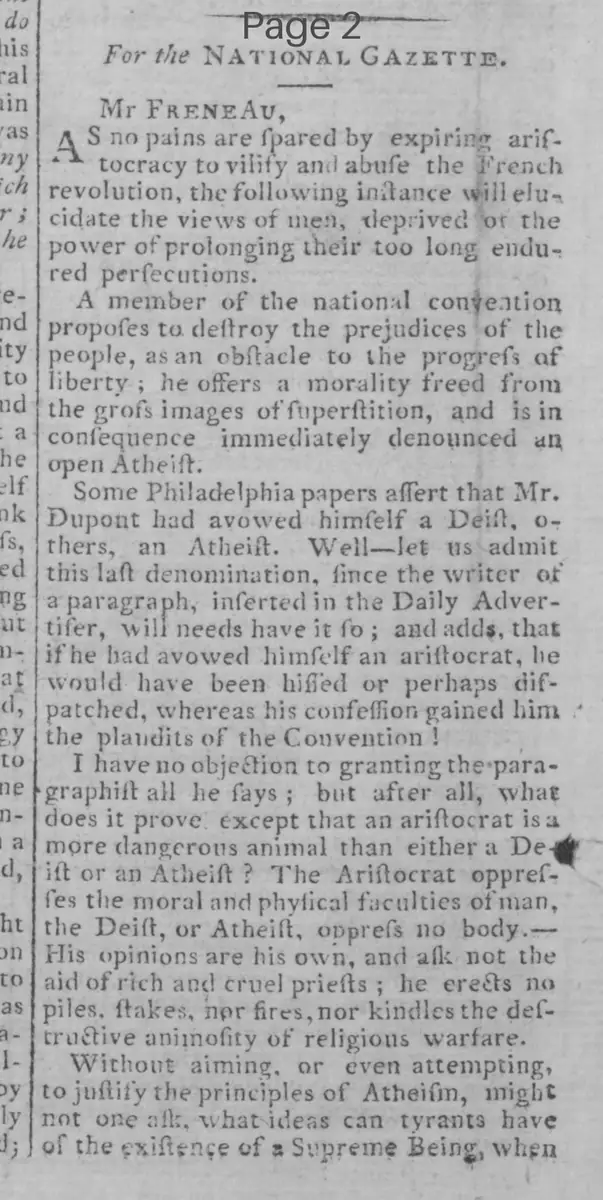
Mr. Freneau,
As no pains are spared by expiring aristocracy to vilify and abuse the French revolution, the following instance will elucidate the views of men, deprived of the power of prolonging their too long endured persecutions.
A member of the national convention proposes to destroy the prejudices of the people, as an obstacle to the progress of liberty; he offers a morality freed from the gross images of superstition, and is in consequence immediately denounced an open Atheist.
Some Philadelphia papers assert that Mr. Dupont had avowed himself a Deist, others, an Atheist. Well—let us admit this last denomination, since the writer of a paragraph, inserted in the Daily Advertiser, will needs have it so; and adds, that if he had avowed himself an aristocrat, he would have been hissed or perhaps dispatched, whereas his confession gained him the plaudits of the Convention!
I have no objection to granting the paragraphist all he says; but after all, what does it prove except that an aristocrat is a more dangerous animal than either a Deist or an Atheist? The Aristocrat oppresses the moral and physical faculties of man, the Deist, or Atheist, oppresses no body.—His opinions are his own, and ask not the aid of rich and cruel priests; he erects no piles, takes, nor fires, nor kindles the destructive animosity of religious warfare.
Without aiming, or even attempting, to justify the principles of Atheism, might not one ask, what ideas can tyrants have of the existence of a Supreme Being, when
When men only in turn bring the world upside down with their ambitious wars—when they imprison, torture, or put to death virtuous men, who have courage enough to tell them the truth—when, to satisfy their avarice they crush nations under an intolerable weight of taxes, imposts, and vexations of every kind.
And let us enquire also, what can be the creed of crafty and covetous priests, who sacrifice every consideration to their thirst for gold?—how can they have the assurance to profess the christian religion—a religion which inculcates poverty, humility, forgiveness of injuries, and even love towards our enemies!
The truth is, they find it their interest to prevent light from spreading among mankind. They are sensible that true science, in restoring the rights of human nature, would soon convince men that they can be happy without the intervention of crowned or religious despots. To set this assertion in a clearer point of view I will introduce a passage of Bardesanes, as quoted by Eusebius. Speaking of the Seres (the ancient Chinese, before the time of Confucius) he says,—Apud Seras lex et nulla caedes, scortatio, furtum, et simulacrorum cultus omnis prohibetur; quare, amplissima regione non templum videns, non lenam, non meretricem, non adulteram, non furem in jus raptum, non homicidium, non toxicum. [Fragment of Bardesanes in Eusebius, Prep. Evang. Lib. 6 Cap. 10.] Among the Seres, the law forbids murder, debauchery, theft, and all kinds of religious worship. Thus, in that immense country, no temple, no public woman, no adulterer, no thief, no murderer, nor poisoner, are to be seen.
What Being is there, endowed with the gift of common sense, that would not prefer living with such a people, rather than as in Europe, to groan under the iron rod of a tyrant, or be subjected to the temporal and spiritual persecution of a set of cruel and bigotted priests?
March 25.
What sub-type of article is it?
What themes does it cover?
What keywords are associated?
What entities or persons were involved?
Letter to Editor Details
Recipient
Mr. Freneau
Main Argument
aristocracy vilifies the french revolution to maintain power; aristocrats are more dangerous than atheists or deists, who oppress no one, while tyrants and priests suppress liberty through wars, taxes, and superstition.
Notable Details