Thank you for visiting SNEWPapers!
Sign up free
The Tacoma Times
Tacoma, Pierce County, Washington
What is this article about?
Historical account of Dr. Marcus Whitman's mission garden near Fort Walla Walla, where a watermelon incident with Indians contributed to later massacre, and how the fertile land now supports a booming pea canning industry in the 1930s, aiding economic recovery in Washington and Oregon.
Clipping
OCR Quality
Full Text
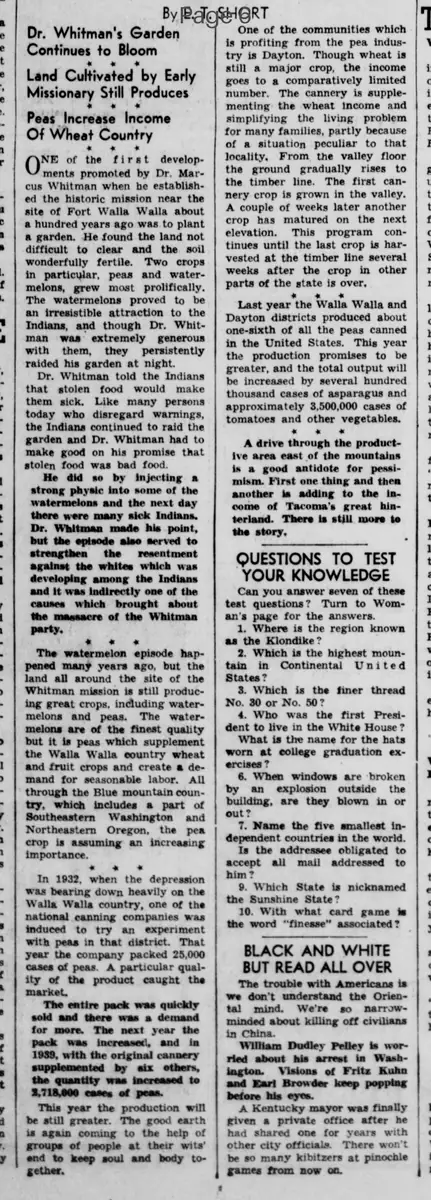
Land Cultivated by Early Missionary Still Produces Peas Increase Income Of Wheat Country
One of the first developments promoted by Dr. Marcus Whitman when he established the historic mission near the site of Fort Walla Walla about a hundred years ago was to plant a garden. He found the land not difficult to clear and the soil wonderfully fertile. Two crops in particular, peas and watermelons, grew most prolifically.
The watermelons proved to be an irresistible attraction to the Indians, and though Dr. Whitman was extremely generous with them, they persistently raided his garden at night.
Dr. Whitman told the Indians that stolen food would make them sick. Like many persons today who disregard warnings, the Indians continued to raid the garden and Dr. Whitman had to make good on his promise that stolen food was bad food.
He did so by injecting a strong physic into some of the watermelons and the next day there were many sick Indians.
Dr. Whitman made his point, but the episode also served to strengthen the resentment against the whites which was developing among the Indians and it was indirectly one of the causes which brought about the massacre of the Whitman party.
The watermelon episode happened many years ago. but the land all around the site of the Whitman mission is still producing great crops, including watermelons and peas. The watermelons are of the finest quality but it is peas which supplement the Walla Walla country wheat and fruit crops and create a demand for seasonable labor. All through the Blue mountain country, which includes a part of Southeastern Washington and Northeastern Oregon, the pea crop is assuming an increasing importance.
In 1932. when the depression was bearing down heavily on the Walla Walla country, one of the national canning companies was induced to try an experiment with peas in that district. That year the company packed 25,000 cases of peas. A particular quality of the product caught the market.
The entire pack was quickly sold and there was a demand for more. The next year the pack was increased, and in 1939, with the original cannery supplemented by six others, the quantity was increased to 2,718,000 cases of peas.
This year the production will be still greater. The good earth is again coming to the help of groups of people at their wits' end to keep soul and body together.
One of the communities which is profiting from the pea industry is Dayton. Though wheat is still a major crop, the income goes to a comparatively limited number. The cannery is supplementing the wheat income and simplifying the living problem for many families, partly because of a situation peculiar to that locality. From the valley floor the ground gradually rises to the timber line. The first cannery crop is grown in the valley. A couple of weeks later another crop has matured on the next elevation. This program continues until the last crop is harvested at the timber line several weeks after the crop in other parts of the state is over.
Last year the Walla Walla and Dayton districts produced about one-sixth of all the peas canned in the United States. This year the production promises to be greater, and the total output will be increased by several hundred thousand cases of asparagus and approximately 3,500,000 cases of tomatoes and other vegetables.
A drive through the productive area east of the mountains is a good antidote for pessimism. First one thing and then another is adding to the income of Tacoma's great hinterland. There is still more to the story.
What sub-type of article is it?
What themes does it cover?
What keywords are associated?
What entities or persons were involved?
Where did it happen?
Story Details
Key Persons
Location
Near The Site Of Fort Walla Walla, Walla Walla Country, Blue Mountain Country, Southeastern Washington, Northeastern Oregon, Dayton
Event Date
About A Hundred Years Ago; 1932; 1939
Story Details
Dr. Marcus Whitman planted a fertile garden at his mission near Fort Walla Walla, where peas and watermelons thrived. Indians raided watermelons despite warnings; Whitman laced some with physic, making them sick, which fueled resentment leading to the Whitman massacre. The land still produces abundant peas and watermelons, boosting the economy; pea canning industry grew from 25,000 cases in 1932 to 2,718,000 in 1939, providing income during depression, especially in Dayton with staggered harvests.