Thank you for visiting SNEWPapers!
Sign up free
The Tribune
Roanoke, Virginia
What is this article about?
Dr. Miller M. Ryans explains milk fever (undulant fever), caused by Brucella abortus, common in animals but transmissible to humans via milk and animal matter. Symptoms include undulating fever up to 105 degrees, joint pains, and prostration. Prevention through regulations and gloves; treatment with Aureomycin and Chloromycetin.
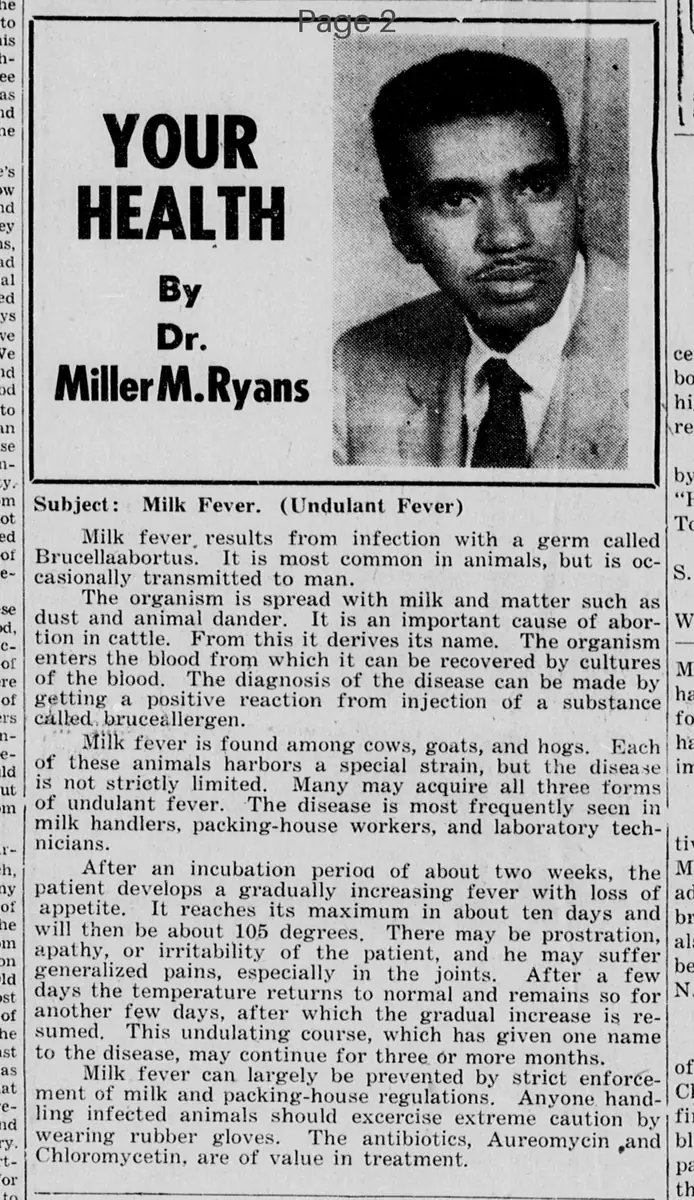
Merged-components note: The image overlaps spatially with the health article text and is likely a photograph of Dr. Miller M. Ryans, the author.
Clipping
OCR Quality
Full Text
By Dr. Miller M. Ryans
Subject: Milk Fever. (Undulant Fever)
Milk fever results from infection with a germ called Brucella abortus. It is most common in animals, but is occasionally transmitted to man.
The organism is spread with milk and matter such as dust and animal dander. It is an important cause of abortion in cattle. From this it derives its name. The organism enters the blood from which it can be recovered by cultures of the blood. The diagnosis of the disease can be made by getting a positive reaction from injection of a substance called brucella allergen.
Milk fever is found among cows, goats, and hogs. Each of these animals harbors a special strain, but the disease is not strictly limited. Many may acquire all three forms of undulant fever. The disease is most frequently seen in milk handlers, packing-house workers, and laboratory technicians.
After an incubation period of about two weeks, the patient develops a gradually increasing fever with loss of appetite. It reaches its maximum in about ten days and will then be about 105 degrees. There may be prostration, apathy, or irritability of the patient, and he may suffer generalized pains, especially in the joints. After a few days the temperature returns to normal and remains so for another few days, after which the gradual increase is resumed. This undulating course, which has given one name to the disease, may continue for three or more months.
Milk fever can largely be prevented by strict enforcement of milk and packing-house regulations. Anyone handling infected animals should exercise extreme caution by wearing rubber gloves. The antibiotics, Aureomycin and Chloromycetin, are of value in treatment.
What sub-type of article is it?
What themes does it cover?
What keywords are associated?
Story Details
Story Details
Milk fever, caused by Brucella abortus, spreads from animals to humans via milk and dander, causing undulating fever, pains, and prostration. Diagnosed by blood cultures or allergen injection. Prevented by regulations and gloves; treated with antibiotics.