Thank you for visiting SNEWPapers!
Sign up free
Editorial
September 23, 1809
The Delaware Gazette
Wilmington, New Castle County, Delaware
What is this article about?
Editorial defends the doctrine of freedom of the seas as originating from Catherine the Great's Armed Neutrality of 1780, not Bonaparte, criticizing Tory misinformation. Praises US policy under Madison and Jefferson to foster ties with Russia for future commercial benefits amid European powers' adherence.
Clipping
OCR Quality
98%
Excellent
Full Text
Freedom of the seas.
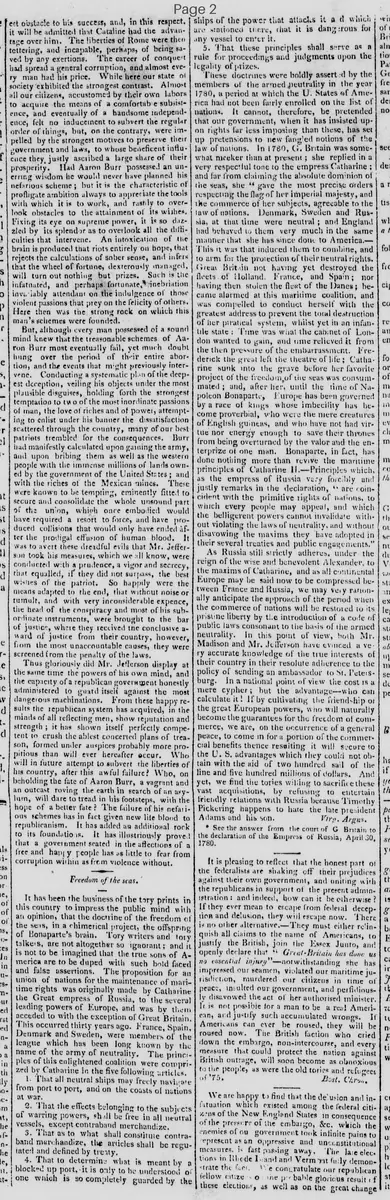
It has been the business of the tory prints in this country to impress the public mind with an opinion, that the doctrine of the freedom of the seas, in a chimerical project, the offspring of Bonaparte's brain. Tory writers and tory talkers are not altogether so ignorant; and it is not to be imagined that the true sons of America are to be duped with such bold faced and false assertions. The proposition for an union of nations for the maintenance of maritime rights was originally made by Catharine the Great empress of Russia, to the several leading powers of Europe, and was by them acceded to with the exception of Great Britain. This occurred thirty years ago. France, Spain, Denmark and Sweden, were members of the league which has been long known by the name of the armed neutrality. The principles of this enlightened coalition were comprised by Catharine in the five following articles.
1. That all neutral ships may freely navigate from port to port, and on the coasts of nations at war.
2. That the effects belonging to the subjects of warring powers, shall be free in all neutral vessels, except contraband merchandize.
3. That as to what shall constitute contraband merchandize, the articles shall be regulated and defined by treaty.
4. That to determine what is meant by a blocked up port, it is only to be understood of one which is so completely guarded by the ships of the power that attacks it and which are stationed there, that it is dangerous for any vessel to enter it.
5. That these principles shall serve as a rule for proceedings and judgments upon the legality of prizes.
These doctrines were boldly asserted by the members of the armed neutrality in the year 1780, a period at which the U. States of America had not been fairly enrolled on the list of nations. It cannot, therefore, be pretended that our government, when it has insisted upon rights far less imposing than these, has set up pretensions to new fangled notions of the law of nations. In 1780, G. Britain was somewhat meeker than at present; she replied in a very respectful tone to the empress Catharine; and far from claiming the absolute dominion of the seas, she "gave the most precise orders respecting the flag of her imperial majesty, and the commerce of her subjects, agreeable to the law of nations." Denmark, Sweden and Russia, at that time were neutral; and England had behaved to them very much in the same manner that she has since done to America. This it was that induced them to combine, and to arm for the protection of their neutral rights. Great Britain not having yet destroyed the fleets of Holland, France, and Spain; nor having then stolen the fleet of the Danes; became alarmed at this maritime coalition, and was compelled to conduct herself with the greatest address to prevent the total destruction of her piratical system, whilst yet in an infant state: Time was what the cabinet of London wanted to gain, and time relieved it from the then pressure of the embarrassment. Frederick the great left the theatre of life; Catharine sunk into the grave before her favorite project of the freedom of the seas was consummated; and, after her, until the time of Napoleon Bonaparte, Europe has been governed by a race of kings whose imbecility has become proverbial, who were the mere creatures of English guineas, and who have not had virtue nor energy enough to save their thrones from being overturned by the valor and the enterprize of one man. Bonaparte, in fact, has done nothing more than revive the maritime principles of Catharine II.—Principles which, as the empress of Russia very forcibly and justly remarks in the declaration, "are coincident with the primitive rights of nations, to which every people may appeal, and which the belligerent powers cannot invalidate without violating the laws of neutrality, and without disavowing the maxims they have adopted in their several treaties and public engagements."
As Russia still strictly adheres, under the reign of the wise and benevolent Alexander, to the maxims of Catharine, and as all continental Europe may be said now to be compressed between France and Russia, we may very rationally anticipate the approach of the period when the commerce of nations will be restored to its pristine liberty by the introduction of a code of public laws consonant to the basis of the armed neutrality. In this point of view, both Mr. Madison and Mr. Jefferson have evinced a very accurate knowledge of the true interests of their country in their resolute adherence to the policy of sending an ambassador to St. Petersburg. In a national point of view the cost is a mere cypher; but the advantage—who can calculate it! If by cultivating the friendship of the great European powers, who will naturally become the guarantees for the freedom of commerce, we are, on the occurrence of a general peace, to come in for a portion of the commercial benefits thence resulting it will secure to the U. S. advantages which they could not obtain with the aid of two hundred sail of the line and five hundred millions of dollars. And yet, we find the tories willing to sacrifice these vast acquisitions, by refusing to entertain friendly relations with Russia because Timothy Pickering happens to hate the late president Adams and his son.
Virg. Argus.
* See the answer from the court of G Britain to the declaration of the Empress of Russia, April 30, 1780.
It has been the business of the tory prints in this country to impress the public mind with an opinion, that the doctrine of the freedom of the seas, in a chimerical project, the offspring of Bonaparte's brain. Tory writers and tory talkers are not altogether so ignorant; and it is not to be imagined that the true sons of America are to be duped with such bold faced and false assertions. The proposition for an union of nations for the maintenance of maritime rights was originally made by Catharine the Great empress of Russia, to the several leading powers of Europe, and was by them acceded to with the exception of Great Britain. This occurred thirty years ago. France, Spain, Denmark and Sweden, were members of the league which has been long known by the name of the armed neutrality. The principles of this enlightened coalition were comprised by Catharine in the five following articles.
1. That all neutral ships may freely navigate from port to port, and on the coasts of nations at war.
2. That the effects belonging to the subjects of warring powers, shall be free in all neutral vessels, except contraband merchandize.
3. That as to what shall constitute contraband merchandize, the articles shall be regulated and defined by treaty.
4. That to determine what is meant by a blocked up port, it is only to be understood of one which is so completely guarded by the ships of the power that attacks it and which are stationed there, that it is dangerous for any vessel to enter it.
5. That these principles shall serve as a rule for proceedings and judgments upon the legality of prizes.
These doctrines were boldly asserted by the members of the armed neutrality in the year 1780, a period at which the U. States of America had not been fairly enrolled on the list of nations. It cannot, therefore, be pretended that our government, when it has insisted upon rights far less imposing than these, has set up pretensions to new fangled notions of the law of nations. In 1780, G. Britain was somewhat meeker than at present; she replied in a very respectful tone to the empress Catharine; and far from claiming the absolute dominion of the seas, she "gave the most precise orders respecting the flag of her imperial majesty, and the commerce of her subjects, agreeable to the law of nations." Denmark, Sweden and Russia, at that time were neutral; and England had behaved to them very much in the same manner that she has since done to America. This it was that induced them to combine, and to arm for the protection of their neutral rights. Great Britain not having yet destroyed the fleets of Holland, France, and Spain; nor having then stolen the fleet of the Danes; became alarmed at this maritime coalition, and was compelled to conduct herself with the greatest address to prevent the total destruction of her piratical system, whilst yet in an infant state: Time was what the cabinet of London wanted to gain, and time relieved it from the then pressure of the embarrassment. Frederick the great left the theatre of life; Catharine sunk into the grave before her favorite project of the freedom of the seas was consummated; and, after her, until the time of Napoleon Bonaparte, Europe has been governed by a race of kings whose imbecility has become proverbial, who were the mere creatures of English guineas, and who have not had virtue nor energy enough to save their thrones from being overturned by the valor and the enterprize of one man. Bonaparte, in fact, has done nothing more than revive the maritime principles of Catharine II.—Principles which, as the empress of Russia very forcibly and justly remarks in the declaration, "are coincident with the primitive rights of nations, to which every people may appeal, and which the belligerent powers cannot invalidate without violating the laws of neutrality, and without disavowing the maxims they have adopted in their several treaties and public engagements."
As Russia still strictly adheres, under the reign of the wise and benevolent Alexander, to the maxims of Catharine, and as all continental Europe may be said now to be compressed between France and Russia, we may very rationally anticipate the approach of the period when the commerce of nations will be restored to its pristine liberty by the introduction of a code of public laws consonant to the basis of the armed neutrality. In this point of view, both Mr. Madison and Mr. Jefferson have evinced a very accurate knowledge of the true interests of their country in their resolute adherence to the policy of sending an ambassador to St. Petersburg. In a national point of view the cost is a mere cypher; but the advantage—who can calculate it! If by cultivating the friendship of the great European powers, who will naturally become the guarantees for the freedom of commerce, we are, on the occurrence of a general peace, to come in for a portion of the commercial benefits thence resulting it will secure to the U. S. advantages which they could not obtain with the aid of two hundred sail of the line and five hundred millions of dollars. And yet, we find the tories willing to sacrifice these vast acquisitions, by refusing to entertain friendly relations with Russia because Timothy Pickering happens to hate the late president Adams and his son.
Virg. Argus.
* See the answer from the court of G Britain to the declaration of the Empress of Russia, April 30, 1780.
What sub-type of article is it?
Foreign Affairs
Trade Or Commerce
War Or Peace
What keywords are associated?
Freedom Of The Seas
Armed Neutrality
Maritime Rights
Catherine The Great
Russia Diplomacy
Neutral Shipping
Tory Misinformation
Us Foreign Policy
What entities or persons were involved?
Catherine The Great
Napoleon Bonaparte
James Madison
Thomas Jefferson
Alexander I
Great Britain
Russia
Armed Neutrality
Timothy Pickering
Editorial Details
Primary Topic
Freedom Of The Seas And Armed Neutrality Principles
Stance / Tone
Defensive Of Maritime Neutrality Rights And Supportive Of Us Russian Diplomacy
Key Figures
Catherine The Great
Napoleon Bonaparte
James Madison
Thomas Jefferson
Alexander I
Great Britain
Russia
Armed Neutrality
Timothy Pickering
Key Arguments
Tory Prints Falsely Claim Freedom Of Seas As Bonaparte's Chimerical Idea
Doctrine Originated With Catherine The Great's 1780 Armed Neutrality League, Joined By France, Spain, Denmark, Sweden
Five Principles Outlined For Neutral Shipping, Contraband, Blockades, And Prizes
Britain Responded Respectfully In 1780 But Later Violated Neutral Rights
Bonaparte Revived Catherine's Principles, Aligning With Primitive Rights Of Nations
Russia Under Alexander Adheres To These Maxims
Us Ambassadors To St. Petersburg Advance National Interests For Post War Commerce
Tories Oppose Relations With Russia Due To Personal Hatreds, Risking Vast Benefits