Thank you for visiting SNEWPapers!
Sign up free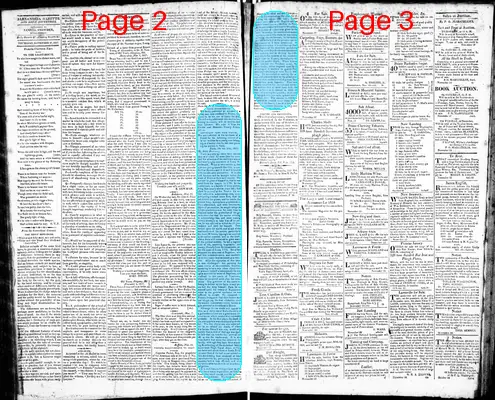
Alexandria Gazette & Daily Advertiser
Alexandria, Virginia
What is this article about?
A letter from Paris dated August 31, 1817, reports on a man claiming to be Louis XVII, son of Louis XVI, confined in Rouen, France. He alleges escape from prison in 1795 via washerman, rejection by uncles, protections, arrests under Napoleon, and current detention post-restoration. Doubts about the prince's death are raised.
Merged-components note: Continuation of the same story about the claim of Louis XVII across pages, sequential reading order.
Clippings

1 of 2
OCR Quality
Full Text
LOUIS SEVENTEENTH.
We lately published an account of a young man now confined in France, who claims to be the son of Louis the 16th. The following additional information respecting his claims, will at least be read with interest. We copy it from the Chester and Delaware County Federalist:—
IMPORTANT NEWS FROM FRANCE.
We are indebted to the kindness of a friend for the following extract of a letter, written by a young man belonging to Chester county, but now pursuing his studies in Paris.
Paris, 8th mo. 31st, 1817.
My Dear B
There is a strange story very current here, and which for some time has occupied the attention of the multitude almost exclusively—the existence of Louis Seventeenth. What is very certain is, that a person giving himself this title, is confined at Rouen—and it is said is treated with considerable distinction. It is also said his case will be brought before the house of Peers at their next session. The account he gives of himself is, that he was saved from the temple in 1795, by the washerman, in a bundle of dirty clothes, being then nearly eleven years old: that when he arrived at the Vendee his uncles refused to acknowledge him, a report having reached there first, that he had died in the prison, and his uncle, the present king, having been proclaimed.— Thus abandoned, and even become the object of persecution, he sought refuge in foreign countries—was for some time in England under the protection of the government—but that his uncles refusing to acknowledge him, and even making several attempts to take him off by poison, he was advised to withdraw his pretensions and shift for himself. Thus turned upon the world, and afraid of the machinations of his uncles, particularly the count D'Artois, he sought an asylum in his native country, and in the south, where there still remained a great many of the ancient nobility, he led a vagrant kind of life, receiving hospitality, and money, liberally from the inhabitants, under the name of Louis XVII. he at last attracted the attention of Napoleon, who had him arrested—tried, and condemned to two years imprisonment as a swindler. After the expiration of this time, he was discharged: but pursuing the same course of life—without, however, appearing to have any other object than to procure himself a subsistence—he was again arrested by order of Napoleon, and confined in the castle of Vincennes, where he remained until after the restoration. _ The governor of the castle refusing to deliver up the keys to any person but the king himself: Here he remained until the return of Napoleon— when in the general confusion he was suffered to escape. He remained in France, living as he had done before, and not disguising his real character, until the second restoration—when he was again arrested and confined in Rouen.
Although this no doubt will appear to thee, as it did to me at first—the story of a pretender—there are a great many circumstances which rendered it extremely probable. In the first place, the death of the young prince was considered as doubtful. The four physicians who were called in to attend his death, of whom the famous Desault was one, would only certify that a child of that age was dead. In less than six months they were all cut off, as was the washerwoman. It is also remarkable that since the return of the family, although they have been searching & collecting all the disturbed family bones from Hugh Capet down, nothing has been said about those of Louis XVI, no more than if he had never existed.— His death being thus rendered at least uncertain—let us, presuming his escape, examine how it was effected, and why his uncles afterwards refused to acknowledge him.
It is well known that previous to that time there was a negociation on foot between the royal uncles and the convention, for his release. The latter demanded as an equivalent, the evacuation of
France by the royal and allied troops --
During this negotiation, the plan for effecting his escape was laid; 50,000 francs were paid to an English cabinet maker named --, residing in Paris, for his son, to substitute him for the prince.
A large dose of opium was given to the child, to procure his unconscious acquiescence -- and this state, he was transported by the washerman, in his basket, and left in the bed of the prince; he being removed as I have mentioned. Of this dose of opium it is said the boy died.
The leaders of the directory perceiving that they were duped -- to save themselves from censure, and to destroy the influence which the opinion of his existence might have in France, immediately declared his sudden death. When this report reached the Vendean army, the royal family, either imposed upon by it, or seeing in it motives to gratify their ambition -- declared at once Louis 18th king. He was hailed as such by the army, and acknowledged by the allied powers -- so that, on the arrival of prince, they treated him as an impostor. They may readily conceive the various and powerful motives they all must have had, for this policy; as it opened to them all hope of wearing the sceptre; or in case of being driven into exile, greater consideration, &c. The manner in which he is said to be treated since being in the power of his family, I am at a loss to account for -- rumor however is very contradictory on this subject.
What sub-type of article is it?
What keywords are associated?
What entities or persons were involved?
Where did it happen?
Foreign News Details
Primary Location
France
Event Date
8th Mo. 31st, 1817
Key Persons
Outcome
pretender confined in rouen; case to be brought before house of peers; substitute boy died from opium.
Event Details
A man claiming to be Louis XVII recounts escape from Temple prison in 1795 via washerman, rejection by uncles in Vendee, refuge in England, vagrant life in France, arrests and imprisonments under Napoleon in Vincennes, escape during confusion, re-arrest after second restoration and confinement in Rouen. Doubts raised on official death due to physicians' vague certification, their subsequent deaths, and lack of royal remains search for Louis XVI. Escape plot involved substitution with English cabinet maker's son drugged with opium who died.