Thank you for visiting SNEWPapers!
Sign up free
Richmond Enquirer
Richmond, Richmond County, Virginia
What is this article about?
1819 article opposing slavery's extension in new U.S. states, quoting revolutionary principles and including John Jay's letter advocating constitutional prohibition of slave importation and gradual abolition. (187 characters)
Clipping
OCR Quality
Full Text
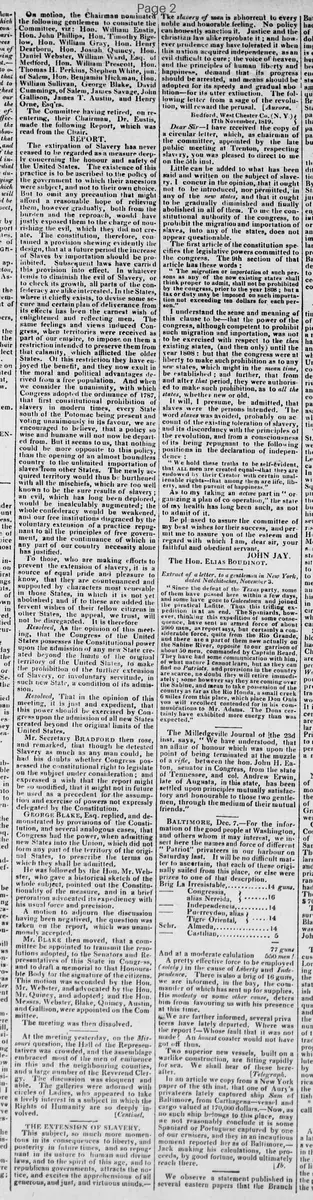
This subject, so much more momentous in its consequences to liberty, and posterity in future times, and so repugnant in its nature to human and divine laws, and to the spirit of this age, and to republican governments, attracts the notice, and excites the apprehensions of all generous, and just, and virtuous minds.—
The slavery of man is abhorrent to every noble and honorable feeling. No policy can honestly sanction it. Justice and the christian law alike reprobate it; and however prudence may have tolerated it when this nation acquired independence, as an evil difficult to cure: the voice of heaven, and the principles of human liberty and happiness, demand that its progress should be arrested, and means should be adopted for its speedy and gradual abolition—for its utter extinction. The following letter from a sage of the revolution, will reward the perusal. [Aurora.
Bedford, West Chester Co. (N. Y.) November 17th, 1819.
Dear Sir—I have received the copy of a circular letter, which, as chairman of the committee, appointed by the late public meeting at Trenton, respecting slavery, you was pleased to direct to me on the 5th inst.
Little can be added to what has been said and written on the subject of slavery. I concur in the opinion, that it ought not to be introduced, nor permitted, in any of the new states, and that it ought to be gradually diminished and finally abolished in all of them. To me the constitutional authority of the congress, to prohibit the migration and importation of slaves, into any of the states, does not appear questionable.
The first article of the constitution specifies the legislative powers committed to the congress. The 9th section of that article has these words:
"The migration or importation of such persons as any of the now existing states shall think proper to admit, shall not be prohibited by the congress, prior to the year 1808; but a tax or duty may be imposed on such importation not exceeding ten dollars for each person."
I understand the sense and meaning of this clause to be—that the power of the congress, although competent to prohibit such migration and importation, was not to be exercised with respect to the then existing states, (and then only) until the year 1808: but that the congress were at liberty to make such prohibition as to any new states, which might in the mean time be established: and further, that from and after that period, they were authorised to make such prohibition, as to all the states, whether new or old.
It will, I presume, be admitted, that slaves were the persons intended. The word slaves was avoided, probably on account of the existing toleration of slavery, and its discordancy with the principles of the revolution, and from a consciousness of its being repugnant to the following positions in the declaration of independence:
"We hold these truths to be self-evident, that ALL men are created equal—that they are endowed by their Creator with certain unalienable rights—that among them are life, liberty, and the pursuit of happiness."
As to my taking an active part in "organizing a plan of co-operation," the state of my health has long been such, as not to admit of it.
Be pleased to assure the committee of my best wishes for their success, and permit me to assure you of the esteem and regard with which I am, dear sir, your faithful and obedient servant,
JOHN JAY.
The Hon. Elias Boudinot.
What sub-type of article is it?
What themes does it cover?
What keywords are associated?
What entities or persons were involved?
Where did it happen?
Story Details
Key Persons
Location
Bedford, West Chester Co. (N. Y.)
Event Date
November 17th, 1819
Story Details
An editorial argues against the extension of slavery, emphasizing its repugnance to liberty and divine law, and calls for its abolition. It includes a letter from John Jay to Elias Boudinot, concurring that slavery should not be permitted in new states, should be gradually abolished, and interpreting the U.S. Constitution as granting Congress authority to prohibit slave importation after 1808 and in new states.