Thank you for visiting SNEWPapers!
Sign up free
Editorial
February 25, 1799
The Gazette
Portland, Cumberland County, Maine
What is this article about?
An editorial criticizing equivocal and duplicitous politicians who shift stances between Jacobins and Federalists, praising or denouncing the Alien and Sedition Acts opportunistically. It highlights figures like General Heath and Gallatin, urging firm government action against such intrigue amid threats to national independence.
Clipping
OCR Quality
98%
Excellent
Full Text
FOR THE GAZETTE.
Such Things Are.
NUMBER VIII.
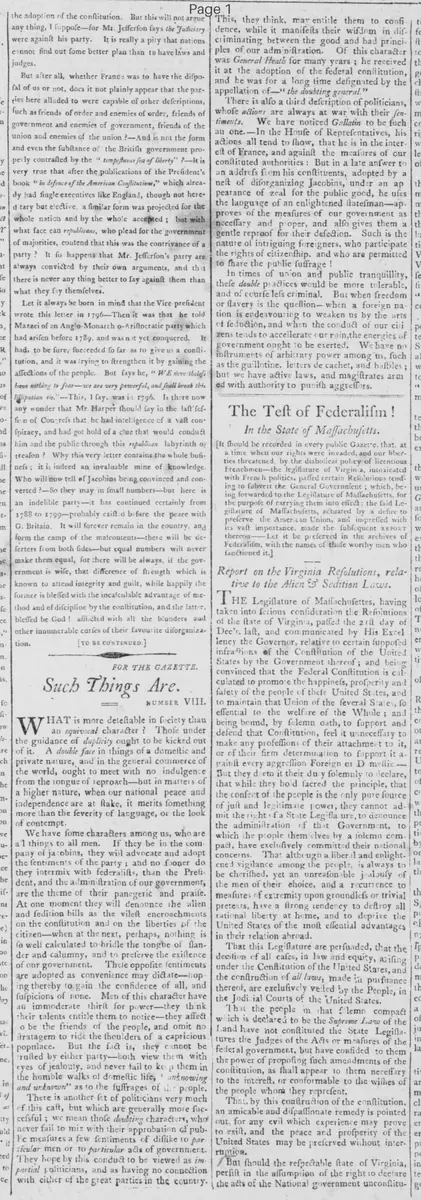
What is more detestable in society than an equivocal character? Those under the guidance of duplicity ought to be kicked out of it. A double face in things of a domestic and private nature, and in the general commerce of the world, ought to meet with no indulgence from the tongue of reproach—but in matters of a higher nature, when our national peace and independence are at stake, it merits something more than the severity of language, or the look of contempt.
We have some characters among us, who are all things to all men. If they be in the company of Jacobins, they will advocate and adopt the sentiments of the party: and no sooner do they intermix with federalists, than the President, and the administration of our government, are the theme of their panegyric and praise. At one moment they will denounce the alien and sedition bills as the vilest encroachments on the constitution and on the liberties of the citizen—when at the next, perhaps, nothing is so well calculated to bridle the tongue of slander and calumny, and to preserve the existence of our government. These opposite sentiments are adopted as convenience may dictate—hoping thereby to gain the confidence of all, and suspicions of none. Men of this character have an immoderate thirst for power—they think their talents entitle them to notice—they affect to be the friends of the people, and omit no stratagem to ride the shoulders of a capricious populace. But the fact is, they cannot be trusted by either party—both view them with eyes of jealousy, and never fail to keep them in the humble walks of domestic life, unknown and unknown as to the suffrages of the people.
There is another sort of politicians very much of this cast, but which are generally more successful; we mean those doubting characters, who never fail to mix with their approbation of public measures a few sentiments of dislike to particular men or to particular acts of government. They hope by this conduct to be viewed as impartial politicians, and as having no connection with either of the great parties in the country.
This, they think, may entitle them to confidence, while it manifests their wisdom in discriminating between the good and bad principles of our administration. Of this character was General Heath for many years: he received it at the adoption of the federal constitution, and he was for a long time designated by the appellation of—“the doubting general.”
There is also a third description of politicians, whose actions are always at war with their sentiments. We have noticed Gallatin to be such an one.—In the House of Representatives, his actions all tend to show, that he is in the interest of France, and against the measures of our constituted authorities: But in a late answer to an address from his constituents, adopted by a nest of disorganizing Jacobins, under an appearance of zeal for the public good, he uses the language of an enlightened statesman—approves of the measures of our government as necessary and proper, and also gives them a gentle reproof for their defection. Such is the nature of intriguing foreigners, who participate the rights of citizenship, and who are permitted to share the public suffrage!
In times of union and public tranquillity, these double practices would be more tolerable, and of course less criminal. But when freedom or slavery is the question—when a foreign nation is endeavouring to weaken us by the arts of seduction, and when the conduct of our citizens tends to accelerate our ruin, the energies of government ought to be exerted. We have no instruments of arbitrary power among us, such as the guillotine, letters de cachet, and bastiles: but we have active laws, and magistrates armed with authority to punish aggressors.
Such Things Are.
NUMBER VIII.
What is more detestable in society than an equivocal character? Those under the guidance of duplicity ought to be kicked out of it. A double face in things of a domestic and private nature, and in the general commerce of the world, ought to meet with no indulgence from the tongue of reproach—but in matters of a higher nature, when our national peace and independence are at stake, it merits something more than the severity of language, or the look of contempt.
We have some characters among us, who are all things to all men. If they be in the company of Jacobins, they will advocate and adopt the sentiments of the party: and no sooner do they intermix with federalists, than the President, and the administration of our government, are the theme of their panegyric and praise. At one moment they will denounce the alien and sedition bills as the vilest encroachments on the constitution and on the liberties of the citizen—when at the next, perhaps, nothing is so well calculated to bridle the tongue of slander and calumny, and to preserve the existence of our government. These opposite sentiments are adopted as convenience may dictate—hoping thereby to gain the confidence of all, and suspicions of none. Men of this character have an immoderate thirst for power—they think their talents entitle them to notice—they affect to be the friends of the people, and omit no stratagem to ride the shoulders of a capricious populace. But the fact is, they cannot be trusted by either party—both view them with eyes of jealousy, and never fail to keep them in the humble walks of domestic life, unknown and unknown as to the suffrages of the people.
There is another sort of politicians very much of this cast, but which are generally more successful; we mean those doubting characters, who never fail to mix with their approbation of public measures a few sentiments of dislike to particular men or to particular acts of government. They hope by this conduct to be viewed as impartial politicians, and as having no connection with either of the great parties in the country.
This, they think, may entitle them to confidence, while it manifests their wisdom in discriminating between the good and bad principles of our administration. Of this character was General Heath for many years: he received it at the adoption of the federal constitution, and he was for a long time designated by the appellation of—“the doubting general.”
There is also a third description of politicians, whose actions are always at war with their sentiments. We have noticed Gallatin to be such an one.—In the House of Representatives, his actions all tend to show, that he is in the interest of France, and against the measures of our constituted authorities: But in a late answer to an address from his constituents, adopted by a nest of disorganizing Jacobins, under an appearance of zeal for the public good, he uses the language of an enlightened statesman—approves of the measures of our government as necessary and proper, and also gives them a gentle reproof for their defection. Such is the nature of intriguing foreigners, who participate the rights of citizenship, and who are permitted to share the public suffrage!
In times of union and public tranquillity, these double practices would be more tolerable, and of course less criminal. But when freedom or slavery is the question—when a foreign nation is endeavouring to weaken us by the arts of seduction, and when the conduct of our citizens tends to accelerate our ruin, the energies of government ought to be exerted. We have no instruments of arbitrary power among us, such as the guillotine, letters de cachet, and bastiles: but we have active laws, and magistrates armed with authority to punish aggressors.
What sub-type of article is it?
Partisan Politics
Constitutional
Moral Or Religious
What keywords are associated?
Political Duplicity
Equivocal Characters
Jacobins
Federalists
Alien Sedition Acts
General Heath
Gallatin
National Independence
What entities or persons were involved?
Jacobins
Federalists
President
General Heath
Gallatin
France
Editorial Details
Primary Topic
Criticism Of Political Duplicity And Equivocal Characters
Stance / Tone
Strongly Critical Of Double Faced Politicians, Supportive Of Government Measures
Key Figures
Jacobins
Federalists
President
General Heath
Gallatin
France
Key Arguments
Equivocal Characters Are Detestable And Untrustworthy In Society And Politics
Such Politicians Shift Stances To Gain Power And Confidence From All Parties
They Denounce Or Praise Alien And Sedition Acts Opportunistically
Doubting Politicians Like General Heath Mix Approval With Criticism To Appear Impartial
Gallatin's Actions Oppose Government But His Words Approve It, Showing Intrigue
In Times Of National Threat, Government Must Exert Energies To Punish Such Aggressors