Thank you for visiting SNEWPapers!
Sign up free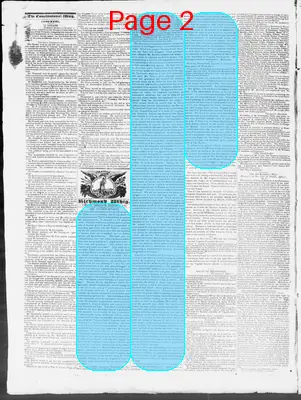
Editorial
March 11, 1831
Constitutional Whig
Richmond, Virginia
What is this article about?
The Richmond Whig defends Senators Tyler and Tazewell's criticism of President Jackson's unconstitutional secret mission to Turkey, rebuking Enquirer editor Thomas Ritchie for his hypocritical mild disapproval and accusing him of manipulating Virginia's political stance to favor the Administration.
Clipping
OCR Quality
95%
Excellent
Full Text
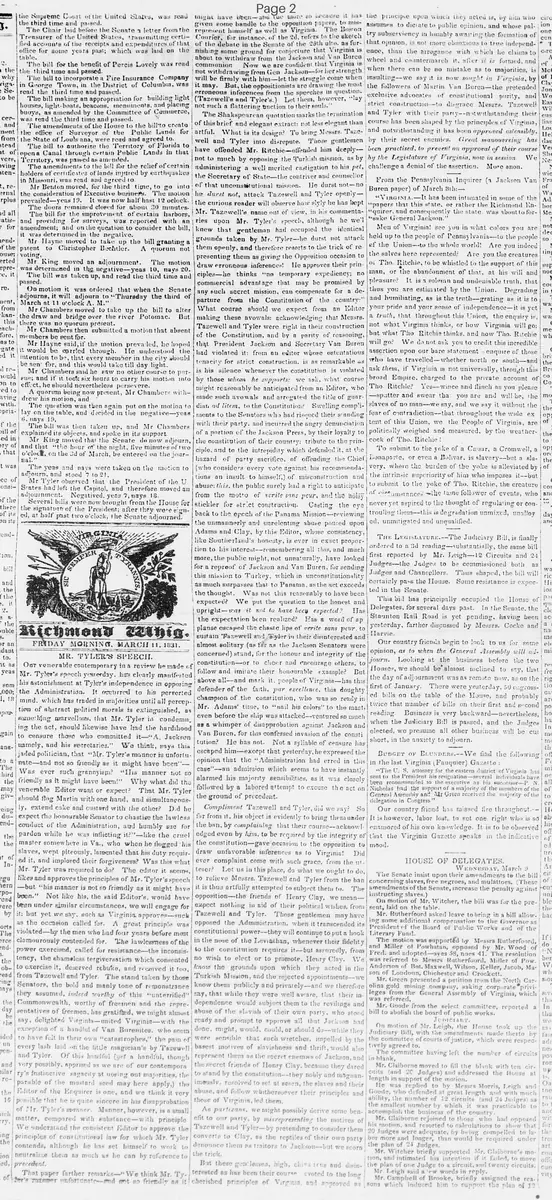
RICHMOND WHIG.
FRIDAY MORNING, MARCH 4, 1831.
MR. TYLER'S SPEECH.
Our venerable contemporary in a review he made of Mr. Tyler's speech yesterday, has clearly manifested his astonishment at Tyler's independence in opposing the Administration.
It recurred to his perverted mind, which was trained in majorities until all perception of abstract political morals is extinguished, as something marvellous, that Mr. Tyler in condemning the act, should likewise have had the hardihood to censure those who committed it—namely, A. Jackson and his secretaries.
We think, says this jaded politician, that "Mr. Tyler's manner is unfortunate—and not so friendly as it might have been"—
Was ever such grannyism?
"His manner not so friendly as it might have been!"
Why what did the venerable Editor want or expect?
That Mr. Tyler should flog Martin with one hand, and simultaneously, extend cake and custard with the other? Did he expect the honourable Senator to chastise the lawless conduct of the Administration, and humbly sue for pardon while he was inflicting it?—like the cruel master somewhere in Va., who when he flogged his slaves, wept piteously, lamented that his duty required it, and implored their forgiveness? Was this what Mr. Tyler was required to do? The editor it seems, likes and approves the principles of Mr. Tyler's speech—but "his manner is not so friendly as it might have been."
Not like his, the said Editor's, would have been under similar circumstances, we will engage for it; but yet we say, such as Virginia approves—such as the occasion called for.
A great principle was violated—by the men who had four years before most clamourously contended for. The lawlessness of the power exercised, called for resistance—the inconsistency, the shameless tergiversation which consented to exercise it, deserved rebuke, and received it too, from Tazewell and Tyler. The stand taken by those Senators, the bold and manly tone of remonstrance they assumed, indeed worthy of this "unterrified" Commonwealth, worthy of freemen and the representatives of freemen, has gratified, we might almost say, delighted Virginia—united Virginia—with the exception of a handful of Van Burenites, who seem to have felt in their own "catastrophes," the pain of every lash laid on the little magician by Tazewell and Tyler. Of this handful (yet a handful, though very possibly, apprised as we are of our contemporary's instinctive sagacity at nosing out majorities, the parable of the mustard seed may here apply,) the Editor of the Enquirer is one, and we think it very possible that he is quite sincere in his disapprobation of Mr. Tyler's manner. Manner, however, is a small matter, compared with substance—with principle.
We understand the consistent Editor to approve the principles of constitutional law for which Mr. Tyler contends, although he has set himself to work to neutralize them as much as he can by reference to precedent.
That paper further remarks—“We think Mr. Tyler's manner unfortunate—and not so friendly as it might have been—and the more so because it has given some handle to the opposition papers, to misrepresent himself as well as Virginia. The Boston Courier, for instance, of the 2d, refers to the sketch of the debate in the Senate of the 28th ulto. as furnishing some ground for conjecture that Virginia is about to withdraw from the Jackson and Van Buren communion. Now we are confident that Virginia is not withdrawing from Gen. Jackson—for her strength will be firmly with him—let the struggle come when it may. But, the oppositionists are drawing the most erroneous inferences from the speeches in question. (Tazewell's and Tyler's.) Let them, however, "lay not such a flattering unction to their souls."
The Shakspearean quotation marks the termination of this brief and elegant extract: not less elegant than artful. What is its design? To bring Messrs. Tazewell and Tyler into disrepute. Those gentlemen have offended Mr. Ritchie—offended him deeply—not so much by opposing the Turkish mission, as by administering a well merited castigation to his pet, the Secretary of State—the contriver and counsellor of that unconstitutional mission. He durst not—no he durst not, attack Tazewell and Tyler openly—the curious reader will observe how slyly he has kept Mr. Tazewell's name out of view, in his commentaries upon Mr. Tyler's speech, although he well knew that gentleman had occupied the identical grounds taken by Mr. Tyler—he durst not attack them openly, and therefore resorts to the trick of representing them as giving the Opposition occasion to draw erroneous inferences! He approves their principles—he thinks "no temporary expediency; no commercial advantage that may be promised by any such secret mission, can compensate for a departure from the Constitution of the country:"
What course should we expect from an Editor making these avowals: acknowledging that Messrs. Tazewell and Tyler were right in their construction of the Constitution, and by a parity of reasoning, that President Jackson and Secretary Van Buren had violated it: from an editor whose ostentatious tenacity for strict construction, is as remarkable as is his silence whenever the constitution is violated by those whom he supports: we ask, what course might reasonably be anticipated from an Editor, who made such avowals and arrogated the title of guardian ad litem, to the Constitution? Swelling compliments to the Senators who had risked their standing with their party, and incurred the angry denunciation of a portion of the Jackson Press, by their loyalty to the constitution of their country: tribute to the principle, and to the intrepidity which defended it, at the hazard of party sacrifice, of offending the Chief (who considers every vote against his recommendations an insult to himself,) of misconstruction and abuse: this, the public surely had a right to anticipate from the motto of verite sans peur, and the noisy stickler for strict construction. Casting the eye back to the epoch of the Panama Mission—reviewing the unmannerly and unrelenting abuse poured upon Adams and Clay, by this Editor, whose consistency, like Southerland's honesty, is ever in exact proportion to his interest—remembering all this, and much more, the public might, not unnaturally, have looked for a reproof of Jackson and Van Buren, for sending this mission to Turkey, which in unconstitutionality as much surpasses that to Panama, as the act exceeds the thought. Was not this reasonably to have been expected? We put the question to the honest and upright—was it not to have been expected? Has the expectation been realized? Has a word of applause escaped the chaste lips of verite sans peur, to sustain Tazewell and Tyler in their disinterested and almost solitary (as far as the Jackson Senators were concerned) stand, for the honour and integrity of the constitution—or to cheer and encourage others, to follow and imitate their honourable example? But above all—and mark it, people of Virginia—has this defender of the faith, par excellence, this doughty champion of the constitution, who was so ready in Mr. Adams' time, to "nail his colors" to the mast, even before the ship was attacked—ventured so much as a whimper of disapprobation against Jackson and Van Buren, for this confessed invasion of the constitution? He has not. Not a syllable of censure has escaped him—except that yesterday, he expressed the opinion that the "Administration had erred in this case"—an admission which seems to have instantly alarmed his majority sensibilities, as it was closely followed by a labored attempt to excuse the act on the ground of precedent.
Compliment Tazewell and Tyler, did we say? So far from it, his object is evidently to bring them under the ban, by complaining that their course—acknowledged even by him, to be required by the integrity of the constitution—gave occasion to the opposition to draw unfavorable inferences as to Virginia! Did ever complaint come with such grace, from the utterer? Let us in this place, do what we ought to do, to relieve Messrs. Tazewell and Tyler from the ban it is thus artfully attempted to subject them to. The opposition—the friends of Henry Clay, we mean—expect nothing in aid of their political wishes, from Tazewell and Tyler. Those gentlemen may have opposed the Administration, when it transcended its constitutional power—they will continue to put a hook in the nose of the Leviathan, whenever their fidelity to the constitution requires it—but assuredly, from no wish to elect or to promote, Henry Clay. We know the grounds upon which they acted in the Turkish Mission, and the rejected appointments—we know them publicly and privately—and we therefore say, that while they were well aware, that their independence would subject them to the revilings and abuse of the slavish of their own party, who stood ready and prompt to approve all that Jackson had done, might, would, could, or should do—while they were sensible that such wretches, impelled by the basest motives of slavishness and thrift, would also represent them as the secret enemies of Jackson, and the secret friends of Henry Clay, because they dared to stand by the constitution—they nobly and magnanimously, resolutely resolved to set at scorn, the slaves and their abuse, and follow whithersoever their principles and those of Virginia, led them.
As partisans, we might possibly derive some benefit to our party, by misrepresenting the motives of Tazewell and Tyler—by pretending to consider them converts to Clay, as the reptiles of their own party denounce them as traitors to Jackson—but we scorn the trick.
But these gentlemen, high, chivalrous and disinterested as have been their course devoted to the long cherished principles of Virginia, and approved as the principle upon which they acted is, by him who assumes to dictate to public opinion, and whose paltry subserviency in humbly awaiting the formation of that opinion, is not more obnoxious to true independence, than the arrogance with which he claims to wheel and countermarch it, after it is formed, and when there can be no mistake as to majorities, is insulting—we say it is now sought in Virginia, by the followers of Martin Van Buren—the pretended exclusive advocates of constitutional purity, and strict construction—to disgrace Messrs. Tazewell and Tyler with their party—notwithstanding their course has been shaped by the principles of Virginia, and notwithstanding it has been approved ostensibly, by their secret enemies. Great manoeuvring has been practised, to prevent an approval of their course by the Legislature of Virginia, now in session.
We challenge a denial of the assertion. More anon.
From the Pennsylvania Inquirer (a Jackson Van Buren paper) of March 8th:-
"VIRGINIA.—It has been intimated in some of the papers that this state, or rather the Richmond Enquirer, and consequently the state, was about to forsake General Jackson."
Men of Virginia! see you in what colors you are held up to the people of Pennsylvania—to the people of the Union—to the whole world! Are you indeed the slaves here represented: Are you the creatures of Tho. Ritchie, to be whistled to the support of this man, or the abandonment of that, at his will and pleasure? It is a solemn and undeniable truth, that thus you are estimated by the Union. Degrading and humiliating, as is the truth—grating as it is to your pride and your sense of independence—it is yet a truth, that throughout this Union, the enquiry is, not what Virginia thinks, or how Virginia will go; but what Tho. Ritchie thinks, and how Tho. Ritchie will go? We do not ask you to credit this incredible assertion upon our bare statement—enquire of those who have travelled—whether north or south—and ask them, if Virginia is not universally, through this broad Empire, charged to the private account of Tho. Ritchie? Yes—wince and flinch as you please—sputter and swear that you are and will be, the slaves of no man—we say, and we say it without the fear of contradiction—that throughout the wide extent of this Union, we the People of Virginia, are politically weighed and measured, by the weather-cock of Tho. Ritchie!
To submit to the yoke of a Caesar, a Cromwell, a Bonaparte, or even a Bolivar, is slavery—but a slavery, where the burden of the yoke is alleviated by the intrinsic superiority of him who imposes it—but to submit to the yoke of Tho. Ritchie, the creature of circumstances—the tame follower of events, who never yet aspired to the thought of regulating or controlling them—this is degradation unmixed, unalloyed, unmitigated and unqualified.
FRIDAY MORNING, MARCH 4, 1831.
MR. TYLER'S SPEECH.
Our venerable contemporary in a review he made of Mr. Tyler's speech yesterday, has clearly manifested his astonishment at Tyler's independence in opposing the Administration.
It recurred to his perverted mind, which was trained in majorities until all perception of abstract political morals is extinguished, as something marvellous, that Mr. Tyler in condemning the act, should likewise have had the hardihood to censure those who committed it—namely, A. Jackson and his secretaries.
We think, says this jaded politician, that "Mr. Tyler's manner is unfortunate—and not so friendly as it might have been"—
Was ever such grannyism?
"His manner not so friendly as it might have been!"
Why what did the venerable Editor want or expect?
That Mr. Tyler should flog Martin with one hand, and simultaneously, extend cake and custard with the other? Did he expect the honourable Senator to chastise the lawless conduct of the Administration, and humbly sue for pardon while he was inflicting it?—like the cruel master somewhere in Va., who when he flogged his slaves, wept piteously, lamented that his duty required it, and implored their forgiveness? Was this what Mr. Tyler was required to do? The editor it seems, likes and approves the principles of Mr. Tyler's speech—but "his manner is not so friendly as it might have been."
Not like his, the said Editor's, would have been under similar circumstances, we will engage for it; but yet we say, such as Virginia approves—such as the occasion called for.
A great principle was violated—by the men who had four years before most clamourously contended for. The lawlessness of the power exercised, called for resistance—the inconsistency, the shameless tergiversation which consented to exercise it, deserved rebuke, and received it too, from Tazewell and Tyler. The stand taken by those Senators, the bold and manly tone of remonstrance they assumed, indeed worthy of this "unterrified" Commonwealth, worthy of freemen and the representatives of freemen, has gratified, we might almost say, delighted Virginia—united Virginia—with the exception of a handful of Van Burenites, who seem to have felt in their own "catastrophes," the pain of every lash laid on the little magician by Tazewell and Tyler. Of this handful (yet a handful, though very possibly, apprised as we are of our contemporary's instinctive sagacity at nosing out majorities, the parable of the mustard seed may here apply,) the Editor of the Enquirer is one, and we think it very possible that he is quite sincere in his disapprobation of Mr. Tyler's manner. Manner, however, is a small matter, compared with substance—with principle.
We understand the consistent Editor to approve the principles of constitutional law for which Mr. Tyler contends, although he has set himself to work to neutralize them as much as he can by reference to precedent.
That paper further remarks—“We think Mr. Tyler's manner unfortunate—and not so friendly as it might have been—and the more so because it has given some handle to the opposition papers, to misrepresent himself as well as Virginia. The Boston Courier, for instance, of the 2d, refers to the sketch of the debate in the Senate of the 28th ulto. as furnishing some ground for conjecture that Virginia is about to withdraw from the Jackson and Van Buren communion. Now we are confident that Virginia is not withdrawing from Gen. Jackson—for her strength will be firmly with him—let the struggle come when it may. But, the oppositionists are drawing the most erroneous inferences from the speeches in question. (Tazewell's and Tyler's.) Let them, however, "lay not such a flattering unction to their souls."
The Shakspearean quotation marks the termination of this brief and elegant extract: not less elegant than artful. What is its design? To bring Messrs. Tazewell and Tyler into disrepute. Those gentlemen have offended Mr. Ritchie—offended him deeply—not so much by opposing the Turkish mission, as by administering a well merited castigation to his pet, the Secretary of State—the contriver and counsellor of that unconstitutional mission. He durst not—no he durst not, attack Tazewell and Tyler openly—the curious reader will observe how slyly he has kept Mr. Tazewell's name out of view, in his commentaries upon Mr. Tyler's speech, although he well knew that gentleman had occupied the identical grounds taken by Mr. Tyler—he durst not attack them openly, and therefore resorts to the trick of representing them as giving the Opposition occasion to draw erroneous inferences! He approves their principles—he thinks "no temporary expediency; no commercial advantage that may be promised by any such secret mission, can compensate for a departure from the Constitution of the country:"
What course should we expect from an Editor making these avowals: acknowledging that Messrs. Tazewell and Tyler were right in their construction of the Constitution, and by a parity of reasoning, that President Jackson and Secretary Van Buren had violated it: from an editor whose ostentatious tenacity for strict construction, is as remarkable as is his silence whenever the constitution is violated by those whom he supports: we ask, what course might reasonably be anticipated from an Editor, who made such avowals and arrogated the title of guardian ad litem, to the Constitution? Swelling compliments to the Senators who had risked their standing with their party, and incurred the angry denunciation of a portion of the Jackson Press, by their loyalty to the constitution of their country: tribute to the principle, and to the intrepidity which defended it, at the hazard of party sacrifice, of offending the Chief (who considers every vote against his recommendations an insult to himself,) of misconstruction and abuse: this, the public surely had a right to anticipate from the motto of verite sans peur, and the noisy stickler for strict construction. Casting the eye back to the epoch of the Panama Mission—reviewing the unmannerly and unrelenting abuse poured upon Adams and Clay, by this Editor, whose consistency, like Southerland's honesty, is ever in exact proportion to his interest—remembering all this, and much more, the public might, not unnaturally, have looked for a reproof of Jackson and Van Buren, for sending this mission to Turkey, which in unconstitutionality as much surpasses that to Panama, as the act exceeds the thought. Was not this reasonably to have been expected? We put the question to the honest and upright—was it not to have been expected? Has the expectation been realized? Has a word of applause escaped the chaste lips of verite sans peur, to sustain Tazewell and Tyler in their disinterested and almost solitary (as far as the Jackson Senators were concerned) stand, for the honour and integrity of the constitution—or to cheer and encourage others, to follow and imitate their honourable example? But above all—and mark it, people of Virginia—has this defender of the faith, par excellence, this doughty champion of the constitution, who was so ready in Mr. Adams' time, to "nail his colors" to the mast, even before the ship was attacked—ventured so much as a whimper of disapprobation against Jackson and Van Buren, for this confessed invasion of the constitution? He has not. Not a syllable of censure has escaped him—except that yesterday, he expressed the opinion that the "Administration had erred in this case"—an admission which seems to have instantly alarmed his majority sensibilities, as it was closely followed by a labored attempt to excuse the act on the ground of precedent.
Compliment Tazewell and Tyler, did we say? So far from it, his object is evidently to bring them under the ban, by complaining that their course—acknowledged even by him, to be required by the integrity of the constitution—gave occasion to the opposition to draw unfavorable inferences as to Virginia! Did ever complaint come with such grace, from the utterer? Let us in this place, do what we ought to do, to relieve Messrs. Tazewell and Tyler from the ban it is thus artfully attempted to subject them to. The opposition—the friends of Henry Clay, we mean—expect nothing in aid of their political wishes, from Tazewell and Tyler. Those gentlemen may have opposed the Administration, when it transcended its constitutional power—they will continue to put a hook in the nose of the Leviathan, whenever their fidelity to the constitution requires it—but assuredly, from no wish to elect or to promote, Henry Clay. We know the grounds upon which they acted in the Turkish Mission, and the rejected appointments—we know them publicly and privately—and we therefore say, that while they were well aware, that their independence would subject them to the revilings and abuse of the slavish of their own party, who stood ready and prompt to approve all that Jackson had done, might, would, could, or should do—while they were sensible that such wretches, impelled by the basest motives of slavishness and thrift, would also represent them as the secret enemies of Jackson, and the secret friends of Henry Clay, because they dared to stand by the constitution—they nobly and magnanimously, resolutely resolved to set at scorn, the slaves and their abuse, and follow whithersoever their principles and those of Virginia, led them.
As partisans, we might possibly derive some benefit to our party, by misrepresenting the motives of Tazewell and Tyler—by pretending to consider them converts to Clay, as the reptiles of their own party denounce them as traitors to Jackson—but we scorn the trick.
But these gentlemen, high, chivalrous and disinterested as have been their course devoted to the long cherished principles of Virginia, and approved as the principle upon which they acted is, by him who assumes to dictate to public opinion, and whose paltry subserviency in humbly awaiting the formation of that opinion, is not more obnoxious to true independence, than the arrogance with which he claims to wheel and countermarch it, after it is formed, and when there can be no mistake as to majorities, is insulting—we say it is now sought in Virginia, by the followers of Martin Van Buren—the pretended exclusive advocates of constitutional purity, and strict construction—to disgrace Messrs. Tazewell and Tyler with their party—notwithstanding their course has been shaped by the principles of Virginia, and notwithstanding it has been approved ostensibly, by their secret enemies. Great manoeuvring has been practised, to prevent an approval of their course by the Legislature of Virginia, now in session.
We challenge a denial of the assertion. More anon.
From the Pennsylvania Inquirer (a Jackson Van Buren paper) of March 8th:-
"VIRGINIA.—It has been intimated in some of the papers that this state, or rather the Richmond Enquirer, and consequently the state, was about to forsake General Jackson."
Men of Virginia! see you in what colors you are held up to the people of Pennsylvania—to the people of the Union—to the whole world! Are you indeed the slaves here represented: Are you the creatures of Tho. Ritchie, to be whistled to the support of this man, or the abandonment of that, at his will and pleasure? It is a solemn and undeniable truth, that thus you are estimated by the Union. Degrading and humiliating, as is the truth—grating as it is to your pride and your sense of independence—it is yet a truth, that throughout this Union, the enquiry is, not what Virginia thinks, or how Virginia will go; but what Tho. Ritchie thinks, and how Tho. Ritchie will go? We do not ask you to credit this incredible assertion upon our bare statement—enquire of those who have travelled—whether north or south—and ask them, if Virginia is not universally, through this broad Empire, charged to the private account of Tho. Ritchie? Yes—wince and flinch as you please—sputter and swear that you are and will be, the slaves of no man—we say, and we say it without the fear of contradiction—that throughout the wide extent of this Union, we the People of Virginia, are politically weighed and measured, by the weather-cock of Tho. Ritchie!
To submit to the yoke of a Caesar, a Cromwell, a Bonaparte, or even a Bolivar, is slavery—but a slavery, where the burden of the yoke is alleviated by the intrinsic superiority of him who imposes it—but to submit to the yoke of Tho. Ritchie, the creature of circumstances—the tame follower of events, who never yet aspired to the thought of regulating or controlling them—this is degradation unmixed, unalloyed, unmitigated and unqualified.
What sub-type of article is it?
Constitutional
Partisan Politics
Foreign Affairs
What keywords are associated?
Tyler Speech
Turkish Mission
Constitutional Violation
Jackson Administration
Thomas Ritchie
Virginia Politics
Partisan Criticism
What entities or persons were involved?
John Tyler
Littleton Tazewell
Andrew Jackson
Martin Van Buren
Thomas Ritchie
Richmond Enquirer
Editorial Details
Primary Topic
Defense Of Tyler And Tazewell's Opposition To The Unconstitutional Turkish Mission
Stance / Tone
Strongly Supportive Of Constitutional Strict Construction; Harshly Critical Of Jackson Administration And Thomas Ritchie
Key Figures
John Tyler
Littleton Tazewell
Andrew Jackson
Martin Van Buren
Thomas Ritchie
Richmond Enquirer
Key Arguments
Tyler's Speech Appropriately Condemns The Administration's Unconstitutional Turkish Mission And Censures Jackson And His Secretaries
Ritchie's Disapproval Of Tyler's 'Unfriendly Manner' Is Hypocritical Grannyism, As He Approves The Principles But Seeks To Undermine Them
Tazewell And Tyler's Bold Remonstrance Unites Virginia Against Lawless Executive Power
Ritchie Slyly Attacks The Senators By Suggesting Their Stance Aids Opposition Misrepresentations
Ritchie's Silence On Jackson's Constitutional Violations Contrasts With His Past Strict Construction Advocacy
Virginia's Political Will Is Not Dictated By Ritchie, Despite Perceptions In The Union