Thank you for visiting SNEWPapers!
Sign up free
Constitutional Whig
Richmond, Virginia
What is this article about?
The Constitutional Whig reports on Ohio elections suggesting a defeat for Jackson supporters and reprints a valedictory letter from Congressman P. P. Barbour, retiring after 16 years, advocating strict constitutional construction and urging moderation on tariff policies to preserve union harmony.
Merged-components note: These two components form the complete valedictory letter from P.P. Barbour, spanning adjacent columns on page 1. The initial label of 'story' for the first component is incorrect; it is a political letter.
Clipping
OCR Quality
Full Text
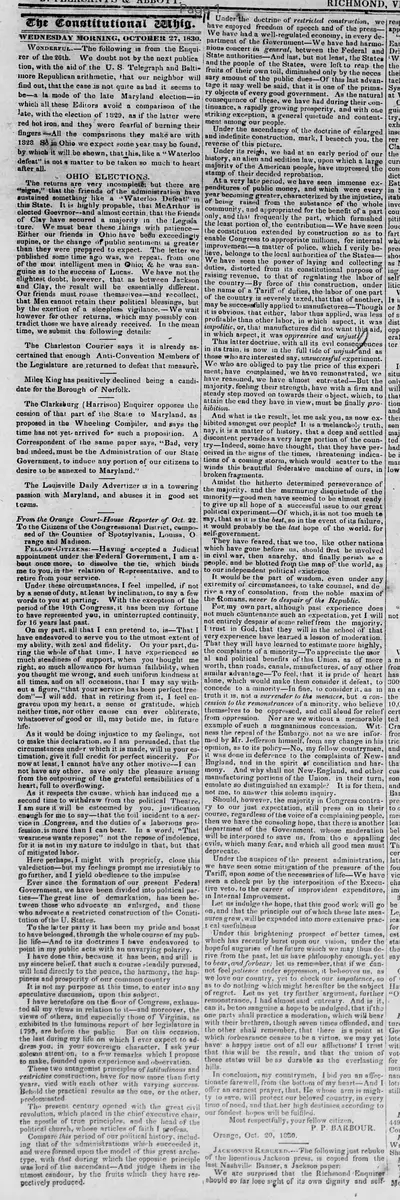
WEDNESDAY MORNING, OCTOBER 27, 1830.
Wonderful.—The following is from the Enquirer of the 26th. We doubt not by the next publication, with the aid of the U. S. Telegraph and Baltimore Republican arithmetic, that our neighbor will find out, that the case is not quite as bad it seems to be—a la mode of the late Maryland election—in which all these Editors avoid a comparison of the late, with the election of 1829, as if the latter were red hot iron, and they were fearful of burning their fingers. All the comparisons they make are with 1828. So in Ohio we expect some year may be found, by which it will be shewn, that this, like a "Waterloo defeat" is not a matter to be taken so much to heart after all.
OHIO ELECTIONS.
The returns are very incomplete; but there are "signs," that the friends of the administration have sustained something like a "Waterloo Defeat" in this State. It is highly probable, that McArthur is elected Governor—and almost certain, that the friends of Clay have secured a majority in the Legislature. We must bear these things with patience—Either our friends in Ohio have been exceedingly supine, or the change of public sentiment is greater than they were prepared to expect. The letter we published some time ago was, we repeat, from one of the most intelligent men in Ohio; & he was sanguine as to the success of Lucas. We have not the slightest doubt, however, that as between Jackson and Clay, the result will be essentially different. Our friends must rouse themselves—and recollect, that Men cannot retain their political blessings, but by the exertion of a sleepless vigilance.—We wait however for other returns, which may possibly contradict those we have already received. In the mean time, we submit the following details:
The Charleston Courier says it is already ascertained that enough Anti-Convention Members of the Legislature are returned to defeat that measure.
Miles King has positively declined being a candidate for the Borough of Norfolk.
The Clarksburg (Harrison) Enquirer opposes the cession of that part of the State to Maryland, as proposed in the Wheeling Compiler, and says the time has not yet arrived for such a proposition. A Correspondent of the same paper says, "Bad, very bad indeed, must be the Administration of our State Government, to induce any portion of our citizens to desire to be annexed to Maryland."
The Louisville Daily Advertiser is in a towering passion with Maryland, and abuses it in good set terms.
From the Orange Court-House Reporter of Oct. 22.
To the Citizens of the Congressional District, composed of the Counties of Spotsylvania, Louisa, Orange and Madison.
Fellow-Citizens: Having accepted a Judicial appointment under the Federal Government, I am about once more, to dissolve the tie, which binds me to you, in the relation of Representative, and to retire from your service.
Under these circumstances, I feel impelled, if not by a sense of duty, at least by inclination, to say a few words to you at parting.
With the exception of the period of the 19th Congress, it has been my fortune to have represented you, in uninterrupted continuity, for 16 years last past.
On my part, all that I can pretend to, is—That I have endeavored to serve you to the utmost extent of my ability, with zeal and fidelity. On your part, during the whole of that time, I have experienced so much steadiness of support, when you thought me right, so much allowance for human fallibility, when you thought me wrong, and such uniform kindness at all times, and on all occasions, that I may say without a figure, "that your service has been perfect freedom"—I will add, that in retiring from it, I feel engraven upon my heart, a sense of gratitude, which neither time, nor other cause can ever obliterate, whatsoever of good or ill, may betide me, in future life.
As it would be doing injustice to my feelings, not to make this declaration, so I am persuaded, that the circumstances under which it is made, will in your estimation, give it full credit for perfect sincerity. For now at least, I cannot have any other motive—I cannot have any other, save only the pleasure arising from the outpouring of the grateful sensibilities of a heart, full to overflowing.
As it respects the cause, which has induced me a second time to withdraw from the political Theatre, I am sure it will be esteemed by you, justification enough for me to say—that the toil incident to a service in Congress, and the duties of a laborious profession, is more than I can bear. In a word, "That weariness wants repose;" not the repose of indolence, for it is not in my nature to indulge in that, but that of mitigated labor.
Here perhaps, I might with propriety, close this valediction—but my feelings prompt me irresistibly to go further, and I yield obedience to the impulse.
Ever since the formation of our present Federal Government, we have been divided into political parties—The great line of demarkation, has been between those who advocate an enlarged, and those who advocate a restricted construction of the Constitution of the U. States.
To the latter party it has been my pride and boast to have belonged, through the whole course of my public life—And to its doctrines I have endeavored to point in my public acts with an unvarying polarity.
I have done this, because it has been, and still is my sincere belief, that such a Course—steadily pursued, will lead directly to the peace, the harmony, the happiness and prosperity of our common country.
It is not my purpose at this time, to enter into any speculative discussion, upon this subject.
I have heretofore on the floor of Congress, exhausted all my views in relation to it—and moreover, the views of others, and especially those of Virginia, as exhibited in the luminous report of her legislature in 1799, are before the public. But on this occasion, the last during my life on which I ever expect to address you, in your sovereign character, I ask your solemn attention, to a few remarks which I propose to make, founded upon experience and observation.
These two antagonist principles of latitudinous and restrictive construction, have for now more than forty years, vied with each other with varying success.
Behold the practical results as the one, or the other predominated.
The present century opened with the great civil revolution, which placed in the chief executive chair, the apostle of true principles, and the head of the political church, whose articles of faith I profess.
Compare this period of our political history, including that of the administrations which succeeded it, and were formed upon the model of this great archetype, with that during which the opposite principle was lord of the ascendant—And judge them in the utmost candour, by the fruits which they have respectively produced.
Under the doctrine of restricted construction, we have enjoyed freedom of speech and of the press—We have had a well-regulated economy, in every department of the Government—We have had harmonious concert in general, between the Federal and State authorities—And last, but not least, the States and the people of the States, were left to reap the fruits of their own toil, diminished only by the necessary amount of the public dues—Of this last advantage it may well be said, that it is one of the primary objects of every good government. As the natural consequence of these, we have had during their continuance, a rapidly growing prosperity, and with one striking exception, a general quietude and contentment among our people.
Under the ascendancy of the doctrine of enlarged and indefinite construction, mark, I beseech you, the reverse of this picture.
Under its reign, we had at an early period of our history, an alien and sedition law, upon which a large majority of the American people, have impressed the stamp of their decided reprobation.
At a very late period, we have seen immense expenditures of public money, and which were every year becoming greater, characterized by the injustice, of being raised from the substance of the whole community, and appropriated for the benefit of a part only, and that frequently the part, which furnished the least portion of the contribution—We have seen the constitution extended by construction so as to enable Congress to appropriate millions, for internal improvement—a matter of police, which I verily believe, belongs to the local authorities of the States—We have seen the power of laying and collecting duties, distorted from its constitutional purpose of raising revenue, to that of regulating the labor of the country—By force of this construction, under the name of a Tariff of duties, the labor of one part of the country is severely taxed, that that of another, may be successfully applied to manufactures—Though it is obvious, that either, labor thus applied, was less profitable than other labor, in which aspect, it was impolitic, or, that manufactures did not want this aid, in which aspect, it was oppressive and unjust!
This latter doctrine, with all its evil consequences in its train, is now in the full tide of unjust, and as those who are interested say, unsuccessful experiment.
We who are obliged to pay the price of this experiment, have complained, we have remonstrated, we have reasoned, we have almost entreated—But the majority, feeling their strength, have with a firm and steady step moved on towards their object, which, to attain the end they have in view, must be finally prohibition.
And what is the result, let me ask you, as now exhibited amongst our people? It is a melancholy truth, nay, it is a matter of history, that a deep and settled discontent pervades a very large portion of the country—Indeed, some have thought, that they have perceived in the signs of the times, threatening indications of a coming storm, which would scatter to the winds this beautiful federative machine of ours, in broken fragments.
Amidst the hitherto determined perseverance of the majority, and the murmuring disquietude of the minority—good men have seemed to be almost ready to give up all hope of a successful issue to our great political experiment—Of which, it is not too much to say, that as it is the best, so in the event of its failure, it would probably be the last hope of the world, for self-government.
They have feared, that we too, like other nations which have gone before us, should first be involved in civil war, then anarchy, and finally perish as a people, and be blotted from the map of the world, as to our independent political existence.
It would be the part of wisdom, even under any extremity or circumstances, to take counsel, and derive a ray of consolation, from the noble maxim of the Romans, never to despair of the Republic.
For my own part, although past experience does not much countenance such an expectation, yet I will not entirely despair of some relief from the majority.
I trust in God, that they will in the school of that very experience have learned a lesson of moderation.
That they will have learned to estimate more highly, the complaints of a minority—To appreciate the moral and political benefits of this Union, as of more worth, than roads, canals, manufactures, or any other similar advantage—To feel, that it is pride of heart alone, which would make them consider it defeat, to concede to a minority—In fine, to consider it, as in truth it is, not a surrender to the menaces, but a concession to the remonstrances of a minority, who believe themselves to be oppressed, and call aloud for relief from oppression. Nor are we without a memorable example of such a magnanimous concession. Witness the repeal of the Embargo, not as we are informed by Mr. Jefferson himself, from any change in his opinion, as to its policy—No, my fellow countrymen, it was done in deference to the complaints of New-England, and in the spirit of conciliation and harmony. And why shall not New-England, and other manufacturing portions of the Union, in their turn, emulate so distinguished an example? It is for them, not me, to answer this solemn inquiry.
Should, however, the majority in Congress contrary to our just expectation, still press on in their course, regardless of the voice of a complaining people, then we have the consoling hope, that there is another department of the Government, whose moderation will be interposed to save us, from those appalling evils, which many fear, and which all good men must deprecate.
Under the auspices of the present administration, we have seen some mitigation of the pressure of the Tariff, upon some of the necessaries of life—We have seen a check put by the interposition of the Executive veto, to the career of improvident expenditure, in Internal Improvement.
Let us indulge the hope, that this good work will go on, and that the principle out of which these late measures grew, will be expanded into more extensive practical usefulness.
Under this brightening prospect of better times which has recently burst upon our vision, under the hopeful auguries of the future which we may thus derive from the past, let us have philosophy enough, yet to bear, and forbear; let us remember, that if we cannot feel patience under oppression, it behooves us, as we love our country, yet to check our impatience, so as to do nothing which might hereafter be the subject of regret. Let us yet try further argument, further remonstrance, I had almost said entreaty. And is it, can it, be too sanguine a hope to be indulged, that if the one party shall practice a moderation, which will bear with their brethren, though seven times offended, and the other shall remember, that there is a point at which forbearance ceases to be a virtue, we may yet have a happy issue out of all our afflictions? I trust that this will be the result, and that the union of these states will be as durable as the everlasting hills.
In conclusion, my countrymen, I bid you an affectionate farewell, from the bottom of my heart—And I offer an earnest prayer, that, He whose arm is mighty to save, will protect our beloved country, in every time of need, and that her high destinies according to our fondest hopes will be fulfilled.
Most respectfully, your fellow citizen,
P. P. BARBOUR.
Orange, Oct. 20, 1830.
What sub-type of article is it?
What themes does it cover?
What keywords are associated?
What entities or persons were involved?
Letter to Editor Details
Author
P. P. Barbour
Recipient
To The Citizens Of The Congressional District, Composed Of The Counties Of Spotsylvania, Louisa, Orange And Madison
Main Argument
upon retiring from congress after 16 years due to health and professional demands, the author reaffirms his commitment to strict constitutional construction, contrasts its benefits with loose construction's harms like the tariff, and urges moderation and concession to minority complaints to preserve national harmony and union.
Notable Details