Thank you for visiting SNEWPapers!
Sign up free
The Liberator
Boston, Suffolk County, Massachusetts
What is this article about?
Editorial in The Liberator discusses true charity as loving yet firm rebuke of sins, applied to divisions in anti-slavery organizations. Acting editor introduces piece by E.Q. criticizing 'morbid charity' that excuses secessionist groups like the Massachusetts Abolition Society and Foreign Society, urging fidelity to the American Anti-Slavery Society amid Garrison's absence in London. Dated June 5, 1840.
Merged-components note: Continuation of the editorial 'True and False Charity' split across columns on page 2; adjacent bounding boxes and identical text content indicate single coherent opinion piece.
Clipping
OCR Quality
Full Text
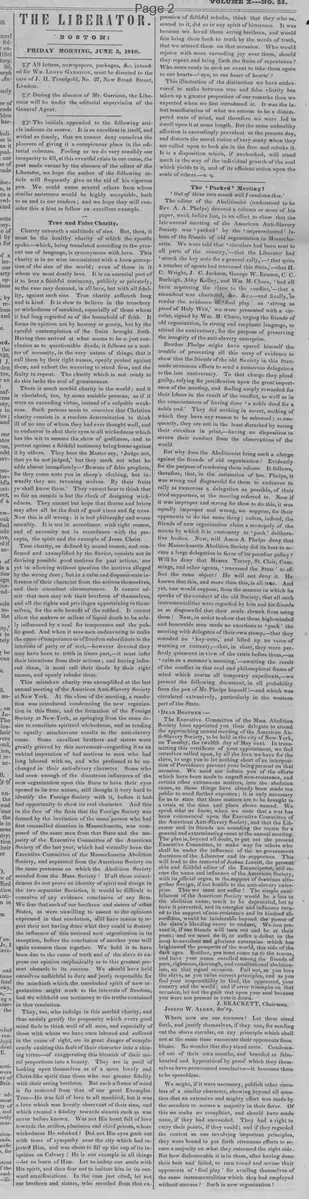
BOSTON:
FRIDAY MORNING, JUNE 5, 1840.
All letters, newspapers, packages, &c. intended for Wm. Lloyd Garrison, must be directed to the care of J. H. Treadgold, No. 27, New Broad Street, London.
During the absence of Mr. Garrison, the Liberator will be under the editorial supervision of the General Agent.
The initials appended to the following article indicate its source. It is so excellent in itself, and withal so timely, that we cannot deny ourselves the pleasure of giving it a conspicuous place in the editorial columns. Feeling as we do very sensibly our incapacity to fill, at this eventful crisis in our cause, the post made vacant by the absence of the editor of the Liberator, we hope the author of the following article will frequently give us the aid of his vigorous pen. We could name several others from whom similar assistance would be highly acceptable, both to us and to our readers; and we hope they will consider this a hint to follow an excellent example.
True and False Charity.
Charity covereth a multitude of sins. But, then, it must be the healthy charity of which the apostle spoke—which, being translated according to the present use of language, is synonymous with love. This charity is in no wise inconsistent with a keen perception of the sins of the world; even of those in it whom we most dearly love. It is an essential part of it to bear a faithful testimony, publicly or privately, as the case may demand, in all love, but with all fidelity, against such sins. True charity suffereth long and is kind. It is slow to believe in the treachery or wickedness of mankind, especially of those whom it had long regarded as of the household of faith. It forms its opinion not by hearsay or gossip, but by the careful contemplation of the fruits brought forth. Having thus arrived at what seems to be a just conclusion as to questionable deeds, it follows as a matter of necessity, in the very nature of things, that it call them by their right names, openly protest against them, and exhort the wavering to stand firm, and the faulty to repent. The charity which is not ready to do this lacks the seal of genuineness.
There is much morbid charity in the world; and it is cherished, too, by some amiable persons, as if it were an exceeding virtue, instead of a culpable weakness. Such persons seem to conceive that Christian charity consists in a resolute determination to think ill of no one of whom they had ever thought well, and to endeavor to shut their eyes to all wickedness which has the wit to assume the show of godliness, and to protest against a faithful testimony being borne against it by others. They hear the Master say, 'Judge not, that ye be not judged,' but they mark not what he adds almost immediately—'Beware of false prophets, for they come unto you in sheep's clothing, but inwardly they are ravening wolves. By their fruits ye shall know them.' They cannot bear to think that so fair an outside is but the cloak of designing wickedness. They cannot but hope that thorns and briers may after all be the fruit of good vines and fig trees.
Now this is all wrong: it is bad philosophy and worse morality. It is not in accordance with right reason, and of necessity not in accordance with the precepts, the spirit and the example of Jesus Christ.
True charity, as defined by sound reason, and confirmed and exemplified by the Savior, consists not in devising possible good motives for past actions, nor yet in allowing without question the motives alleged by the wrong doer; but in a calm and dispassionate inference of their character from the actions themselves, and their attendant circumstances. It cannot admit that men may rob their brethren of themselves, and all the rights and privileges appertaining to themselves, for the sole benefit of the robbed. It cannot allow the makers or sellers of liquid death to be solely influenced by a zeal for temperance and the public good. And when it sees men endeavoring to make the cause of temperance or of freedom subordinate to the interests of party or of sect,—however devoted they may have been to truth in times past,—it must infer their intentions from their actions; and having inferred them, it must call their deeds by their right names, and openly rebuke them.
This mistaken charity was exemplified at the last annual meeting of the American Anti-Slavery Society at New York. At the close of the meeting, a resolution was introduced condemning the new organization in this State, and the formation of the Foreign Society at New-York, as springing from the same desire to conciliate spiritual wickedness, and as tending to equally mischievous results to the anti-slavery cause. Some excellent brothers and sisters were greatly grieved by this movement—regarding it as an unkind imputation of bad motives to men who had long labored with us, and who professed to be unchanged in their anti-slavery character. Some who had seen enough of the disastrous influences of the new organization upon this State to have their eyes opened to its true nature, still thought it very hard to identify the Foreign Society with it, before it had had opportunity to show its real character. And this in the face of the facts that the Foreign Society was formed by the invitation of the same person who had first counselled disunion in Massachusetts, was composed of the same men from that State and the majority of the Executive Committee of the American Society of the last year, which had virtually been the Executive Committee of the Massachusetts Abolition Society, and separated from the American Society on the same pretences on which the Abolition Society seceded from the Mass. Society! If all these coincidences do not prove an identity of spirit and design in the two separatist Societies, it would be difficult to conceive of any evidence conclusive of any facts.
We fear that such of our brethren and sisters of other States, as were unwilling to assent to the opinions expressed in that resolution, will have reason to regret their not having done what they could to destroy the influence of this national new organization in its inception, before the conclusion of another year will again summon them together. We hold it to have been due to the cause of truth and of the slave to express our opinion emphatically as to this greatest present obstacle to its success. We should have held ourselves unfaithful to duty and justly responsible for the mischiefs which the unrebuked spirit of new organization might work to the interests of freedom, had we withheld our testimony to the truths contained in that resolution.
They, too, who indulge in this morbid charity, and thus unduly gratify the propensity which every good mind feels to think well of all men, and especially of those with whom we have once labored and suffered in the cause of right, are in great danger of complacently exalting this fault of their character into a shining virtue—of exaggerating this blemish of their moral proportions into a beauty. They are in peril of looking upon themselves as of a more lovely and Christ-like spirit than those who use greater fidelity with their erring brethren. But such a frame of mind is far removed from that of our great Exemplar.
True—He was full of love to all mankind, but it was a love which was keenly observant of their sins, and which created a fidelity towards sinners such as was never before known. Was not His heart full of love towards the scribes, pharisees and chief priests, whose wickedness He rebuked? Did not His eyes gush out with tears of sympathy over the city which had rejected Him, and was about to fill up the cup of its iniquities on Calvary? He is our example in all things—let us learn of Him. Let us imbue our souls with His spirit, and then fear not to imitate him in its outward manifestations. In the case just cited, let not our brethren and sisters, who recoiled from that expression of faithful rebuke, think that they who assented to it, did so in any spirit of bitterness. It was because we loved those erring brethren, and would fain bring them back to truth by the words of truth, that we uttered them on that occasion. Who would rejoice with more exceeding joy over them, should they repent and bring forth the fruits of repentance? Who more ready in such an event to take them again to our hearts—'aye, to our heart of hearts'?
This illustration of the distinction we have endeavored to make between true and false charity has taken up a greater proportion of our remarks than we expected when we first introduced it. It was the latest manifestation of what we esteem to be a distempered state of mind, and therefore we were led to dwell upon it at some length. But the same unhealthy affection is exceedingly prevalent at the present day, and distorts the moral vision of very many when they are called upon to look sin in the face and rebuke it. It is a disposition which, if unchecked, will stand much in the way of the individual growth of the soul which yields to it, and of its efficient action upon the souls of others.—E. Q.
What sub-type of article is it?
What keywords are associated?
What entities or persons were involved?
Editorial Details
Primary Topic
Distinction Between True And False Charity In Rebuking Errors Within The Anti Slavery Movement
Stance / Tone
Advocating Faithful Rebuke Of Secessionist Tendencies In Abolition Societies While Emphasizing Loving Correction
Key Figures
Key Arguments