Thank you for visiting SNEWPapers!
Sign up free
Literary
October 18, 1873
Rapides Gazette
Alexandria, Rapides County, Louisiana
What is this article about?
Essay by H.W. Beecher advising that happiness comes from infusing personal affection, diligence, and positive attitude into daily duties and surroundings, transforming the ordinary and even unpleasant into something beautiful and agreeable.
Clipping
OCR Quality
95%
Excellent
Full Text
How to be Happy.
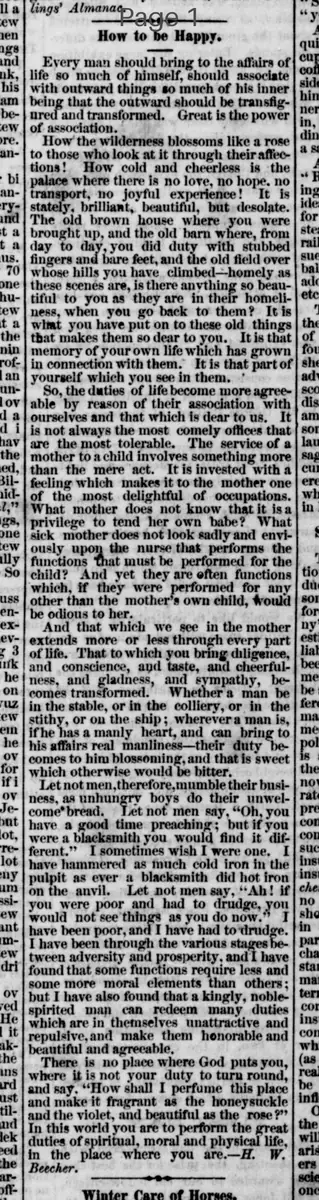
Every man should bring to the affairs of life so much of himself, should associate with outward things so much of his inner being that the outward should be transfigured and transformed. Great is the power of association.
How the wilderness blossoms like a rose to those who look at it through their affections! How cold and cheerless is the palace where there is no love, no hope, no transport, no joyful experience! It is stately, brilliant, beautiful, but desolate. The old brown house where you were brought up, and the old barn where, from day to day, you did duty with stubbed fingers and bare feet, and the old field over whose hills you have climbed—homely as these scenes are, is there anything so beautiful to you as they are in their homeliness, when you go back to them? It is what you have put on to these old things that makes them so dear to you. It is that memory of your own life which has grown in connection with them. It is that part of yourself which you see in them.
So, the duties of life become more agreeable by reason of their association with ourselves and that which is dear to us. It is not always the most comely offices that are the most tolerable. The service of a mother to a child involves something more than the mere act. It is invested with a feeling which makes it to the mother one of the most delightful of occupations. What mother does not know that it is a privilege to tend her own babe? What sick mother does not look sadly and enviously upon the nurse that performs the functions that must be performed for the child? And yet they are often functions which, if they were performed for any other than the mother's own child, would be odious to her.
And that which we see in the mother extends more or less through every part of life. That to which you bring diligence, and conscience, and taste, and cheerfulness, and gladness, and sympathy, becomes transformed. Whether a man be in the stable, or in the colliery, or in the stithy, or on the ship; wherever a man is, if he has a manly heart, and can bring to his affairs real manliness—their duty becomes to him blossoming, and that is sweet which otherwise would be bitter.
Let not men, therefore, mumble their business, as unhungry boys do their unwelcome bread. Let not men say, "Oh, you have a good time preaching; but if you were a blacksmith you would find it different." I sometimes wish I were one. I have hammered as much cold iron in the pulpit as ever a blacksmith did hot iron on the anvil. Let not men say, "Ah! if you were poor and had to drudge, you would not see things as you do now." I have been poor, and I have had to drudge. I have been through the various stages between adversity and prosperity, and I have found that some functions require less and some more moral elements than others; but I have also found that a kingly, noble-spirited man can redeem many duties which are in themselves unattractive and repulsive, and make them honorable and beautiful and agreeable.
There is no place where God puts you, where it is not your duty to turn round and say, "How shall I perfume this place and make it fragrant as the honeysuckle and the violet, and beautiful as the rose?" In this world you are to perform the great duties of spiritual, moral and physical life, in the place where you are.—H. W. Beecher.
Every man should bring to the affairs of life so much of himself, should associate with outward things so much of his inner being that the outward should be transfigured and transformed. Great is the power of association.
How the wilderness blossoms like a rose to those who look at it through their affections! How cold and cheerless is the palace where there is no love, no hope, no transport, no joyful experience! It is stately, brilliant, beautiful, but desolate. The old brown house where you were brought up, and the old barn where, from day to day, you did duty with stubbed fingers and bare feet, and the old field over whose hills you have climbed—homely as these scenes are, is there anything so beautiful to you as they are in their homeliness, when you go back to them? It is what you have put on to these old things that makes them so dear to you. It is that memory of your own life which has grown in connection with them. It is that part of yourself which you see in them.
So, the duties of life become more agreeable by reason of their association with ourselves and that which is dear to us. It is not always the most comely offices that are the most tolerable. The service of a mother to a child involves something more than the mere act. It is invested with a feeling which makes it to the mother one of the most delightful of occupations. What mother does not know that it is a privilege to tend her own babe? What sick mother does not look sadly and enviously upon the nurse that performs the functions that must be performed for the child? And yet they are often functions which, if they were performed for any other than the mother's own child, would be odious to her.
And that which we see in the mother extends more or less through every part of life. That to which you bring diligence, and conscience, and taste, and cheerfulness, and gladness, and sympathy, becomes transformed. Whether a man be in the stable, or in the colliery, or in the stithy, or on the ship; wherever a man is, if he has a manly heart, and can bring to his affairs real manliness—their duty becomes to him blossoming, and that is sweet which otherwise would be bitter.
Let not men, therefore, mumble their business, as unhungry boys do their unwelcome bread. Let not men say, "Oh, you have a good time preaching; but if you were a blacksmith you would find it different." I sometimes wish I were one. I have hammered as much cold iron in the pulpit as ever a blacksmith did hot iron on the anvil. Let not men say, "Ah! if you were poor and had to drudge, you would not see things as you do now." I have been poor, and I have had to drudge. I have been through the various stages between adversity and prosperity, and I have found that some functions require less and some more moral elements than others; but I have also found that a kingly, noble-spirited man can redeem many duties which are in themselves unattractive and repulsive, and make them honorable and beautiful and agreeable.
There is no place where God puts you, where it is not your duty to turn round and say, "How shall I perfume this place and make it fragrant as the honeysuckle and the violet, and beautiful as the rose?" In this world you are to perform the great duties of spiritual, moral and physical life, in the place where you are.—H. W. Beecher.
What sub-type of article is it?
Essay
What themes does it cover?
Moral Virtue
What keywords are associated?
Happiness
Association
Daily Duties
Positive Attitude
Moral Transformation
Personal Affection
What entities or persons were involved?
H. W. Beecher
Literary Details
Title
How To Be Happy.
Author
H. W. Beecher
Key Lines
How The Wilderness Blossoms Like A Rose To Those Who Look At It Through Their Affections!
Great Is The Power Of Association.
That To Which You Bring Diligence, And Conscience, And Taste, And Cheerfulness, And Gladness, And Sympathy, Becomes Transformed.
There Is No Place Where God Puts You, Where It Is Not Your Duty To Turn Round And Say, "How Shall I Perfume This Place And Make It Fragrant As The Honeysuckle And The Violet, And Beautiful As The Rose?"