Thank you for visiting SNEWPapers!
Sign up free
Story
February 11, 1960
Gadsden County Times
Quincy, Gadsden County, Florida
What is this article about?
Heart research in Boston applies radioactive tracers to assess liver blood flow in cirrhosis patients, enabling better surgical decisions for shunt operations to relieve portal hypertension and improve survival rates.
Clipping
OCR Quality
98%
Excellent
Full Text
LIVING
WITH
YOUR
HEART
Furnished as a public service by the Florida Heart Association.
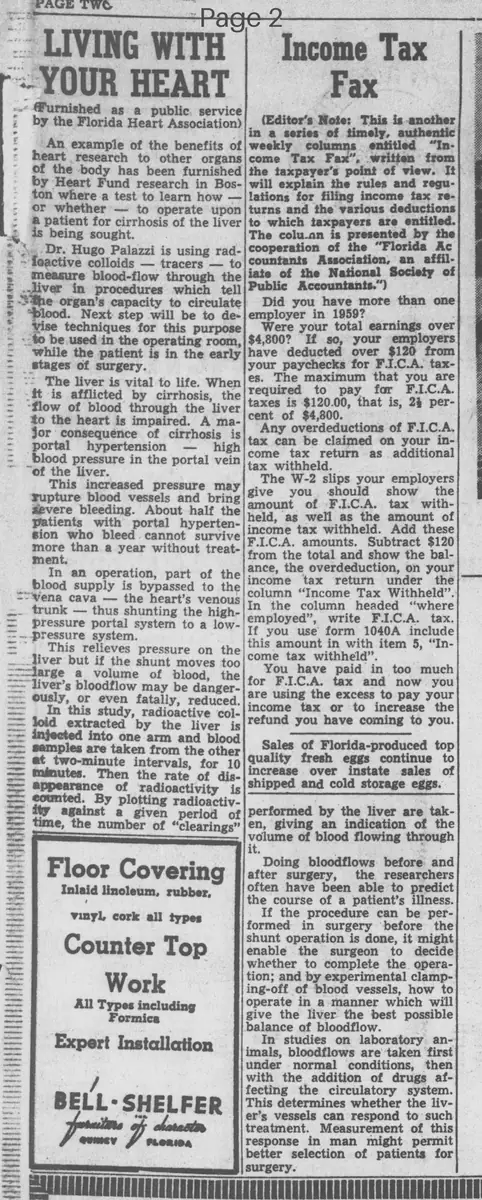
An example of the benefits of heart research to other organs of the body has been furnished by Heart Fund research in Boston where a test to learn how - or whether - to operate upon a patient for cirrhosis of the liver is being sought.
Dr. Hugo Palazzi is using radioactive colloids - tracers - to measure blood-flow through the liver in procedures which tell the organ's capacity to circulate blood. Next step will be to devise techniques for this purpose to be used in the operating room, while the patient is in the early stages of surgery.
The liver is vital to life. When it is afflicted by cirrhosis, the flow of blood through the liver to the heart is impaired. A major consequence of cirrhosis is portal hypertension - high blood pressure in the portal vein of the liver.
This increased pressure may rupture blood vessels and bring severe bleeding. About half the patients with portal hypertension who bleed cannot survive more than a year without treatment.
In an operation, part of the blood supply is bypassed to the vena cava - the heart's venous trunk - thus shunting the high-pressure portal system to a low-pressure system.
This relieves pressure on the liver but if the shunt moves too large a volume of blood, the liver's bloodflow may be dangerously, or even fatally, reduced.
In this study, radioactive colloid extracted by the liver is injected into one arm and blood samples are taken from the other at two-minute intervals, for 10 minutes. Then the rate of disappearance of radioactivity is counted. By plotting radioactivity against a given period of time, the number of 'clearings' performed by the liver are taken, giving an indication of the volume of blood flowing through it.
Doing bloodflows before and after surgery, the researchers often have been able to predict the course of a patient's illness.
If the procedure can be performed in surgery before the shunt operation is done, it might enable the surgeon to decide whether to complete the operation; and by experimental clamping-off of blood vessels, how to operate in a manner which will give the liver the best possible balance of bloodflow.
In studies on laboratory animals, bloodflows are taken first under normal conditions, then with the addition of drugs affecting the circulatory system.
This determines whether the liver's vessels can respond to such treatment. Measurement of this response in man might permit better selection of patients for surgery.
WITH
YOUR
HEART
Furnished as a public service by the Florida Heart Association.
An example of the benefits of heart research to other organs of the body has been furnished by Heart Fund research in Boston where a test to learn how - or whether - to operate upon a patient for cirrhosis of the liver is being sought.
Dr. Hugo Palazzi is using radioactive colloids - tracers - to measure blood-flow through the liver in procedures which tell the organ's capacity to circulate blood. Next step will be to devise techniques for this purpose to be used in the operating room, while the patient is in the early stages of surgery.
The liver is vital to life. When it is afflicted by cirrhosis, the flow of blood through the liver to the heart is impaired. A major consequence of cirrhosis is portal hypertension - high blood pressure in the portal vein of the liver.
This increased pressure may rupture blood vessels and bring severe bleeding. About half the patients with portal hypertension who bleed cannot survive more than a year without treatment.
In an operation, part of the blood supply is bypassed to the vena cava - the heart's venous trunk - thus shunting the high-pressure portal system to a low-pressure system.
This relieves pressure on the liver but if the shunt moves too large a volume of blood, the liver's bloodflow may be dangerously, or even fatally, reduced.
In this study, radioactive colloid extracted by the liver is injected into one arm and blood samples are taken from the other at two-minute intervals, for 10 minutes. Then the rate of disappearance of radioactivity is counted. By plotting radioactivity against a given period of time, the number of 'clearings' performed by the liver are taken, giving an indication of the volume of blood flowing through it.
Doing bloodflows before and after surgery, the researchers often have been able to predict the course of a patient's illness.
If the procedure can be performed in surgery before the shunt operation is done, it might enable the surgeon to decide whether to complete the operation; and by experimental clamping-off of blood vessels, how to operate in a manner which will give the liver the best possible balance of bloodflow.
In studies on laboratory animals, bloodflows are taken first under normal conditions, then with the addition of drugs affecting the circulatory system.
This determines whether the liver's vessels can respond to such treatment. Measurement of this response in man might permit better selection of patients for surgery.
What sub-type of article is it?
Medical Curiosity
What themes does it cover?
Recovery
What keywords are associated?
Liver Cirrhosis
Blood Flow Measurement
Radioactive Tracers
Portal Hypertension
Shunt Surgery
What entities or persons were involved?
Dr. Hugo Palazzi
Where did it happen?
Boston
Story Details
Key Persons
Dr. Hugo Palazzi
Location
Boston
Story Details
Heart Fund research in Boston uses radioactive colloids to measure liver blood flow in cirrhosis patients, helping determine surgical viability and predict outcomes by assessing the liver's capacity to circulate blood before and after shunt operations.