Thank you for visiting SNEWPapers!
Sign up free
The Kentucky Gazette
Lexington, Fayette County, Kentucky
What is this article about?
French squadron under Rear Admiral Richery blockaded St. John's, Newfoundland, in September, destroyed Bay of Bulls settlement, ravaged Labradore coast, and disrupted trade before departing. Fleet included ships like Le Jupiter (74 guns) and others, with about 14,000 troops aboard.
Merged-components note: These components form a continuous report on the French fleet's activities at Newfoundland, including extracts from letters and details of ships; text flows directly across pages with sequential reading order.
Clippings
1 of 2
OCR Quality
Full Text
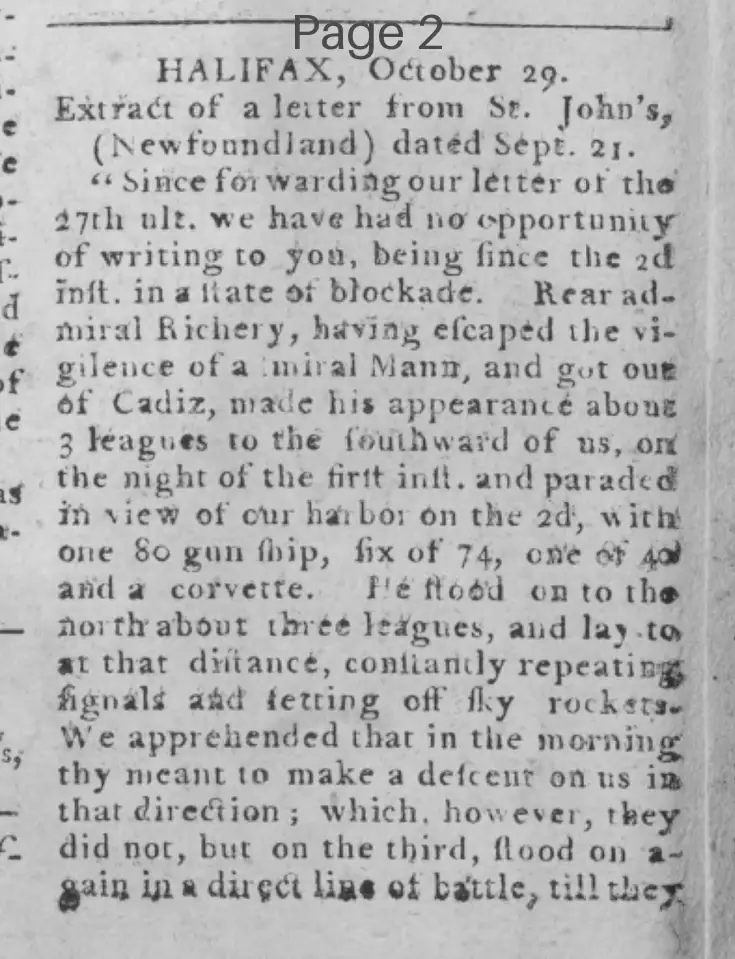
Extract of a letter from St. John's, (Newfoundland) dated Sept. 21.
"Since forwarding our letter of the 27th ult. we have had no opportunity of writing to you, being since the 2d inst. in a state of blockade. Rear admiral Richery, having escaped the vigilance of admiral Mann, and got out of Cadiz, made his appearance about 3 leagues to the southward of us, on the night of the first inst. and paraded in view of our harbor on the 2d, with one 80 gun ship, six of 74, one of 40 and a corvette. He stood on to the north thro' about three leagues, and lay to at that distance, constantly repeating signals and setting off sky rockets. We apprehended that in the morning they meant to make a descent on us in that direction; which, however, they did not, but on the third, stood on again in a direct line of battle, till they approached near Cape Spear, when they bore down in an irregular line direct for the narrows. At this time we imagined their intention was to force into the harbor: meanwhile all the batteries were extremely well manned, and the forges at work heating balls. Martial law was also proclaimed, and all the inhabitants, without distinction were under arms, and at their respective posts, determined to make the most vigorous defence. Two frigates, a sloop of war, and the Romney of 50 guns, were stationed at the opening of the narrows, with springs on their cables. In this situation our arrangements stood, expecting every moment the firing to commence. When the enemy arrived within gun-shot of the batteries, and in full view of our force, having reconnoitred our strength and position, the admiral thought proper to sheer off, and stand to the southward, and his whole fleet followed his example. That night they lay to in Petty Harbor Bay, where we were also apprehensive of their intention to land troops; but not thinking that measure advisable, they steered to the southward, and came to anchor in the Bay of Bulls. That devoted settlement they have reduced to ashes. By this destruction the house of Ougier and Page, have lost some thousands. On the 7th the enemy weighed anchor and proceeded to the south-east in view of the different harbors; and shortly after got out of sight. The 40 gun frigate appeared, on the ninth off Trepassey, into which place she chased some bankers, after which she stood on to the westward. On the 14th and 15th, the French fleet again appeared in Placentia Bay, steering N. W. S. W. for Cape Chapeau Rouge, and this is the last exact account we have of them. Their manoeuvres have appeared unaccountable and we think, indicate a want of harmony among them. They are supposed to have gone to intercept the outward bound Quebec fleet, which is under convoy of the Pearl frigate. They are known to be in want of bread, and consequently must soon repair to some port in the States. This visit has so much deranged the trade of the island, that we fear it will be productive of very bad consequences this fall. The servants of the southern ports have behaved very unruly, in plundering stores, and running away with vessels and boats; but as the fear of the enemy has subsided, matters are reinstated again, and the servants returning to their duty. The Shark is just arrived in the narrows. We are in hopes martial law will soon cease, and our attention be restored to our business."
The following permit, given to a family to go on shore at the Bay of Bulls, proves the French fleet at Newfoundland, to be Richery's from Cadiz:
Liberty
Equality.
Navy of the French Republic.
Squadron under the command of rear Admiral Richery
The ship Le Duquesne, commanded by Citizen Allemand, Captain of the Navy.
After the request made to Citizen Richery, by the wife of Richard Driskall, prisoner of war, and 5 children, of Bay Bulls, it is permitted to the said wife and her family to disembark from the ship Le Duquesne, to return to the said Bay. We invite all the citizens who shall meet the said family, not to disturb them in any manner, but on the contrary, to give them all the assistance in their power.
On board the ship Le Duquesne, the 21st Fructidor 4th year of the Republic of France.
Seen by me Captain Commandant.
ALLEMAND.
Yesterday arrived here from St. John's Newfoundland, the ships John and Jane, capt. Branston. This ship left England with the Britannia store ship, which arrived here some time since. She is laden with government provisions. Having put into Newfoundland on the 26th of August, and the French fleet appearing off the island of September, she has been detained by the embargo which was laid on all Shipping in that port. She left St. John's on Thursday last, the 20th inst under convoy of his majesty's ship Spencer, capt. Evans. The account capt. Branston gives of the French fleet, agrees with the intelligence contained in the preceding letter. The ships which were detached by admiral Richery to the Labradore coast, on the 6th of Sept. were the Censeur, Duquesne and Fripon. By capt. Evans, in the brig Madonna, who had made his escape from Labradore, and arrived at St. John's 3 days before the John and Jane sailed, intelligence was received, that the French ships had entered Temple bay, and laid the whole settlements in ruins. Among the shipping destroyed there, was a fine merchant ship, called the Regulator, mounting 20 guns. Captain Evans left the Labradore Coast the 10th instant, at which time those ships were still there. The chief part of the fleet was in at St. Pierre's on the 20th ult. on which day two sail of the line went out on a cruise. On the 26th, the admiral gave to captain Long, who commanded a ship which was destroyed at the Bay of Bulls, and who, with his wife, had been made prisoners, a schooner which he had captured, and permitted him to take with him 60 other prisoners and go where he pleased; and the same evening the remainder of the fleet left St. Pierre's, and it was supposed they were all to meet at some other place of rendezvous. The prisoners who have been landed from the fleet, report, that about 14,000 troops were said to be on board the different ships. Those which they saw were a shabby looking pack. Captain Branston has favored us with the following list of the French fleet:
Le Jupiter, Ad. Richery, 74,
Le Censeur, a Commodore, 84, Le Berwick, 74, La Victoire, 84, Le Barras, 74, Le Revolutionaire, 74, La Duquesne, 74, L'Ambushade, 36, La Felicite 36, Friponne 36.
What sub-type of article is it?
What keywords are associated?
What entities or persons were involved?
Where did it happen?
Foreign News Details
Primary Location
Newfoundland
Event Date
September 1796
Key Persons
Outcome
bay of bulls settlement reduced to ashes; house of ougier and page lost some thousands; settlements in temple bay laid in ruins; merchant ship regulator (20 guns) destroyed; about 14,000 troops on board; fleet departed after reconnaissance and disruptions; trade deranged, unruly servants plundered stores.
Event Details
French squadron under Rear Admiral Richery escaped Cadiz, appeared off St. John's on Sept 1-2, blockaded harbor from Sept 2; fleet included one 80-gun ship, six 74s, one 40, corvette; approached narrows on Sept 3 but sheered off after reconnaissance; anchored in Bay of Bulls, destroyed settlement; proceeded south-east on Sept 7; frigate off Trepassey on Sept 9; reappeared in Placentia Bay Sept 14-15; detached ships Censeur, Duquesne, Fripon to Labradore coast on Sept 6, destroyed Temple Bay settlements; main fleet at St. Pierre's on Aug 20 (20th ult.), two sail out on cruise; on Aug 26, admiral released Capt. Long with 60 prisoners; fleet left St. Pierre's evening of Aug 26; permit issued on Le Duquesne for family disembarkation at Bay Bulls on 21st Fructidor (Sept 7, 1796); fleet short of bread, suspected to intercept Quebec convoy or go to U.S. port; martial law proclaimed in St. John's, defenses prepared but no engagement.