Thank you for visiting SNEWPapers!
Sign up free
Letter to Editor
April 17, 1820
Daily National Intelligencer
Washington, District Of Columbia
What is this article about?
Harrison Gray Otis writes to Thomas H. Perkins explaining his vote against the U.S. Senate's Bankrupt Bill, due to amendments by a Delaware senator that transformed it into an unfair insolvent act favoring debtors over creditors, excluding small debtors and lacking creditor protections.
Clipping
OCR Quality
95%
Excellent
Full Text
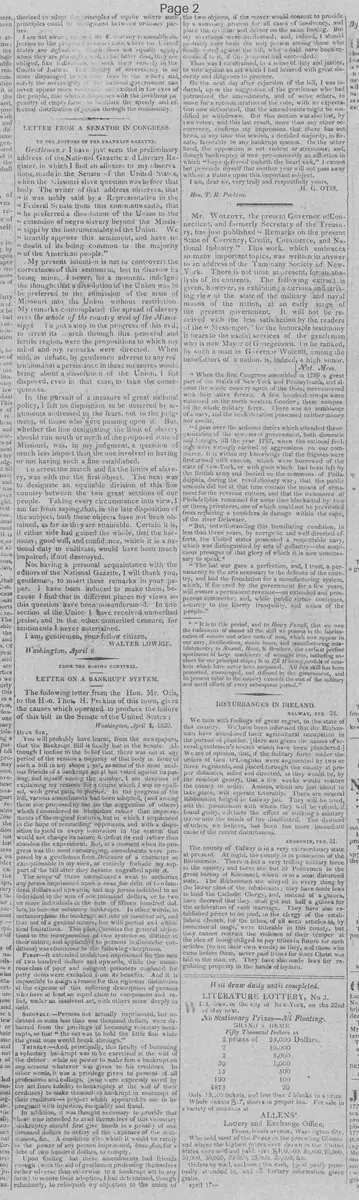
FROM THE BOSTON CENTINEL.
LETTER ON A BANKRUPT SYSTEM.
The following letter from the Hon. Mr. Otis, to the Hon. Thos. H. Perkins of this town, gives the causes which operated to produce the failure of this bill in the Senate of the United States:
Washington, April 1, 1820.
DEAR SIR,
You will probably have learnt, from the newspapers, that the Bankrupt Bill is finally lost in the Senate. Although I incline to the belief that there was not at any period of the session a majority of that body in favor of such a bill in any shape; yet as some of the most zealous friends of a bankrupt act at last voted against its passing, and myself among the number, I am desirous of explaining my reasons for a course which I was compelled, with great pain, to pursue. In the progress of the bill, various amendments had been adopted, (and among them one proposed by me on the suggestion of others) which I considered as blemishes rather than improvements of the original features, but in which I acquiesced in the hope of reconciling opponents, and with a disposition to yield to every innovation in the system that would not change its nature & defeat its end rather than abandon the experiment. But, at a moment when its progress was the most encouraging, amendments were proposed by a gentleman from Delaware of a character so exceptionable in my view, as entirely forbade my support of the bill after they became engrafted upon it. The scope of these amendments went to authorize any person imprisoned upon a bona fide debt of two hundred dollars and upwards, and any person indebted to an individual in the sum of one thousand dollars, or to two or more individuals in the sum of fifteen hundred dollars, to become voluntary bankrupts. In other words, to metamorphose the bankrupt act into an insolvent act, and that not of a general nature, but with partial and whimsical limitations. This plan, (besides the general objections to the incorporation of two systems so distinct in their nature, and applicable to persons in dissimilar conditions) was obnoxious to the following exceptions.
First—It extended to debtors imprisoned for the sum of two hundred dollars and upwards, while the numerous class of poor and indigent prisoners confined for petty debts were excluded from its benefits. And it is impossible to assign a reason for this rigorous distinction at the expense of this suffering description of persons who have at least an equal claim to compassion and relief, under an insolvent act, with others more deeply in debt.
Secondly.—Persons not actually imprisoned, but indebted in sums less than one thousand dollars, were debarred from the privilege of becoming voluntary bankrupts, so that "the net was to hold the little fish while the great ones would break through."
Thirdly.—And, principally, this faculty of becoming a voluntary bankrupt was to be exercised at the will of the debtor: while no power to make him a bankrupt on any account whatever was given to his creditors. In other words, it was a privilege given to persons of all professions and callings, (who were expressly saved by the act from liability to bankruptcy at the will of their creditors) to make themselves bankrupt in contempt of their creditors—a project which appeared to me to be pregnant with injustice, inequality and fraud.
In addition, it was thought necessary to provide that those who intended to avail themselves of this voluntary bankruptcy should first give bonds in a penalty of one thousand dollars to defray all the expenses of the commission, &c. A condition with which it would be rarely in the power of any person imprisoned, bona-fide, for a debt of two hundred dollars, to comply.
Upon finding that these amendments had friends enough (with the aid of gentlemen professing themselves rather adverse than otherwise to a bankrupt act in any form) to secure their adoption, I had determined, though reluctantly, to relinquish my objection to the union of the two objects, if the mover would consent to provide by a summary process for all cases of insolvency, and place the creditor and debtor on the same footing. But my overtures were ineffectual; and, indeed, I should probably have been the only person among those who finally voted against the bill, who would have been reconciled to it, if this proposal had succeeded.
Thus was I constrained, by a sense of duty and justice, to vote against an act which I had labored with great sincerity and diligence to procure.
On the next day after rejection of the bill, I was induced, upon the suggestion of the gentleman who had patronized the amendments, and of some others, to move for a reconsideration of the vote, with an expectation now authorized, that the amendments might be modified or withdrawn. But this motion was also lost, by two votes; and this last result, more than any other occurrence, confirms my impression that there has not been, at any time this session, a decided majority, in Senate, favorable to any bankrupt system. On the other hand, the opposition is not violent or strenuous; and, though bankruptcy is now pre-eminently an affliction in which "hope deferred maketh the heart sick," I cannot but persuade myself that another year will not pass away without a statute upon this important subject.
I am, dear sir, very truly and respectfully yours,
H. G. OTIS.
Hon. T. H. Perkins.
LETTER ON A BANKRUPT SYSTEM.
The following letter from the Hon. Mr. Otis, to the Hon. Thos. H. Perkins of this town, gives the causes which operated to produce the failure of this bill in the Senate of the United States:
Washington, April 1, 1820.
DEAR SIR,
You will probably have learnt, from the newspapers, that the Bankrupt Bill is finally lost in the Senate. Although I incline to the belief that there was not at any period of the session a majority of that body in favor of such a bill in any shape; yet as some of the most zealous friends of a bankrupt act at last voted against its passing, and myself among the number, I am desirous of explaining my reasons for a course which I was compelled, with great pain, to pursue. In the progress of the bill, various amendments had been adopted, (and among them one proposed by me on the suggestion of others) which I considered as blemishes rather than improvements of the original features, but in which I acquiesced in the hope of reconciling opponents, and with a disposition to yield to every innovation in the system that would not change its nature & defeat its end rather than abandon the experiment. But, at a moment when its progress was the most encouraging, amendments were proposed by a gentleman from Delaware of a character so exceptionable in my view, as entirely forbade my support of the bill after they became engrafted upon it. The scope of these amendments went to authorize any person imprisoned upon a bona fide debt of two hundred dollars and upwards, and any person indebted to an individual in the sum of one thousand dollars, or to two or more individuals in the sum of fifteen hundred dollars, to become voluntary bankrupts. In other words, to metamorphose the bankrupt act into an insolvent act, and that not of a general nature, but with partial and whimsical limitations. This plan, (besides the general objections to the incorporation of two systems so distinct in their nature, and applicable to persons in dissimilar conditions) was obnoxious to the following exceptions.
First—It extended to debtors imprisoned for the sum of two hundred dollars and upwards, while the numerous class of poor and indigent prisoners confined for petty debts were excluded from its benefits. And it is impossible to assign a reason for this rigorous distinction at the expense of this suffering description of persons who have at least an equal claim to compassion and relief, under an insolvent act, with others more deeply in debt.
Secondly.—Persons not actually imprisoned, but indebted in sums less than one thousand dollars, were debarred from the privilege of becoming voluntary bankrupts, so that "the net was to hold the little fish while the great ones would break through."
Thirdly.—And, principally, this faculty of becoming a voluntary bankrupt was to be exercised at the will of the debtor: while no power to make him a bankrupt on any account whatever was given to his creditors. In other words, it was a privilege given to persons of all professions and callings, (who were expressly saved by the act from liability to bankruptcy at the will of their creditors) to make themselves bankrupt in contempt of their creditors—a project which appeared to me to be pregnant with injustice, inequality and fraud.
In addition, it was thought necessary to provide that those who intended to avail themselves of this voluntary bankruptcy should first give bonds in a penalty of one thousand dollars to defray all the expenses of the commission, &c. A condition with which it would be rarely in the power of any person imprisoned, bona-fide, for a debt of two hundred dollars, to comply.
Upon finding that these amendments had friends enough (with the aid of gentlemen professing themselves rather adverse than otherwise to a bankrupt act in any form) to secure their adoption, I had determined, though reluctantly, to relinquish my objection to the union of the two objects, if the mover would consent to provide by a summary process for all cases of insolvency, and place the creditor and debtor on the same footing. But my overtures were ineffectual; and, indeed, I should probably have been the only person among those who finally voted against the bill, who would have been reconciled to it, if this proposal had succeeded.
Thus was I constrained, by a sense of duty and justice, to vote against an act which I had labored with great sincerity and diligence to procure.
On the next day after rejection of the bill, I was induced, upon the suggestion of the gentleman who had patronized the amendments, and of some others, to move for a reconsideration of the vote, with an expectation now authorized, that the amendments might be modified or withdrawn. But this motion was also lost, by two votes; and this last result, more than any other occurrence, confirms my impression that there has not been, at any time this session, a decided majority, in Senate, favorable to any bankrupt system. On the other hand, the opposition is not violent or strenuous; and, though bankruptcy is now pre-eminently an affliction in which "hope deferred maketh the heart sick," I cannot but persuade myself that another year will not pass away without a statute upon this important subject.
I am, dear sir, very truly and respectfully yours,
H. G. OTIS.
Hon. T. H. Perkins.
What sub-type of article is it?
Informative
Persuasive
Political
What themes does it cover?
Economic Policy
Politics
What keywords are associated?
Bankrupt Bill
Senate Amendments
Insolvent Act
Debtor Privilege
Creditor Rights
Voluntary Bankruptcy
Economic Legislation
What entities or persons were involved?
H. G. Otis
Hon. T. H. Perkins
Letter to Editor Details
Author
H. G. Otis
Recipient
Hon. T. H. Perkins
Main Argument
otis voted against the bankrupt bill because amendments proposed by a delaware senator turned it into an unfair insolvent act that privileged debtors over creditors, excluded small debtors, and allowed voluntary bankruptcy without creditor input, leading to injustice and fraud.
Notable Details
Amendments By Gentleman From Delaware Authorizing Voluntary Bankruptcy For Debts Over $200 If Imprisoned Or $1000+ Otherwise
Exclusion Of Petty Debtors And Small Non Imprisoned Debtors
Quote: 'The Net Was To Hold The Little Fish While The Great Ones Would Break Through'
Bond Requirement Of $1000 For Expenses
Motion For Reconsideration Lost By Two Votes
Quote: 'Hope Deferred Maketh The Heart Sick'