Thank you for visiting SNEWPapers!
Sign up free
Letter to Editor
June 17, 1841
Watchman Of The South
Richmond, Virginia
What is this article about?
A letter to the Watchman of the South urges Southern pastors and slave masters to collaborate in providing religious instruction to slaves, highlighting the moral duty to save their souls amid widespread ignorance and vice among the enslaved population in Virginia and beyond.
Clipping
OCR Quality
95%
Excellent
Full Text
For the Watchman of the South
RELIGIOUS INSTRUCTION OF THE SLAVES.
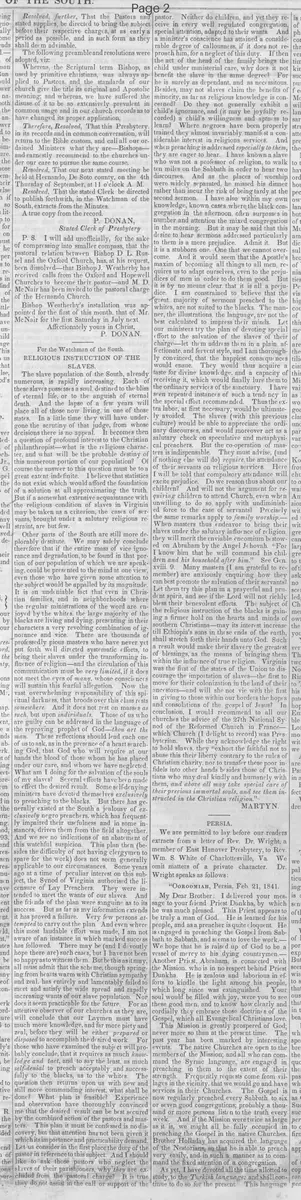
The slave population of the South, already numerous, is rapidly increasing. Each of these slaves possesses a soul, destined to the bliss of eternal life, or to the anguish of eternal death. And the lapse of a few years will place all of those now living, in one of those states. In a little time they will have undergone the scrutiny of that judge, from whose decisions there is no appeal. It becomes then a question of profound interest to the Christian philanthropist—what is the religious character, and what will be the probable destiny of this numerous portion of our population? Of course the answer to this question must be to a great extent indefinite. I believe that statistics do not exist which would afford the foundation of a solution at all approximating the truth. But if a somewhat extensive acquaintance with the religious condition of slaves in Virginia may be taken as a criterion, the cases of servants, brought under a salutary religious restraint, are but few. Other parts of the South are still more deplorably destitute. We may safely conclude therefore that if the entire mass of vice ignorance and degradation, to be found in that portion of our population of which we are speaking, could be presented to the mind at one view, even those who have given some attention to the subject would be appalled by its magnitude It is an undeniable fact that even in Christian families, and in neighborhoods where the regular ministrations of the word are enjoyed by the whites, the large majority of the blacks are living and dying, presenting in their characters a very revolting combination of ignorance and vice. There are thousands of professedly pious masters who have never yet put forth well directed systematic efforts, to bring their slaves under the transforming influence of religion —and the circulation of this communication must be very limited, if it does not meet the eyes of many, whose consciences will sustain this fearful allegation. Now the vast overwhelming responsibility of this spiritual darkness, that broods over this class rests somewhere. And it does not rest on masses as such, but upon individuals. Those of us who are guilty can be addressed in the language of the reproving prophet of God—thou art the man. These reflections should lead each one of us to ask, as in the presence of a heart searching God, that God who will require at our hands the blood of those whom he has placed under our care, and whom we have neglected. What am I doing for the salvation of the souls of my slaves? Several efforts have been made to effect the desired result. Some self-denying ministers have devoted themselves exclusively to preaching to the blacks. But there has generally existed at the South a jealousy of exclusively negro preachers, which has frequently impaired their usefulness and in some instances, driven them from the field altogether And we see no indications of an abatement of this watchful suspicion. This plan then (besides the difficulty of not having clergymen to spare for the work) does not seem generally applicable to our circumstances. Some years ago at a time of peculiar interest on this subject, the Synod of Virginia authorised the licensure of Lay Preachers. They were intended to meet the wants of our slaves. And the friends of the plan were sanguine as to its success. But as far as my information extends it has proved a failure. Very few persons attempted to carry out the plan. And even where this most laudable effort was made, I am not aware of an instance in which marked success has followed. There may be (and I devoutly hope there are) such cases, but I have not been so happy as to witness them. But be this as it may, all must admit that the scheme, though springing from hearts warm with Christian sympathy and zeal, has entirely and lamentably failed to meet and satisfy the wide spread and rapidly increasing wants of our slave population. Nor does it seem practicable for the future. For an attentive observer of our churches as they are, will conclude that our Laymen must have much more knowledge, and far more piety and zeal, before they will be either prepared or disposed to accomplish the desired work. For those who have examined the subject will probably conclude, that it requires as much knowledge and tact, and to say the least, as much self-denial to preach acceptably and successfully to the blacks, as to the whites. The question then returns upon us with new and still more commanding interest, what shall be done? What plan is feasible? Experience and observation have thoroughly convinced me that the desired result can be best secured by the combined action of the pastors and masters. This plan it must be confessed is no discovery, but that attention has not been given it which its importance and practicability demand. Let us consider in the first place the duty of the pastor in reference to this subject. And I should like to ask those pastors who neglect the slaves of their parishioners, why they are excluded from the pastoral charge? It is true they do not assist in the call or support of the pastor. Neither do children, and yet they receive in every well regulated congregation, special attention, adapted to their wants. And a minister's conscience has attained a considerable degree of callousness, if it does not reproach him, for a neglect of this duty. If then the act of the head of the family brings the child under ministerial care, why does it not benefit the slave in the same degree? For he is surely as dependant, and as necessitous. Besides, may not slaves claim the benefits of minority, as far as religious knowledge is concerned? Do they not generally exhibit a child's ignorance, and (it may be joyfully recorded) a child's willingness and aptness to learn? Where negroes have been properly trained they almost invariably manifest a considerable interest in religious services. And when preaching is addressed especially to them, they are eager to hear. I have known a slave who was not a professor of religion, to walk ten miles on the Sabbath in order to hear two discourses. And as the places of worship were widely separated, he missed his dinner rather than incur the risk of being tardy at the second sermon. I have also within my own knowledge, known cases where the black congregation in the afternoon, often surpasses in number and attention the mixed congregation in the morning. But it may be said that this desire to hear sermons addressed particularly to them is a mere prejudice. Admit it. But it is a stubborn one. One that we cannot overcome. And it would seem that the Apostle's maxim of becoming all things to all men, requires us to adapt ourselves, even to the prejudices of men in order to do them good. But it is by no means clear, that it is all a prejudice. I am constrained to believe that the great majority of sermons preached to the whites, are not suited to the blacks. The manner, the illustrations, the language, are not the best calculated to impress their minds. Let our ministers try the plan of devoting special effort to the salvation of the slaves of their charge—let them address them in a plain affectionate, and fervent style, and I am thoroughly convinced, that the happiest consequences would ensue. They would thus acquire a taste for divine knowledge, and a capacity of receiving it, which would finally lure them to the ordinary services of the sanctuary. I have seen repeated instances of such a tendency in the special effort recommended. Thus the extra labor, at first necessary, would be ultimately avoided. The slaves (with this previous culture) would be able to appreciate the ordinary discourses, and would moreover act as a salutary check on speculative and metaphysical preachers. But the co-operation of masters is indispensable. They must advise, (and if nothing else will do) require, the attendance of their servants on religious services. Here I will be told that compulsory attendance will excite prejudice. Do we reason thus about our children? And will not the argument for requiring children to attend Church, even when unwilling to do so, apply with undiminished force to the case of servants? Precisely the same remarks apply to family worship.— When masters thus endeavor to bring their slaves under the salutary influence of religion they will merit the enviable encomium bestowed on Abraham by the Angel Jehovah. "For I know him that he will command his children and his household after him." See Gen. xviii. 19. Many masters (I am grateful to remember) are anxiously enquiring how they can best promote the salvation of their servants? Let them try this plan in a prayerful and prudent spirit, and see if the Lord will not richly bless their benevolent efforts. The subject of the religious instruction of the blacks is gaining a firmer hold on the hearts and minds of southern Christians—may its interest increase till Ethiopia's sons in these ends of the earth, shall stretch forth their hands unto God. Such a result would make their slavery the greatest of blessings, as the means of bringing them within the influence of true religion. Virginia was the first of the states of the Union to discourage the importation of slaves—the first to move for their colonization in the land of their ancestors—and will she not vie with the first in giving to those within our borders the hopes and consolations of the gospel of Jesus? In conclusion, I would recommend to all our churches the advice of the 27th National Synod of the Reformed Church in France— which Church (I delight to record) was Presbyterian. While they acknowledge the right to hold slaves, they "exhort the faithful not to abuse this their liberty contrary to the rules of Christian charity, nor to transfer these poor infidels into other hands besides those of Christians who may deal kindly and humanely with them, and above all may take special care of their precious immortal souls, and see them instructed in the Christian religion."
MARTYN.
RELIGIOUS INSTRUCTION OF THE SLAVES.
The slave population of the South, already numerous, is rapidly increasing. Each of these slaves possesses a soul, destined to the bliss of eternal life, or to the anguish of eternal death. And the lapse of a few years will place all of those now living, in one of those states. In a little time they will have undergone the scrutiny of that judge, from whose decisions there is no appeal. It becomes then a question of profound interest to the Christian philanthropist—what is the religious character, and what will be the probable destiny of this numerous portion of our population? Of course the answer to this question must be to a great extent indefinite. I believe that statistics do not exist which would afford the foundation of a solution at all approximating the truth. But if a somewhat extensive acquaintance with the religious condition of slaves in Virginia may be taken as a criterion, the cases of servants, brought under a salutary religious restraint, are but few. Other parts of the South are still more deplorably destitute. We may safely conclude therefore that if the entire mass of vice ignorance and degradation, to be found in that portion of our population of which we are speaking, could be presented to the mind at one view, even those who have given some attention to the subject would be appalled by its magnitude It is an undeniable fact that even in Christian families, and in neighborhoods where the regular ministrations of the word are enjoyed by the whites, the large majority of the blacks are living and dying, presenting in their characters a very revolting combination of ignorance and vice. There are thousands of professedly pious masters who have never yet put forth well directed systematic efforts, to bring their slaves under the transforming influence of religion —and the circulation of this communication must be very limited, if it does not meet the eyes of many, whose consciences will sustain this fearful allegation. Now the vast overwhelming responsibility of this spiritual darkness, that broods over this class rests somewhere. And it does not rest on masses as such, but upon individuals. Those of us who are guilty can be addressed in the language of the reproving prophet of God—thou art the man. These reflections should lead each one of us to ask, as in the presence of a heart searching God, that God who will require at our hands the blood of those whom he has placed under our care, and whom we have neglected. What am I doing for the salvation of the souls of my slaves? Several efforts have been made to effect the desired result. Some self-denying ministers have devoted themselves exclusively to preaching to the blacks. But there has generally existed at the South a jealousy of exclusively negro preachers, which has frequently impaired their usefulness and in some instances, driven them from the field altogether And we see no indications of an abatement of this watchful suspicion. This plan then (besides the difficulty of not having clergymen to spare for the work) does not seem generally applicable to our circumstances. Some years ago at a time of peculiar interest on this subject, the Synod of Virginia authorised the licensure of Lay Preachers. They were intended to meet the wants of our slaves. And the friends of the plan were sanguine as to its success. But as far as my information extends it has proved a failure. Very few persons attempted to carry out the plan. And even where this most laudable effort was made, I am not aware of an instance in which marked success has followed. There may be (and I devoutly hope there are) such cases, but I have not been so happy as to witness them. But be this as it may, all must admit that the scheme, though springing from hearts warm with Christian sympathy and zeal, has entirely and lamentably failed to meet and satisfy the wide spread and rapidly increasing wants of our slave population. Nor does it seem practicable for the future. For an attentive observer of our churches as they are, will conclude that our Laymen must have much more knowledge, and far more piety and zeal, before they will be either prepared or disposed to accomplish the desired work. For those who have examined the subject will probably conclude, that it requires as much knowledge and tact, and to say the least, as much self-denial to preach acceptably and successfully to the blacks, as to the whites. The question then returns upon us with new and still more commanding interest, what shall be done? What plan is feasible? Experience and observation have thoroughly convinced me that the desired result can be best secured by the combined action of the pastors and masters. This plan it must be confessed is no discovery, but that attention has not been given it which its importance and practicability demand. Let us consider in the first place the duty of the pastor in reference to this subject. And I should like to ask those pastors who neglect the slaves of their parishioners, why they are excluded from the pastoral charge? It is true they do not assist in the call or support of the pastor. Neither do children, and yet they receive in every well regulated congregation, special attention, adapted to their wants. And a minister's conscience has attained a considerable degree of callousness, if it does not reproach him, for a neglect of this duty. If then the act of the head of the family brings the child under ministerial care, why does it not benefit the slave in the same degree? For he is surely as dependant, and as necessitous. Besides, may not slaves claim the benefits of minority, as far as religious knowledge is concerned? Do they not generally exhibit a child's ignorance, and (it may be joyfully recorded) a child's willingness and aptness to learn? Where negroes have been properly trained they almost invariably manifest a considerable interest in religious services. And when preaching is addressed especially to them, they are eager to hear. I have known a slave who was not a professor of religion, to walk ten miles on the Sabbath in order to hear two discourses. And as the places of worship were widely separated, he missed his dinner rather than incur the risk of being tardy at the second sermon. I have also within my own knowledge, known cases where the black congregation in the afternoon, often surpasses in number and attention the mixed congregation in the morning. But it may be said that this desire to hear sermons addressed particularly to them is a mere prejudice. Admit it. But it is a stubborn one. One that we cannot overcome. And it would seem that the Apostle's maxim of becoming all things to all men, requires us to adapt ourselves, even to the prejudices of men in order to do them good. But it is by no means clear, that it is all a prejudice. I am constrained to believe that the great majority of sermons preached to the whites, are not suited to the blacks. The manner, the illustrations, the language, are not the best calculated to impress their minds. Let our ministers try the plan of devoting special effort to the salvation of the slaves of their charge—let them address them in a plain affectionate, and fervent style, and I am thoroughly convinced, that the happiest consequences would ensue. They would thus acquire a taste for divine knowledge, and a capacity of receiving it, which would finally lure them to the ordinary services of the sanctuary. I have seen repeated instances of such a tendency in the special effort recommended. Thus the extra labor, at first necessary, would be ultimately avoided. The slaves (with this previous culture) would be able to appreciate the ordinary discourses, and would moreover act as a salutary check on speculative and metaphysical preachers. But the co-operation of masters is indispensable. They must advise, (and if nothing else will do) require, the attendance of their servants on religious services. Here I will be told that compulsory attendance will excite prejudice. Do we reason thus about our children? And will not the argument for requiring children to attend Church, even when unwilling to do so, apply with undiminished force to the case of servants? Precisely the same remarks apply to family worship.— When masters thus endeavor to bring their slaves under the salutary influence of religion they will merit the enviable encomium bestowed on Abraham by the Angel Jehovah. "For I know him that he will command his children and his household after him." See Gen. xviii. 19. Many masters (I am grateful to remember) are anxiously enquiring how they can best promote the salvation of their servants? Let them try this plan in a prayerful and prudent spirit, and see if the Lord will not richly bless their benevolent efforts. The subject of the religious instruction of the blacks is gaining a firmer hold on the hearts and minds of southern Christians—may its interest increase till Ethiopia's sons in these ends of the earth, shall stretch forth their hands unto God. Such a result would make their slavery the greatest of blessings, as the means of bringing them within the influence of true religion. Virginia was the first of the states of the Union to discourage the importation of slaves—the first to move for their colonization in the land of their ancestors—and will she not vie with the first in giving to those within our borders the hopes and consolations of the gospel of Jesus? In conclusion, I would recommend to all our churches the advice of the 27th National Synod of the Reformed Church in France— which Church (I delight to record) was Presbyterian. While they acknowledge the right to hold slaves, they "exhort the faithful not to abuse this their liberty contrary to the rules of Christian charity, nor to transfer these poor infidels into other hands besides those of Christians who may deal kindly and humanely with them, and above all may take special care of their precious immortal souls, and see them instructed in the Christian religion."
MARTYN.
What sub-type of article is it?
Persuasive
Religious
Ethical Moral
What themes does it cover?
Religion
Slavery Abolition
Morality
What keywords are associated?
Religious Instruction Slaves
Southern Christians Duty
Pastoral Responsibility
Master Cooperation
Virginia Slaves
Lay Preachers Failure
Synod Virginia
Reformed Church Advice
What entities or persons were involved?
Martyn.
For The Watchman Of The South
Letter to Editor Details
Author
Martyn.
Recipient
For The Watchman Of The South
Main Argument
pastors and slave masters in the south must collaborate to provide systematic religious instruction to slaves, as current efforts have failed and the moral responsibility for their spiritual salvation rests on individuals, particularly in virginia where ignorance and vice prevail among the enslaved.
Notable Details
References Synod Of Virginia's Licensure Of Lay Preachers As A Failed Effort
Cites Genesis 18:19 On Abraham Commanding His Household
Quotes 27th National Synod Of The Reformed Church In France On Christian Duty Toward Slaves
Mentions Slaves' Eagerness For Tailored Religious Services And Walking Miles To Attend Sermons