Thank you for visiting SNEWPapers!
Sign up free
The Virginia Gazette
Richmond, Williamsburg, Richmond County, Virginia
What is this article about?
On June 25, 1770, in Cambridge, the Massachusetts House of Representatives and Council sent messages to Lt. Gov. Thomas Hutchinson defending their stance on not proceeding with business at Cambridge and disputing charter interpretations on gubernatorial powers, leading to the assembly's prorogation until July 25.
Merged-components note: This is a continuation of the same article detailing messages and proceedings between the House of Representatives, Council, and Lieutenant Governor Hutchinson regarding the General Court; the text flows directly from the end of the first component to the start of the second, spanning pages 1 and 2. Relabeled from 'notice' to 'domestic_news' as it reports on colonial political events.
Clippings
1 of 2
OCR Quality
Full Text
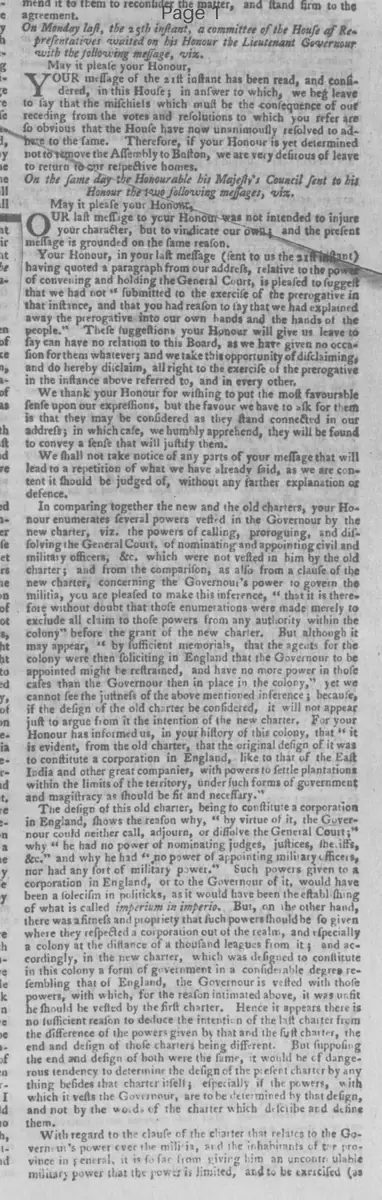
May it please your Honour,
OUR message of the 21st instant has been read, and considered, in this House; in answer to which, we beg leave to say that the mischiefs which must be the consequence of our receding from the votes and resolutions to which you refer are so obvious that the House have now unanimously resolved to adhere to the same. Therefore, if your Honour is yet determined not to remove the Assembly to Boston, we are very desirous of leave to return to our respective homes.
On the same day the Honourable his Majesty's Council sent to his Honour the two following messages, viz.
May it please your Honour.
OUR last message to your Honour was not intended to injure your character, but to vindicate our own: and the present message is grounded on the same reason.
Your Honour, in your last message (sent to us the 21st instant) having quoted a paragraph from our address, relative to the power of convening and holding the General Court, is pleased to suggest that we had not "submitted to the exercise of the prerogative in that instance, and that you had reason to say that we had explained away the prerogative into our own hands and the hands of the people." These suggestions your Honour will give us leave to say can have no relation to this Board, as we have given no occasion for them whatever; and we take this opportunity of disclaiming, and do hereby disclaim, all right to the exercise of the prerogative in the instance above referred to, and in every other.
We thank your Honour for wishing to put the most favourable sense upon our expressions, but the favour we have to ask for them is that they may be considered as they stand connected in our address; in which case, we humbly apprehend, they will be found to convey a sense that will justify them.
We shall not take notice of any parts of your message that will lead to a repetition of what we have already said, as we are content it should be judged of, without any farther explanation or defence.
In comparing together the new and the old charters, your Honour enumerates several powers vested in the Governour by the new charter, viz. the powers of calling, proroguing, and dissolving the General Court, of nominating and appointing civil and military officers, &c. which were not vested in him by the old charter; and from the comparison, as also from a clause of the new charter, concerning the Governour's power to govern the militia, you are pleased to make this inference, "that it is therefore without doubt that those enumerations were made merely to exclude all claim to those powers from any authority within the colony" before the grant of the new charter. But although it may appear, "by sufficient memorials, that the agents for the colony were then soliciting in England that the Governour to be appointed might be restrained, and have no more power in those cases than the Governour then in place in the colony," yet we cannot see the justness of the above mentioned inference; because, if the design of the old charter be considered, it will not appear just to argue from it the intention of the new charter. For your Honour has informed us, in your history of this colony, that "it is evident, from the old charter, that the original design of it was to constitute a corporation in England, like to that of the East India and other great companies, with powers to settle plantations within the limits of the territory, under such forms of government and magistracy as should be fit and necessary."
The design of this old charter, being to constitute a corporation in England, shows the reason why, "by virtue of it, the Governour could neither call, adjourn, or dissolve the General Court;" why "he had no power of nominating judges, justices, sheriffs, &c." and why he had "no power of appointing military officers, nor had any sort of military power." Such powers given to a corporation in England, or to the Governour of it, would have been a solecism in politicks, as it would have been the establishing of what is called imperium in imperio. But, on the other hand, there was a fitness and propriety that such powers should be so given where they respected a corporation out of the realm, and especially a colony at the distance of a thousand leagues from it; and accordingly, in the new charter, which was designed to constitute in this colony a form of government in a considerable degree resembling that of England, the Governour is vested with those powers, with which, for the reason intimated above, it was unfit he should be vested by the first charter. Hence it appears there is no sufficient reason to deduce the intention of the last charter from the difference of the powers given by that and the first charter, the end and design of those charters being different. But supposing the end and design of both were the same, it would be of dangerous tendency to determine the design of the present charter by any thing besides that charter itself; especially if the powers, with which it vests the Governour, are to be determined by that design, and not by the words of the charter which describe and define them.
With regard to the clause of the charter that relates to the Governour's power over the militia, and the inhabitants of the province in general, it is so far from giving him an uncontrollable military power that the power is limited, and to be exercised (as the words are) "according to law;"
in that clause mentioned) for the special defence and safety of the province. The words cited by your Honour, viz. "full power to govern the militia," if they refer to any thing further than the training, instructing, and exercising the militia, cannot be understood to give a greater power than may be exercised over the inhabitants in general, which it is plain is limited, and to be exercised as above mentioned. The said clause then does not give to a subject an uncontrollable military power. The consequences rising from the contrary supposition cannot therefore support the inference above mentioned, nor can they affect either the power given to the Governour by that clause or by any other clause of the charter and therefore cannot affect the Governour's power of convening, adjourning, proroguing, or dissolving the General Court.
Though it be absurd that a subject should be vested by the Crown with a military power uncontrollable by itself, yet with regard to civil offices there is no absurdity to suppose they should vest power uncontrollable by the Crown. Nay it is highly expedient, and necessary, that some of them should vest such a power; and, in fact, such a power is vested in the judges of England. And (to give no other instance) we think it is vested also in the Governour of this province, so far as it relates to the adjourning, proroguing, and dissolving the General Court.
In the last paragraph of your Honour's message, it is said "that any farther arguments will only tend to increase the breaches which you should think yourself happy to be able to repair." We are wholly ignorant what breaches are here referred to. The only breach we know of is that your Honour and the Council have different opinions, about a clause of the charter; and this breach (if it can be called one) must of necessity continue until we see sufficient reason to accede to your opinion. In the mean time, we take this occasion to assure your Honour that this difference in opinion shall never, on our part, interrupt the harmony which it will give us pleasure to see kept up between all the branches of the General Court.
May it please your Honour,
It gives the Board great concern that in your message of the 22d instant, directed to both Houses, after declaring how sensible you are of the mischiefs which must be the consequence of our final refusal to proceed in the publick business, you recommend it to us to reconsider our votes or resolves to the contrary; when nothing is more certain than that the Board never passed any one vote, resolve, or order, relative to their proceeding or not proceeding on publick business, so far from it as that it never was so much as the subject of their debate.
His Honour's answer to the messages of the Council.
Gentlemen of the Council,
When it shall be considered that in your first message to me you tell me that it would give you great pleasure to proceed in the publick business, and then go on to give your reasons against holding the Court at Cambridge; and when it is farther considered that for three weeks together you have done no business, although great part of the business lying before the Court might with propriety originate with you, and that your messages to me, in which you take exception to the Court's sitting at Cambridge, and my answers, are sent down to the House, which is new and unusual, and that their votes and resolves against doing business are sent up to you, in the like unusual manner, I am content that it should be judged of, without any farther explanation, whether I had not sufficient reason to say that you declined doing business, and whether it was not equivalent to an express refusal. If you did not intend it should be deemed a refusal, I wish you had let me know, in answer to my last message that you were willing to proceed to business.
You seem to mistake my intention in observing to you that the several parts of the Governour's power, specified in the new charter, were such as the Governour, under the old charter, was not vested with. To prevent any exception to the Governour's exercising these powers under the new charter is an obvious reason for the mentioning them. To suppose they were likewise intended to exclude the Crown from its right of controul is without foundation.
Whether there was greater propriety in the grant of these powers under the new charter than under the old is immaterial. Let the propriety be ever so great, yet it was necessary to specify them, or there would have been room left for dispute; for although the old charter was intended for a corporation in England, yet it had been carried to America, and the powers granted by it had been exercised there, and there was the same necessity of a special explanation and restriction in the new charter as if the old had been originally designed for a corporation or colony in America.
And although, as you observe, powers may be necessary for a colony different from those of a corporation in England, yet it by no means follows that the Crown is excluded from its right of controul in the exercise of those powers; and if it be excluded, perhaps, in both cases, we shall be alike involved in the solecism of imperium in imperio.
I cannot agree with you that it would be of dangerous tendency to determine the design of the present charter by any thing besides the charter itself. Where there is any ambiguity, there seems to be the same reason for recurring to the particular circumstances attending the soliciting and granting it as there is to historical facts for the construction of any uncertain ambiguous expressions in any statute.
You say that the Governour's military power is limited, for the special defence and safety of the province. Be it so, it does not follow that the Crown has excluded itself from directing how it shall be exercised for this purpose, in what places the Governour shall erect forts, &c. and yet the Governour has as full power to erect forts as he has to call, adjourn, or prorogue the Court. Nor does there appear to me any reason to suppose the Crown intended by the same mode of expression to retain its military, and give up its civil controul; for your observation upon the power vested in the judges does not prove a distinction between the civil and military, but between the judiciary and ministerial power.
As I see no prospect of persuading the Court to proceed to business, and as I am unwilling the good people of the province should be at farther charge, I shall give you a short recess, in hopes that at the next meeting the difficulties you are now under will be removed, and that the several branches of the legislature will agree in sentiment upon these points.
Cambridge, June 25, 1770.
T. HUTCHINSON.
In the afternoon the Secretary went to the House, and said:
"It is his Honour's pleasure that this Great and General Court or Assembly be prorogued to Wednesday the 25th of July next, then to meet at Harvard college in Cambridge; and the said Great and General Court is prorogued accordingly."
What sub-type of article is it?
What keywords are associated?
What entities or persons were involved?
Where did it happen?
Domestic News Details
Primary Location
Cambridge
Event Date
June 25, 1770
Key Persons
Outcome
the great and general court was prorogued to wednesday the 25th of july next, to meet at harvard college in cambridge.
Event Details
A committee of the House of Representatives delivered a message to the Lieutenant Governour stating their adherence to votes and resolutions against proceeding in Cambridge and requesting leave to return home. The Council sent two messages defending their position on charter interpretations regarding the Governor's powers and disclaiming any refusal to proceed in business. The Lieutenant Governour responded, defending his views and proroguing the assembly.