Thank you for visiting SNEWPapers!
Sign up free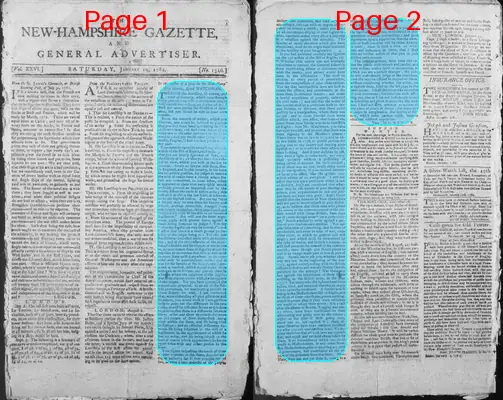
The New Hampshire Gazette And General Advertiser
Portsmouth, Exeter, Rockingham County, New Hampshire
What is this article about?
In this letter, 'The Monitor' rebuts 'Watchman's' criticisms of proposed amendments to New Hampshire's Bill of Rights. Defends provisions for changing trial venues to ensure impartiality and retrospective laws to confiscate estates of absentees who joined the British during the Revolution, arguing they are just and necessary.
Merged-components note: These two components form a single continuous letter to the editor by THE MONITOR, split across pages.
Clippings
1 of 2
OCR Quality
Full Text
THOUGH the scurrility, ill-nature, and want of decency, which runs through every part of your rude performance, might well excuse my taking no notice of it; I shall for once pursue the direction of Solomon, lest you should be wise in your own conceit.
From the warmth of temper, which you discover, one would be induced to suppose that you had some hand in framing the Plan of Government, and had some secret views unknown to the other members of the Convention: and that the Monitor (alias Logs matit, Prophet.) had touched you in a sore part.
Your remarks upon the exception to the 7th article of the Bill of Rights must either prove that you are totally ignorant of law, and the history of it: or that you have some object in view, which you wish at present to conceal. Surely no lawyer will deny, that in England, and in this country, it has been the invariable practice, for judges to remove the trial of causes from a county where the fact was committed, to some other, when it appeared to them that party spirit would probably prevent an impartial trial in the county where the cause of action arose: this custom is as old as the law itself, & is founded in the highest reason. But you say "that a subject may be torn from his family and friends, perhaps moneyless, dragged from one county to another, there imprisoned and detained for trial, at the will of an incensed legislature." But will not the same argument apply with greater force, against a cause being removed by judges? You say " that the legislature may be incensed"; and I assert that there is a much greater probability of the judges being so: Yet the law has hitherto entrusted them with this authority; and if the circumstances of the counties of Cheshire and Grafton, were not before us, no uncommon share of sagacity would be required to determine that this power must in every State exist somewhere, to be exercised only in extraordinary cases: and it was for the benefit of the subject, that I proposed a method, which would make those removals more solemn, and prevent them in all cases where the judgment of the legislative body did not concur with the sentiments of the judges. Yet you have compared the amendment proposed, to an act of the British parliament, for transporting persons to Great-Britain for trial. I am convinced that, notwithstanding all your assurance and ill-nature, you would blush if I was particularly to point out the difference in the two cases; it will be sufficient for me at this time to observe, that there is a difference between thirty miles and three thousand--between an inhabitant of New-Hampshire being tried within the State, and his being tried in Europe; and an essential difference between his being subjected to the will of a legislature, in the appointment of which he has no voice, and his being subject to the laws of one in whose appointment he has an equal voice with any other person in the State.
Your Query respecting the revolt of three or four counties of this State, does not merit an answer; for if four counties out of five, or even a bare majority of the people
declare their intentions, and take measures accordingly. This can with no degree of propriety be termed a revolt; unless you could by an uncommon display of your logical talents, convince us that every act of a majority is a rebellion against the minority. The species of revolt therefore which you have mentioned, must for its origin stand indebted to the fertility of your imagination.
If you had answered candidly my Queries on the 23d article of the Bill of Rights, viz. "Whether that article was not evidently calculated to prevent the General Assembly from confiscating estates of Absentees now with the enemy, your answer would have been in the affirmative: This must be obvious to every person of penetration, from the complexion of your observations. You say that retrospective laws are such as create the offence, and punishment, at the same time, in criminal matters; and make a lawful acquisition of property, unlawful (in civil cases:) and add that the writer of the queries must be a proficient both in law and divinity, to discover, that there could possibly be a transgression, where there was no law: and to cover yourself from every possible attack, you assert, that some of the other States have similar articles in their Bills of Rights; here Mr. Watchman, you have betrayed yourself, and proved, that there was some sagacity in the Monitor's queries: There surely was no law in 1775, and in very few States in 1776, to punish persons for going over to the enemy and bearing arms against us; or to confiscate their estates for so doing. And if your doctrine be just, they have a right to come back, and enjoy their property without a possibility of being called to account for such conduct; for as there was no law, surely there could be no transgression. If your learned definition be as you assert, like the golden rule, which admits of no exception. I will not assert that you are a proficient either in law or divinity, but I am convinced that whatever may be the extent of your theological talents, your acquirements in law and politics have not been very great: And I flatter myself that the freemen of New-Hampshire will not pay so much respect to your divinity, as to believe that those men who joined the enemy at the commencement of the present contest with Great-Britain, have done no ill; even though none "but a petty scribbler," should attempt to write against a person of your consummate abilities. You appear incapable of conceiving, that in time of revolutions, and even in time of war, cases often occur, to which no general rule will apply: and which must be determined by the rules of reason, and in such a manner, as will best promote the interest of the commonwealth; even though you should please to call it an image made part of iron & part of clay. Permit me to ask you, whether there was any law in the beginning of the year 1775, against corresponding with the British officers in Boston, and was not Doctor Church punished for the attempt? Was there any law against the inhabitants of those States enlisting in the British army, in the year 1775? Yet many who did so, have been since taken, tried, and executed therefor, in many States upon the continent. A similar article being in the Massachusetts Bill of Rights, and in those of some other States, proves nothing, unless it proves that if they were mistaken we ought to adopt their errors: It is a fact that the estates of Brattle, Ruggles, and many others, have been confiscated for their absconding and going over to the enemy; although at the time of their going over, there was no law against it; these estates therefore have been declared forfeited by what you call retrospective laws. To declare therefore that all such laws are oppressive, and unjust, and yet hold estates taken by them, is an inconsistency which can do no credit to Massachusetts, or any other State. But Massachusetts, prior to adopting any plan of government, had confiscated all the estates of the absentees from that State. New-Hampshire has not yet done it, owing to a
violent opposition from a quarter which I need not mention.
Your observations respecting a quorum of the legislative branches, are founded in your ignorance of public proceedings; and your arguments, upon a supposition that the members of both branches will be either knaves, or fools: there is such a vein of wildness and indecency in them, that I shall take no further notice of that part of your abusive performance.
The other objections, have been laid before the public with fairness and candor, and were written with a spirit of moderation, to which you are a perfect stranger; the public will undoubtedly judge of the objections, from the reasons offered in support of them, without considering whether the writer, for or against them, filled up the last page in the news-paper. I shall therefore take no notice of your comments: but conclude with assuring you, that as I am not sufficiently versed in scurrility and abuse to enter the lists with you, I shall not even attempt an answer to any piece of yours in future: but leave you to enjoy in imagination that species of victory, which some persons relish, because obtained without opposition.
THE MONITOR.
What sub-type of article is it?
What themes does it cover?
What keywords are associated?
What entities or persons were involved?
Letter to Editor Details
Author
The Monitor.
Recipient
To The Author Of A Piece In The New Hampshire Gazette, Signed Watchman.
Main Argument
'the monitor' defends proposed amendments to new hampshire's bill of rights against 'watchman's' attacks, justifying venue changes for impartial trials and retrospective laws to punish absentees who joined the enemy, as necessary for justice and state security during revolution.
Notable Details