Thank you for visiting SNEWPapers!
Sign up free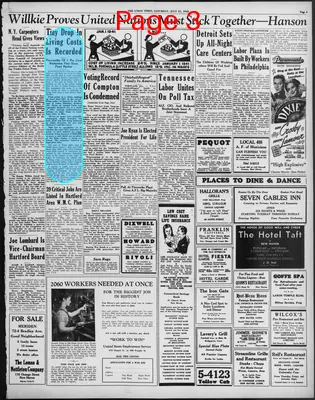
Story
July 31, 1943
The Union Times
New Haven, New Haven County, Connecticut
What is this article about?
In June 1943, the US cost of living for city workers dropped 0.2% for the first time since before Pearl Harbor, due to butter subsidies and seasonal vegetable declines, as announced by Secretary of Labor Frances Perkins. Food prices fell 0.8%, with unchanged meats and reviews of the index underway.
Clipping
OCR Quality
92%
Excellent
Full Text
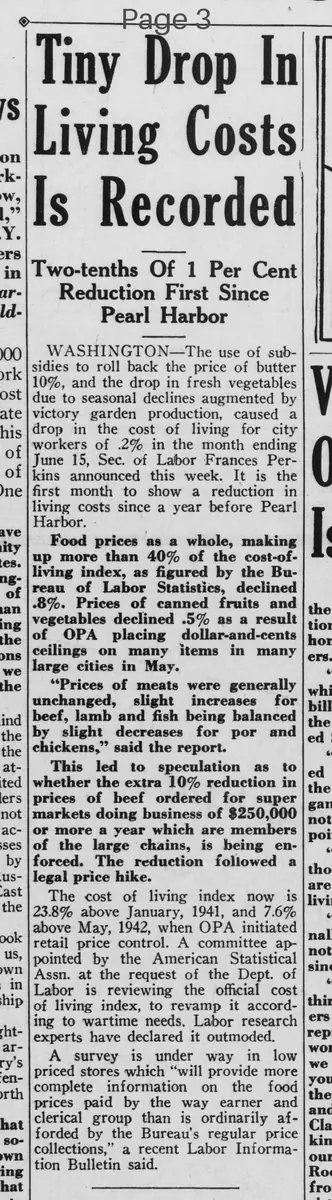
Tiny Drop In Living Costs Is Recorded
Two-tenths Of 1 Per Cent Reduction First Since Pearl Harbor
WASHINGTON—The use of subsidies to roll back the price of butter 10%, and the drop in fresh vegetables due to seasonal declines augmented by victory garden production, caused a drop in the cost of living for city workers of .2% in the month ending June 15, Sec. of Labor Frances Perkins announced this week. It is the first month to show a reduction in living costs since a year before Pearl Harbor.
Food prices as a whole, making up more than 40% of the cost-of-living index, as figured by the Bureau of Labor Statistics, declined .8%. Prices of canned fruits and vegetables declined .5% as a result of OPA placing dollar-and-cents ceilings on many items in many large cities in May.
"Prices of meats were generally unchanged, slight increases for beef, lamb and fish being balanced by slight decreases for pork and chickens," said the report.
This led to speculation as to whether the extra 10% reduction in prices of beef ordered for super markets doing business of $250,000 or more a year which are members of the large chains, is being enforced. The reduction followed a legal price hike.
The cost of living index now is 23.8% above January, 1941, and 7.6% above May, 1942, when OPA initiated retail price control. A committee appointed by the American Statistical Assn. at the request of the Dept. of Labor is reviewing the official cost of living index, to revamp it according to wartime needs. Labor research experts have declared it outmoded.
A survey is under way in low priced stores which "will provide more complete information on the food prices paid by the wage earner and clerical group than is ordinarily afforded by the Bureau's regular price collections," a recent Labor Information Bulletin said.
Two-tenths Of 1 Per Cent Reduction First Since Pearl Harbor
WASHINGTON—The use of subsidies to roll back the price of butter 10%, and the drop in fresh vegetables due to seasonal declines augmented by victory garden production, caused a drop in the cost of living for city workers of .2% in the month ending June 15, Sec. of Labor Frances Perkins announced this week. It is the first month to show a reduction in living costs since a year before Pearl Harbor.
Food prices as a whole, making up more than 40% of the cost-of-living index, as figured by the Bureau of Labor Statistics, declined .8%. Prices of canned fruits and vegetables declined .5% as a result of OPA placing dollar-and-cents ceilings on many items in many large cities in May.
"Prices of meats were generally unchanged, slight increases for beef, lamb and fish being balanced by slight decreases for pork and chickens," said the report.
This led to speculation as to whether the extra 10% reduction in prices of beef ordered for super markets doing business of $250,000 or more a year which are members of the large chains, is being enforced. The reduction followed a legal price hike.
The cost of living index now is 23.8% above January, 1941, and 7.6% above May, 1942, when OPA initiated retail price control. A committee appointed by the American Statistical Assn. at the request of the Dept. of Labor is reviewing the official cost of living index, to revamp it according to wartime needs. Labor research experts have declared it outmoded.
A survey is under way in low priced stores which "will provide more complete information on the food prices paid by the wage earner and clerical group than is ordinarily afforded by the Bureau's regular price collections," a recent Labor Information Bulletin said.
What sub-type of article is it?
Historical Event
What themes does it cover?
Fortune Reversal
What keywords are associated?
Cost Of Living
Price Drop
Butter Subsidies
Food Prices
Pearl Harbor
Opa Controls
Victory Gardens
What entities or persons were involved?
Frances Perkins
Where did it happen?
Washington
Story Details
Key Persons
Frances Perkins
Location
Washington
Event Date
Month Ending June 15, 1943
Story Details
Announcement of a 0.2% drop in city workers' cost of living due to butter subsidies and vegetable production, first reduction since before Pearl Harbor; food prices declined 0.8%, meats stable, index review ongoing.