Thank you for visiting SNEWPapers!
Sign up free
Gazette Of The United States, & Daily Advertiser
Philadelphia, Philadelphia County, Pennsylvania
What is this article about?
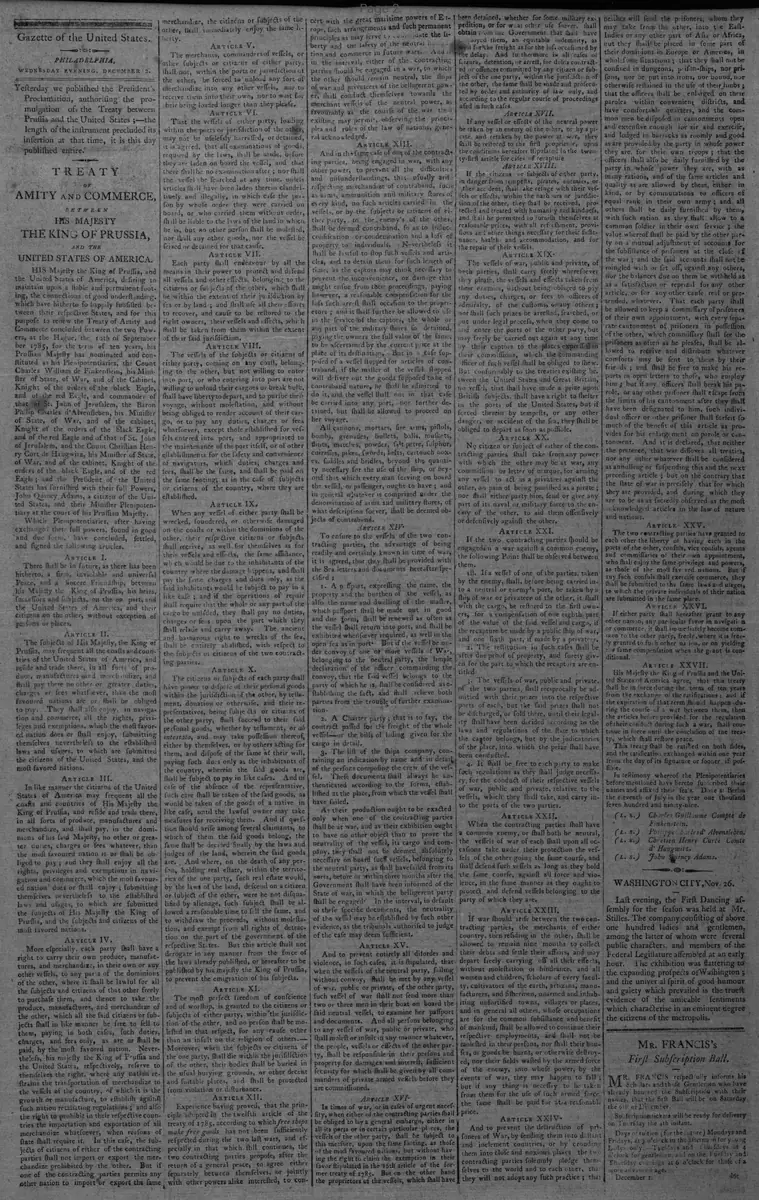
The newspaper publishes the full Treaty of Amity and Commerce between the King of Prussia and the United States of America, signed in Berlin on July 11, 1799, renewing the 1785 treaty for ten years. It outlines peace, trade rights, navigation privileges, and wartime conduct.
Merged-components note: Introductory domestic_news about publishing the treaty merges with the full treaty text as a single narrative unit on the Prussia-US treaty; relabeled to story as full narrative article.
Clipping
OCR Quality
Full Text
TREATY
OF
AMITY AND COMMERCE,
BETWEEN
HIS MAJESTY
THE KING OF PRUSSIA,
AND THE
UNITED STATES OF AMERICA.
HIS Majesty the King of Prussia, and the United States of America, desiring to maintain upon a stable and permanent footing, the connections of good understanding, which have hitherto so happily subsisted between their respective States, and for this purpose to renew the Treaty of Amity and Commerce concluded between the two Powers, at the Hague, the 10th of September 1785, for the term of ten years, his Prussian Majesty has nominated and constituted as his Plenipotentiaries, the Count Charles William de Finkenstein, his Minister of State, of War, and of the Cabinet, Knight of the orders of the black Eagle, and of the red Eagle, and commander of that of St. John of Jerusalem, the Baron Philip Charles d'Alvensleben, his Minister of State, of War, and of the cabinet, Knight of the orders of the black Eagle, and of the red Eagle and of that of St. John of Jerusalem, and the Count Christian Henry Curt de Haugwitz, his Minister of State, of War, and of the cabinet, Knight of the orders of the black Eagle, and of the red Eagle: and the President of the United States has furnished with their full Powers, John Quincy Adams, a citizen of the United States, and their Minister Plenipotentiary at the court of his Prussian Majesty.
Which Plenipotentiaries, after having exchanged their full powers, found in good and due form, have concluded, settled, and signed the following articles.
ARTICLE I.
There shall be in future, as there has been hitherto, a firm, inviolable and universal Peace, and a sincere Friendship, between his Majesty the King of Prussia, his heirs, successors and subjects, on the one part, and the United States of America, and their citizens on the other, without exception of persons or places.
ARTICLE II.
The subjects of His Majesty, the King of Prussia, may frequent all the coasts and countries of the United States of America, and reside and trade there, in all sorts of produce, manufactures and merchandise, and shall pay there no other or greater duties, charges or fees whatsoever, than the most favoured nations are or shall be obliged to pay. They shall also enjoy, in navigation and commerce, all the rights, privileges and exemptions, which the most favored nation does or shall enjoy, submitting themselves nevertheless to the established laws and usages, to which are submitted the citizens of the United States, and the most favored nations.
ARTICLE III.
In like manner the citizens of the United States of America may frequent all the coasts and countries of His Majesty the King of Prussia, and reside and trade there, in all sorts of produce, manufactures and merchandise, and shall pay, in the dominions of his said Majesty, no other or greater duties, charges or fees whatever, than the most favoured nation is or shall be obliged to pay; and they shall enjoy all the rights, privileges and exemptions in navigation and commerce, which the most favoured nation does or shall enjoy; submitting themselves nevertheless to the established laws and usages, to which are submitted the subjects of His Majesty the King of Prussia, and the subjects and citizens of the most favored nations.
ARTICLE IV.
More especially, each party shall have a right to carry their own produce, manufactures, and merchandise, in their own or any other vessels, to any parts of the dominions of the other, where it shall be lawful for all the subjects and citizens of that other freely to purchase them, and thence to take the produce, manufactures, and merchandise of the other, which all the said citizens or subjects shall in like manner be free to sell to them, paying in both cases, such duties, charges, and fees only, as are or shall be paid, by the most favored nation. Nevertheless, his majesty the King of Prussia and the United States, respectively, reserve to themselves the right, where any nation restrains the transportation of merchandise to the vessels of the country, of which it is the growth or manufacture, to establish against such nation retaliating regulations; and also the right to prohibit in their respective countries the importation and exportation of all merchandise whatsoever, when reasons of state shall require it. In this case, the subjects or citizens of either of the contracting parties shall not import or export the merchandise prohibited by the other. But if one of the contracting parties permits any other nation to import or export the same merchandise, the citizens or subjects of the other, shall immediately enjoy the same liberty.
ARTICLE V.
The merchants, commanders of vessels, or other subjects or citizens of either party, shall not, within the ports or jurisdiction of the other, be forced to unload any sort of merchandise into any other vessels, nor to receive them into their own, nor to wait for their being loaded longer than they please.
ARTICLE VI.
That the vessels of either party, loading within the ports or jurisdiction of the other, may not be uselessly harassed, or detained, it is agreed, that all examinations of goods, required by the laws, shall be made, before they are laden on board the vessel, and that there shall be no examination after; nor shall the vessel be searched at any time, unless articles shall have been laden therein clandestinely and illegally, in which case the person by whose order they were carried on board, or who carried them without order, shall be liable to the laws of the land in which he is, but no other person shall be molested, nor shall any other goods, nor the vessel be seized or detained for that cause.
ARTICLE VII.
Each party shall endeavour by all the means in their power to protect and defend all vessels and other effects, belonging to the citizens or subjects of the other, which shall be within the extent of their jurisdiction by sea or by land; and shall use all their efforts to recover, and cause to be restored to the right owners, their vessels and effects, which shall be taken from them within the extent of their said jurisdiction.
ARTICLE VIII.
The vessels of the subjects or citizens of either party, coming on any coast, belonging to the other, but not willing to enter into port, or who entering into port are not willing to unload their cargoes or break bulk, shall have liberty to depart, and to pursue their voyage, without molestation, and without being obliged to render account of their cargo, or to pay any duties, charges or fees whatsoever, except those established for vessels entered into port, and appropriated to the maintenance of the port itself, or of other establishments for the safety and convenience of navigators, which duties, charges and fees, shall be the same, and shall be paid on the same footing; as in the case of subjects or citizens of the country, where they are established.
ARTICLE IX.
When any vessel of either party shall be wrecked, foundered, or otherwise damaged on the coasts or within the dominions of the other, their respective citizens or subjects shall receive, as well for themselves as for their vessels and effects, the same assistance, which would be due to the inhabitants of the country where the damage happens, and shall pay the same charges and dues only, as the said inhabitants would be subject to pay in a like case; and if the operations of repair shall require that the whole or any part of the cargo be unloaded, they shall pay no duties, charges or fees upon the part which they shall reload and carry away. The ancient and barbarous right to wrecks of the sea, shall be entirely abolished, with respect to the subjects or citizens of the two contracting parties.
ARTICLE X.
The citizens or subjects of each party shall have power to dispose of their personal goods within the jurisdiction of the other, by testament, donation or otherwise, and their representatives, being subjects or citizens of the other party, shall succeed to their said personal goods, whether by testament, or ab intestato, and may take possession thereof, either by themselves, or by others acting for them, and dispose of the same at their will, paying such dues only as the inhabitants of the country, wherein the said goods are, shall be subject to pay in like cases. And in case of the absence of the representative, such care shall be taken of the said goods, as would be taken of the goods of a native in like case, until the lawful owner may take measures for receiving them. And if question should arise among several claimants, to which of them the said goods belong, the same shall be decided finally by the laws and judges of the land, wherein the said goods are. And where, on the death of any person, holding real estate, within the territories of the one party, such real estate would, by the laws of the land, descend on a citizen or subject of the other, were he not disqualified by alienage, such subject shall be allowed a reasonable time to sell the same, and to withdraw the proceeds, without molestation, and exempt from all rights of detraction on the part of the government of the respective States. But this article shall not derogate in any manner from the force of the laws already published, or hereafter to be published by his majesty the King of Prussia, to prevent the emigration of his subjects.
ARTICLE XI.
The most perfect freedom of conscience and of worship, is granted to the citizens or subjects of either party, within the jurisdiction of the other, and no person shall be molested in that respect, or any cause other than an insult on the religion of others. Moreover, when the subjects or citizens of the one party, shall die within the jurisdiction of the other, their bodies shall be buried in the usual burying grounds, or other decent and suitable places, and shall be protected from violation or disturbance.
ARTICLE XII.
Experience having proved, that the principle adopted in the twelfth article of the treaty of 1785, according to which free ships make free goods has not been sufficiently respected during the two last wars, and especially in that which still continues, the two contracting parties propose, after the first return of a general peace, to agree either separately between themselves, or jointly with other powers alike interested, to concert with the great maritime powers of Europe, such arrangements and such permanent principles as may serve to constitute the liberty and the safety of the neutral navigation and commerce in future wars. And in the interval, either of the contracting parties should be engaged in a war, to which the other should remain neutral, the ships of war and privateers of the belligerent power, shall conduct themselves towards the merchant vessels of the neutral power, as favourably as the course of the war then existing may permit, observing the principles and rules of the law of nations, general acknowledged.
ARTICLE XIII.
And in the same case of one of the contracting parties, being engaged in war, with any other power, to prevent all the difficulties and misunderstandings, that usually arise respecting merchandise of contraband, such as arms, ammunition and military stores of every kind, no such articles carried in the vessels, or by the subjects or citizens of either party, to the enemies of the other, shall be deemed contraband, so as to induce confiscation or condemnation and a loss of property to individuals. Nevertheless it shall be lawful to stop such vessels and articles, and to detain them for such length of time, as the captors may think necessary to prevent the inconvenience, or damage that might ensue from their proceeding, paying however, a reasonable compensation for the loss such arrest shall occasion to the proprietors; and it shall further be allowed to use in the service of the captors, the whole or any part of the military stores so detained. paying the owners the full value of the same, to be ascertained by the current price at the place of its destination. But in a case supposed of a vessel stopped for articles of contraband, if the master of the vessel stopped will deliver out the goods supposed to be of contraband nature, he shall be admitted to do it, and the vessel shall not in that case be carried into any port, nor further detained, but shall be allowed to proceed on her voyage.
All cannons, mortars, fire arms, pistols, bombs, grenades, bullets, balls, muskets, flints, matches, powder, salt petre, sulphur, cuirasies, pikes, swords, belts, cartouch boxes, saddles and bridles, beyond the quantity necessary for the use of the ship, or beyond that which every man serving on board the vessel, or passenger, ought to have; and in general whatever is comprised under the denomination of arms and military stores, of what description soever, shall be deemed objects of contraband.
ARTICLE XIV.
To ensure to the vessels of the two contracting parties, the advantage of being readily and certainly known in time of war, it is agreed, that they shall be provided with the Sea letters and documents hereafter specified:
1. A passport, expressing the name, the property and the burthen of the vessel, as also the name and dwelling of the master, which passport shall be made out in good and due form, shall be renewed as often as the vessel shall return into port, and shall be exhibited wheresoever required, as well in the open sea as in port. But if the vessel be under convoy of one or more vessels of War, belonging to the neutral party, the simple declaration of the officer commanding the convoy, that the said vessel belongs to the party of which he is, shall be considered as establishing the fact, and shall relieve both parties from the trouble of further examination.
2. A Charter party; that is to say, the contract passed for the freight of the whole vessel—or the bills of lading given for the cargo in detail.
3. The list of the Ship's company, containing an indication by name and in detail of the persons composing the crew of the vessel. These documents shall always be authenticated according to the forms, established at the place, from which the vessel shall have sailed.
As their production ought to be exacted only when one of the contracting parties shall be at war, and as their exhibition ought to have no other object than to prove the neutrality of the vessel, its cargo and company. they shall not be deemed absolutely necessary on board such vessels, belonging to the neutral party, as shall have sailed from its ports, before or within three months after the Government shall have been informed of the State of war, in which the belligerent party shall be engaged. In the interval, in default of these specific documents, the neutrality of the vessel may be established by such other evidence, as the tribunals authorized to judge of the case may deem sufficient.
ARTICLE XV.
And to prevent entirely all disorder and violence, in such cases, it is stipulated, that when the vessels of the neutral party, sailing without convoy, shall be met by any vessel of war, public or private, of the other party, such vessel of war shall not send more than two or three men in their boat on board the said neutral vessel, to examine her passport and documents. And all persons belonging to any vessel of war, public or private, who shall molest or insult in any manner whatever, the people, vessels or effects of the other party, shall be responsible in their persons and property for damages and interest, sufficient security for which shall be given by all commanders of private armed vessels before they are commissioned.
ARTICLE XVI.
In times of war, or in cases of urgent necessity, when either of the contracting parties shall be obliged to lay a general embargo, either in all its ports or in certain particular places, the vessels of the other party, shall be subject to this measure, upon the same footing, as those of the most favoured nations, but without having the right to claim the exemption in their favor stipulated in the 16th article of the former treaty of 1785. But on the other hand the proprietors of the vessels, which shall have been detained, whether for some military expedition, or for what other use soever, shall obtain from the Government that shall have employed them, an equitable indemnity, as well for the freight as for the loss occasioned by the delay. And furthermore in all cases of seizure, detention, or arrest, for debts contracted or offences committed by any citizen or subject of the one party, within the jurisdiction of the other, the same shall be made and prosecuted by order and authority of law only, and according to the regular course of proceedings used in such cases.
ARTICLE XVII.
If any vessel or effects of the neutral power be taken by an enemy of the other, or by a pirate, and retaken by the power at war, they shall be restored to the first proprietor, upon the conditions hereafter stipulated in the twenty-first article for cases of recapture.
ARTICLE XVIII.
If the citizens or subjects of either party, in danger from tempests, pirates, enemies, or other accident, shall take refuge with their vessels or effects, within the harbors or jurisdiction of the other, they shall be received, protected and treated with humanity and kindness, and shall be permitted to furnish themselves at reasonable prices, with all refreshment, provisions and other things necessary for their sustenance, health, and accommodation, and for the repair of their vessels.
ARTICLE XIX.
The vessels of war, public and private, of both parties, shall carry freely wheresoever they please, the vessels and effects taken from their enemies, without being obliged to pay any duties, charges, or fees to officers of admiralty, of the customs, or any others; nor shall such prizes be arrested, searched, or put under legal process, when they come to and enter the ports of the other party, but may freely be carried out again at any time by their captors to the places expressed in their commissions, which the commanding officer of such vessel shall be obliged to show. But conformably to the treaties existing between the United States and Great Britain, no vessel, that shall have made a prize upon British subjects, shall have a right to shelter in the ports of the United States, but if forced therein by tempests, or any other danger, or accident of the sea, they shall be obliged to depart as soon as possible.
ARTICLE XX.
No citizen or subject of either of the contracting parties shall take from any power with which the other may be at war, any commission or letter of marque, for arming any vessel to act as a privateer against the other, on pain of being punished as a pirate; nor shall either party hire, send or give any part of its naval or military force to the enemy of the other, to aid them offensively or defensively against the other.
ARTICLE XXI.
If the two contracting parties should be engaged in a war against a common enemy, the following Points shall be observed between them.
1st. If a vessel of one of the parties, taken by the enemy, shall, before being carried into a neutral or enemy's port, be taken by a ship of war or privateer of the other, it shall with the cargo, be restored to the first owners, for a compensation of one eighth part of the value of the said vessel and cargo, if the recapture be made by a public ship of war, and one sixth part, if made by a privateer.
2. The restitution in such cases shall be after due proof of property, and surety given for the part to which the recaptors are entitled.
3. The vessels of war, public and private, of the two parties, shall reciprocally be admitted with their prizes into the respective ports of each, but the said prizes shall not be discharged, or sold there, until their legality shall have been decided according to the laws and regulations of the state to which the captor belongs, but by the judicatories of the place, into which the prize shall have been conducted.
4. It shall be free to each party to make such regulations as they shall judge necessary, for the conduct of their respective vessels of war, public and private, relative to the vessels, which they shall take, and carry into the ports of the two parties.
ARTICLE XXII.
When the contracting parties shall have a common enemy, or shall both be neutral, the vessels of war of each shall upon all occasions take under their protection the vessels of the other going the same course, and shall defend such vessels as long as they hold the same course, against all force and violence, in the same manner as they ought to protect and defend vessels belonging to the party of which they are.
ARTICLE XXIII.
If war should arise between the two contracting parties, the merchants of either country, then residing in the other, shall be allowed to remain nine months to collect their debts and settle their affairs, and may depart freely carrying off all their effects, without molestation or hindrance, and all women and children, scholars of every faculty, cultivators of the earth, artisans, manufacturers, and fishermen, unarmed and inhabiting unfortified towns, villages or places, and in general all others, whose occupations are for the common subsistence and benefit of mankind, shall be allowed to continue their respective employments, and shall not be molested in their persons, nor shall their houses, or goods be burnt, or otherwise destroyed, nor their fields wasted by the armed force of the enemy, into whose power, by the events of war, they may happen to fall: but if anything is necessary to be taken from them for the use of such armed force the same shall be paid for at a reasonable price.
ARTICLE XXIV.
And to prevent the destruction of prisoners of War, by sending them into distant and inclement countries, or by crowding them into close and noxious places the two contracting parties solemnly pledge themselves to the world and to each other, that neither will send the prisoners, whom they may take from the other, into the East Indies or any other part of Asia or Africa, but they shall be placed in some part of their dominions in Europe or America, in wholesome situations; that they shall not be confined in dungeons, prison-ships, nor prisons, nor be put into irons, nor bound, nor otherwise retained in the use of their limbs: that the officers shall be enlarged on their paroles within convenient districts, and have comfortable quarters, and the common men be disposed in cantonments open and extensive enough for air and exercise. and lodged in barracks as roomily and good as are provided by the party in whose power they are, for their own troops; that the officers shall also be daily furnished by the party in whose power they are, with as many rations, and of the same articles and quality as are allowed by them, either in kind, or by commutations to officers of equal rank in their own army; and all others shall be daily furnished by them with such ration as they shall allow to a common soldier in their own service; the value whereof shall be paid by the other party on a mutual adjustment of accounts for the subsistence of prisoners at the close of the war; and the said accounts shall not be mingled with or set off, against any others, nor the balances due on them be withheld as a satisfaction or reprisal for any other article, or for any other cause real or pretended, whatever. That each party shall be allowed to keep a commissary of prisoners of their own appointment, with every separate cantonment of prisoners in possession of the other, which commissary shall see the prisoners as often as he pleases, shall be allowed to receive and distribute whatever comforts may be sent to them by their friends; and shall be free to make his reports in open letters to those, who employ him; but if any officers shall break his parole, or any other prisoner shall escape from the limits of his cantonment after they shall have been designated to him, such individual officer or other prisoner shall forfeit so much of the benefit of this article as provides for his enlargement on parole or cantonment. And it is declared, that neither the pretence, that war dissolves all treaties, nor any other whatever shall be considered as annulling or suspending this and the next preceding article; but on the contrary that the state of war is precisely that for which they are provided, and during which they are to be as sacredly observed as the most acknowledged articles in the law of nature and nations.
ARTICLE XXV.
The two contracting parties have granted to each other the liberty of having each in the ports of the other, consuls, vice consuls, agents and commissaries of their own appointment, who shall enjoy the same privileges and powers, as those of the most favored nations. But if any such consuls shall exercise commerce, they shall be submitted to the same laws and usages, to which the private individuals of their nation are submitted in the same place.
ARTICLE XXVI.
If either party shall hereafter grant to any other nation, any particular favor in navigation or commerce, it shall immediately become common to the other party, freely, where it is freely granted to such other nation, or on yielding the same compensation when the grant is conditional.
ARTICLE XXVII.
His Majesty the King of Prussia and the United States of America agree, that this treaty shall be in force during the term of ten years from the exchange of the ratifications; and if the expiration of that term should happen during the course of a war between them, then the articles before provided for the regulation of their conduct during such a war, shall continue in force until the conclusion of the treaty, which shall restore peace.
This Treaty shall be ratified on both sides, and the ratifications exchanged within one year from the day of its signature or sooner if possible.
In testimony whereof the Plenipotentiaries before mentioned have hereto subscribed their names and affixed their seals. Done at Berlin the eleventh of July in the year one thousand seven hundred and ninety-nine.
(L. S.) Charles Guillaume Comte de Finkenstein.
(L. S.)
Philippe Charles d'Alvensleben.
(L. S.)
Chretien Henri Curt Comte d'Haugwitz.
(L. S.) John Quincy Adams.
What sub-type of article is it?
What keywords are associated?
What entities or persons were involved?
Where did it happen?
Story Details
Key Persons
Location
Berlin
Event Date
Eleventh Of July In The Year One Thousand Seven Hundred And Ninety Nine
Story Details
Renewal of the 1785 Treaty of Amity and Commerce between Prussia and the United States for ten years, establishing peace, reciprocal trade rights, navigation privileges, protections in wartime, and rules for neutrals and contraband.