Thank you for visiting SNEWPapers!
Sign up free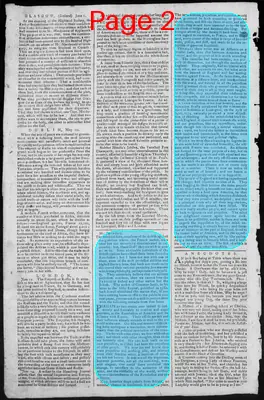
Fowle's New Hampshire Gazette And General Advertiser
Portsmouth, Rockingham County, New Hampshire
What is this article about?
A letter to the printer observes the fading of British-influenced prejudices against the French in post-Revolutionary America and recommends publishing extracts from Thomas Paine's 1782 letter to Abbe Raynal. The extracts argue that the Revolution and French Alliance transformed American thinking, expelling old biases and fostering enlightened views toward the world.
Merged-components note: These two components continue the same letter to the editor, extracting from Thomas Paine's work on prejudices and the Franco-American alliance.
Clipping
OCR Quality
Full Text
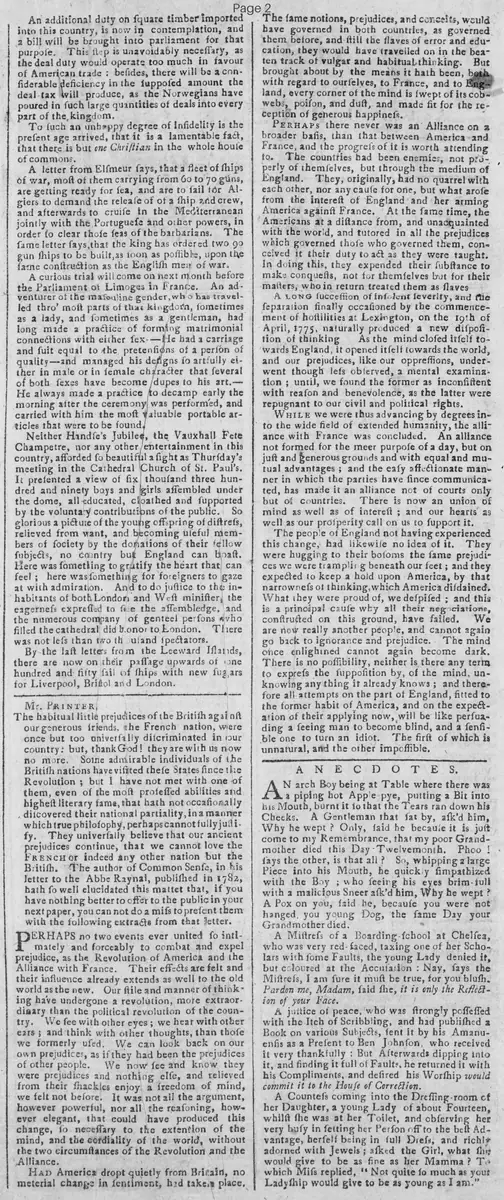
The habitual little prejudices of the British against our generous friends, the French nation, were once but too universally discriminated in our country: but, thank God! they are with us now no more. Some admirable individuals of the British nations have visited these States since the Revolution: but I have not met with one of them, even of the most professed abilities and highest literary fame, that hath not occasionally discovered their national partiality, in a manner which true philosophy, perhaps cannot fully justify.
They universally believe that our ancient prejudices continue, that we cannot love the FRENCH or indeed any other nation but the BRITISH. The author of Common Sense, in his letter to the Abbe Raynal, published in 1782, hath so well elucidated this matter that, if you have nothing better to offer to the public in your next paper, you can not do amiss to present them with the following extracts from that letter.
PERHAPS no two events ever united so intimately and forcibly to combat and expel prejudice, as the Revolution of America and the Alliance with France. Their effects are felt and their influence already extends as well to the old world as the new. Our style and manner of thinking have undergone a revolution, more extraordinary than the political revolution of the country. We see with other eyes; we hear with other ears; and think with other thoughts, than those we formerly used. We can look back on our own prejudices, as if they had been the prejudices of other people. We now see and know they were prejudices and nothing else, and relieved from their shackles enjoy a freedom of mind, we felt not before. It was not all the argument, however powerful, nor all the reasoning, however elegant, that could have produced this change, so necessary to the extension of the mind, and the cordiality of the world, without the two circumstances of the Revolution and the Alliance.
Had America dropt quietly from Britain, no material change in sentiment, had taken place.
The same notions, prejudices, and conceits, would have governed in both countries, as governed them before, and still the slaves of error and education, they would have travelled on in the beaten track of vulgar and habitual thinking. But brought about by the means it hath been, both with regard to ourselves, to France, and to England, every corner of the mind is swept of its cobwebs, poison, and dust, and made fit for the reception of generous happiness.
Perhaps there never was an Alliance on a broader basis, than that between America and France, and the progress of it is worth attending to. The countries had been enemies, not properly of themselves, but through the medium of England. They, originally, had no quarrel with each other, nor any cause for one, but what arose from the interest of England and her arming America against France. At the same time, the Americans at a distance from, and unacquainted with the world, and tutored in all the prejudices which governed those who governed them, conceived it their duty to act as they were taught.
In doing this, they expended their substance to make conquests, not for themselves but for their masters, who in return treated them as slaves. A long succession of insolent severity, and misrepresentation finally occasioned by the commencement of hostilities at Lexington, on the 10th of April, 1775, naturally produced a new disposition of thinking. As the mind closed itself towards England, it opened itself towards the world; and our prejudices, like our oppressions, underwent though less observed, a mental examination: until, we found the former as inconsistent with reason and benevolence, as the latter were repugnant to our civil and political rights.
WHILE we were thus advancing by degrees into the wide field of extended humanity, the alliance with France was concluded. An alliance not formed for the meer purpose of a day, but on just and generous grounds and with equal and mutual advantages; and the easy affectionate manner in which the parties have since communicated, has made it an alliance not of courts only but of countries. There is now an union of mind as well as of interest; and our hearts as well as our prosperity call on us to support it.
The people of England not having experienced this change, had likewise no idea of it. They were hugging to their bosoms the same prejudices we were trampling beneath our feet; and they expected to keep a hold upon America, by that narrowness of thinking, which America disdained. What they were proud of, we despised; and this is a principal cause why all their negociations, constructed on this ground, have failed. We are now really another people, and cannot again go back to ignorance and prejudice. The mind once enlightened cannot again become dark.
There is no possibility, neither is there any term to express the supposition by, of the mind, unknowing any thing it already knows; and therefore all attempts on the part of England, fitted to the former habit of America, and on the expectation of their applying now, will be like persuading a seeing man to become blind, and a sensible one to turn an idiot. The first of which is unnatural, and the other impossible.
What sub-type of article is it?
What themes does it cover?
What keywords are associated?
What entities or persons were involved?
Letter to Editor Details
Recipient
Mr. Printer
Main Argument
british prejudices against the french have faded in america due to the revolution and alliance with france, which enlightened minds and dispelled old biases; recommends printing extracts from thomas paine's 1782 letter to abbe raynal to illustrate this transformation.
Notable Details