Thank you for visiting SNEWPapers!
Sign up free
Letter to Editor
October 25, 1797
The New Hampshire Gazette
Portsmouth, Rockingham County, New Hampshire
What is this article about?
An 1797 article from Albany promotes Dr. Elisha Perkins' patented metallic tractors for treating diseases, connecting the practice to recent advances in chemistry and animal electricity by European and American scientists, foreseeing a medical revolution despite opposition.
Clipping
OCR Quality
95%
Excellent
Full Text
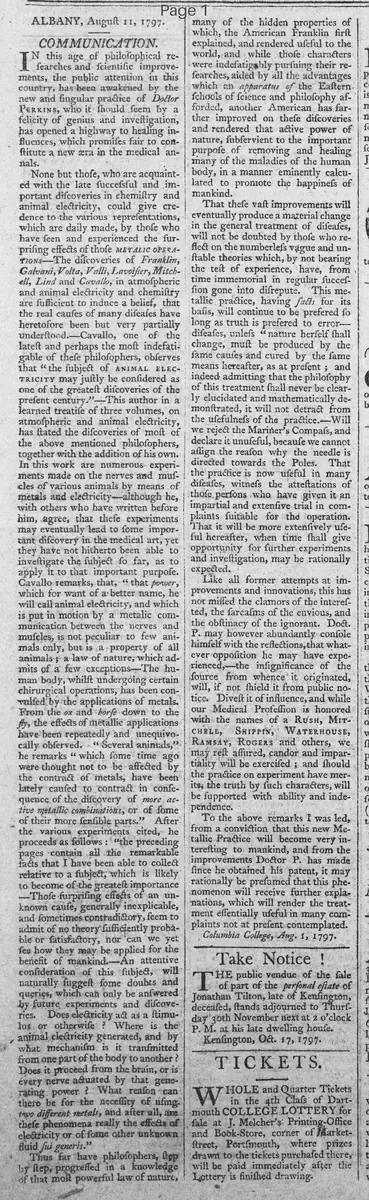
ALBANY, August 11, 1797.
COMMUNICATION
In this age of philosophical researches and scientific improvements, the public attention in this country, has been awakened by the new and singular practice of Doctor Perkins, who it should seem by a felicity of genius and investigation, has opened a highway to healing influences, which promises fair to constitute a new era in the medical annals.
None but those, who are acquainted with the late successful and important discoveries in chemistry and animal electricity, could give credence to the various representations, which are daily made, by those who have seen and experienced the surprising effects of those METALLIC OPERATIONS—The discoveries of Franklin, Galvani, Volta, Valli, Lavoisier, Mitchell, Lind and Cavallo, in atmospheric and animal electricity and chemistry are sufficient to induce a belief, that the real causes of many diseases have heretofore been but very partially understood.—Cavallo, one of the latest and perhaps the most indefatigable of these philosophers, observes that "the subject of ANIMAL ELECTRICITY may justly be considered as one of the greatest discoveries of the present century."—This author in a learned treatise of three volumes, on atmospheric and animal electricity, has stated the discoveries of most of the above mentioned philosophers, together with the addition of his own.
In this work are numerous experiments made on the nerves and muscles of various animals by means of metals and electricity—although he, with others who have written before him, agree, that these experiments may eventually lead to some important discovery in the medical art, yet they have not hitherto been able to investigate the subject so far, as to apply it to that important purpose.
Cavallo remarks, that, "that power, which for want of a better name, he will call animal electricity, and which is put in motion by a metallic communication between the nerves and muscles, is not peculiar to few animals only, but is a property of all animals; a law of nature, which admits of a few exceptions—The human body, whilst undergoing certain chirurgical operations, has been convulsed by the applications of metals.
From the ox and horse down to the fly, the effects of metallic applications have been repeatedly and unequivocally observed. "Several animals," he remarks "which some time ago were thought not to be affected by the contact of metals, have been lately caused to contract in consequence of the discovery of more active metallic combinations, or of some of their more sensible parts." After the various experiments cited, he proceeds as follows: "the preceding pages contain all the remarkable facts that I have been able to collect relative to a subject, which is likely to become of the greatest importance Those surprising effects of an unknown cause, generally inexplicable, and sometimes contradictory, seem to admit of no theory sufficiently probable or satisfactory, nor can we yet see how they may be applied for the benefit of mankind.—An attentive consideration of this subject, will naturally suggest some doubts and queries, which can only be answered by future experiments and discoveries. Does electricity act as a stimulus or otherwise? Where is the animal electricity generated, and by what mechanism is it transmitted from one part of the body to another? Does it proceed from the brain, or is every nerve actuated by that generating power? What reason can there be for the necessity of using two different metals, and after all, are these phenomena really the effects of electricity or of some other unknown fluid sui generis."
Thus far have philosophers, step by step, progressed in a knowledge of that most powerful law of nature, many of the hidden properties of which, the American Franklin first explained, and rendered useful to the world, and while those characters were indefatigably pursuing their researches, aided by all the advantages which an apparatus of the European schools of science and philosophy afforded, another American has farther improved on these discoveries and rendered that active power of nature, subservient to the important purpose of removing and healing many of the maladies of the human body, in a manner eminently calculated to promote the happiness of mankind.
That these vast improvements will eventually produce a material change in the general treatment of diseases, will not be doubted by those who reflect on the numberless vague and unstable theories which, by not bearing the test of experience, have, from time immemorial in regular succession gone into disrepute. This metallic practice, having facts for its basis, will continue to be preferred so long as truth is preferred to error—diseases, unless "nature herself shall change, must be produced by the same causes and cured by the same means hereafter, as at present; and indeed admitting that the philosophy of this treatment shall never be clearly elucidated and mathematically demonstrated, it will not detract from the usefulness of the practice.—Will we reject the Mariner's Compass, and declare it useless, because we cannot assign the reason why the needle is directed towards the Poles. That the practice is now useful in many diseases, witness the attestations of those persons who have given it an impartial and extensive trial in complaints suitable for the operation.
That it will be more extensively useful hereafter, when time shall give opportunity for further experiments and investigation, may be rationally expected.
Like all former attempts at improvements and innovations, this has not missed the clamors of the interested, the sarcasms of the envious, and the obstinacy of the ignorant. Doct. P. may however abundantly console himself with the reflections, that whatever opposition he may have experienced,—the insignificance of the source from whence it originated, will, if not shield it from public notice. Divest it of influence, and while our Medical Profession is honored with the names of a Rush, Mitchell, Shippen, Waterhouse, Ramsay, Rogers and others, we may rest assured, candor and impartiality will be exercised; and should the practice on experiment have merits, the truth by such characters, will be supported with ability and independence.
To the above remarks I was led, from a conviction that this new Metallic Practice will become very interesting to mankind, and from the improvements Doctor P. has made since he obtained his patent, it may rationally be presumed that this phenomenon will receive further explanations, which will render the treatment essentially useful in many complaints not at present contemplated.
Columbia College, Aug. 1, 1797.
COMMUNICATION
In this age of philosophical researches and scientific improvements, the public attention in this country, has been awakened by the new and singular practice of Doctor Perkins, who it should seem by a felicity of genius and investigation, has opened a highway to healing influences, which promises fair to constitute a new era in the medical annals.
None but those, who are acquainted with the late successful and important discoveries in chemistry and animal electricity, could give credence to the various representations, which are daily made, by those who have seen and experienced the surprising effects of those METALLIC OPERATIONS—The discoveries of Franklin, Galvani, Volta, Valli, Lavoisier, Mitchell, Lind and Cavallo, in atmospheric and animal electricity and chemistry are sufficient to induce a belief, that the real causes of many diseases have heretofore been but very partially understood.—Cavallo, one of the latest and perhaps the most indefatigable of these philosophers, observes that "the subject of ANIMAL ELECTRICITY may justly be considered as one of the greatest discoveries of the present century."—This author in a learned treatise of three volumes, on atmospheric and animal electricity, has stated the discoveries of most of the above mentioned philosophers, together with the addition of his own.
In this work are numerous experiments made on the nerves and muscles of various animals by means of metals and electricity—although he, with others who have written before him, agree, that these experiments may eventually lead to some important discovery in the medical art, yet they have not hitherto been able to investigate the subject so far, as to apply it to that important purpose.
Cavallo remarks, that, "that power, which for want of a better name, he will call animal electricity, and which is put in motion by a metallic communication between the nerves and muscles, is not peculiar to few animals only, but is a property of all animals; a law of nature, which admits of a few exceptions—The human body, whilst undergoing certain chirurgical operations, has been convulsed by the applications of metals.
From the ox and horse down to the fly, the effects of metallic applications have been repeatedly and unequivocally observed. "Several animals," he remarks "which some time ago were thought not to be affected by the contact of metals, have been lately caused to contract in consequence of the discovery of more active metallic combinations, or of some of their more sensible parts." After the various experiments cited, he proceeds as follows: "the preceding pages contain all the remarkable facts that I have been able to collect relative to a subject, which is likely to become of the greatest importance Those surprising effects of an unknown cause, generally inexplicable, and sometimes contradictory, seem to admit of no theory sufficiently probable or satisfactory, nor can we yet see how they may be applied for the benefit of mankind.—An attentive consideration of this subject, will naturally suggest some doubts and queries, which can only be answered by future experiments and discoveries. Does electricity act as a stimulus or otherwise? Where is the animal electricity generated, and by what mechanism is it transmitted from one part of the body to another? Does it proceed from the brain, or is every nerve actuated by that generating power? What reason can there be for the necessity of using two different metals, and after all, are these phenomena really the effects of electricity or of some other unknown fluid sui generis."
Thus far have philosophers, step by step, progressed in a knowledge of that most powerful law of nature, many of the hidden properties of which, the American Franklin first explained, and rendered useful to the world, and while those characters were indefatigably pursuing their researches, aided by all the advantages which an apparatus of the European schools of science and philosophy afforded, another American has farther improved on these discoveries and rendered that active power of nature, subservient to the important purpose of removing and healing many of the maladies of the human body, in a manner eminently calculated to promote the happiness of mankind.
That these vast improvements will eventually produce a material change in the general treatment of diseases, will not be doubted by those who reflect on the numberless vague and unstable theories which, by not bearing the test of experience, have, from time immemorial in regular succession gone into disrepute. This metallic practice, having facts for its basis, will continue to be preferred so long as truth is preferred to error—diseases, unless "nature herself shall change, must be produced by the same causes and cured by the same means hereafter, as at present; and indeed admitting that the philosophy of this treatment shall never be clearly elucidated and mathematically demonstrated, it will not detract from the usefulness of the practice.—Will we reject the Mariner's Compass, and declare it useless, because we cannot assign the reason why the needle is directed towards the Poles. That the practice is now useful in many diseases, witness the attestations of those persons who have given it an impartial and extensive trial in complaints suitable for the operation.
That it will be more extensively useful hereafter, when time shall give opportunity for further experiments and investigation, may be rationally expected.
Like all former attempts at improvements and innovations, this has not missed the clamors of the interested, the sarcasms of the envious, and the obstinacy of the ignorant. Doct. P. may however abundantly console himself with the reflections, that whatever opposition he may have experienced,—the insignificance of the source from whence it originated, will, if not shield it from public notice. Divest it of influence, and while our Medical Profession is honored with the names of a Rush, Mitchell, Shippen, Waterhouse, Ramsay, Rogers and others, we may rest assured, candor and impartiality will be exercised; and should the practice on experiment have merits, the truth by such characters, will be supported with ability and independence.
To the above remarks I was led, from a conviction that this new Metallic Practice will become very interesting to mankind, and from the improvements Doctor P. has made since he obtained his patent, it may rationally be presumed that this phenomenon will receive further explanations, which will render the treatment essentially useful in many complaints not at present contemplated.
Columbia College, Aug. 1, 1797.
What sub-type of article is it?
Informative
Persuasive
Philosophical
What themes does it cover?
Health Medicine
Science Nature
What keywords are associated?
Metallic Operations
Doctor Perkins
Animal Electricity
Medical Innovation
Scientific Discoveries
Healing Diseases
What entities or persons were involved?
The Public
Letter to Editor Details
Recipient
The Public
Main Argument
doctor perkins' metallic operations represent a groundbreaking advancement in medicine, building on discoveries in animal electricity and chemistry by scientists like franklin and cavallo, promising a new era in healing diseases through metallic applications.
Notable Details
References Discoveries By Franklin, Galvani, Volta, Valli, Lavoisier, Mitchell, Lind, And Cavallo
Quotes Cavallo On Animal Electricity As A Major Discovery
Mentions Experiments On Animals And Human Body With Metals
Cites Medical Figures Like Rush, Mitchell, Shippen, Waterhouse, Ramsay, Rogers