Thank you for visiting SNEWPapers!
Sign up free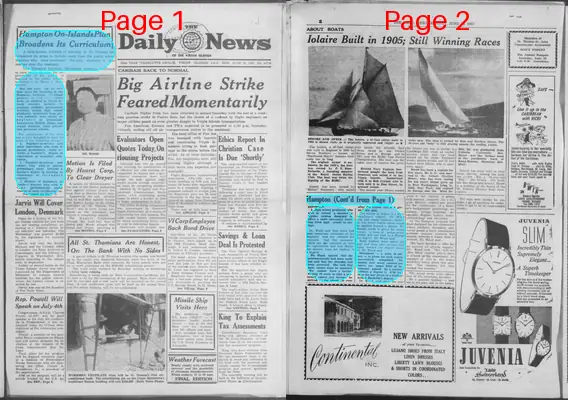
The Daily News Of The Virgin Islands
Charlotte Amalie, Saint Thomas County, Virgin Islands
What is this article about?
The Hampton Institute On-Islands program in St. Thomas, Virgin Islands, expands its curriculum beyond public school teachers to include diverse students like graduates, government workers, and others, aiming to improve teaching quality and offer degree pathways.
Merged-components note: Continuation of Hampton Institute story from page 1 to page 2.
Clippings
1 of 2
OCR Quality
Full Text
A little-known fortress of learning in St. Thomas has broadened its scope to include more than the public school teachers who were previously the only students, it was learned over the weekend.
The Hampton Institute On-Islands program continues to have as its objective the improvement of the quality of teaching in the public schools, according to Dr. Marie V. Wood, director.
But this year, for the first time since the inception of the Hampton Institute On-Islands program in 1953, the student body, in addition to Virgin Islands teachers, includes 25 graduate students, government workers, recent high school graduates, secretaries from private industry, sales clerks, an engineer, an accountant, housewives, British aliens, and school teachers from private and parochial schools.
The curriculum of the institute is now designed to meet the needs of the following groups:
1. Teachers-in-service and other individuals who wish to pursue preliminary study towards a bachelor's degree in elementary or secondary education.
2. Teachers-in-service and others who wish to pursue preliminary study towards a master's degree in teaching in elementary or secondary schools.
3. Holders of bachelor's or master's degrees who wish to take professionally useful courses or meet certification requirements.
(Continued on Page 2)
Hampton (Cont'd from Page 1)
requirements.
4. High school graduates who wish to attend a summer or regular session designed to effect a more successful transition from high school to college.
Dr. Wood said that there had been numerous criticisms of the program: that the courses are repeated, that the announcements are not received in time for registration and that Hampton courses were not leading to a degree.
Dr. Wood agreed that the announcements had been tardy but said that the situation had been corrected. She said that basic classes must be repeated. "We cannot have a teacher waiting 10 years to take a necessary course just because he arrived on the island the year after the course was first given," she said.
The matter of degree is a more complicated subject. Dr. Wood said that many teachers believed that every course taken would be applied toward a degree. Although credit is given for every course, amass of hodge-podge credits will not lead to a Hampton degree, Dr. Wood said.
Each teacher must select his goal and then take courses that apply toward the degree desired, Dr. Wood said. Increment a raise in salary is given for each course successfully completed. No matter how many courses are taken, the upper limit of increment gained by a teacher without a degree is $100 less than the pay given to a teacher with a Bachelor's degree.
Dr. Wood said: tha
What sub-type of article is it?
What keywords are associated?
What entities or persons were involved?
Where did it happen?
Story Details
Key Persons
Location
St. Thomas, Virgin Islands
Event Date
1953 (Inception); This Year (Expansion)
Story Details
The Hampton Institute On-Islands program, started in 1953 to improve public school teaching, now includes diverse students beyond teachers and offers curriculum for bachelor's/master's pursuits, certification, and high school-to-college transition. Dr. Wood addresses criticisms on course repetition, announcements, and degree credits, noting salary increments but limits without degrees.