Thank you for visiting SNEWPapers!
Sign up free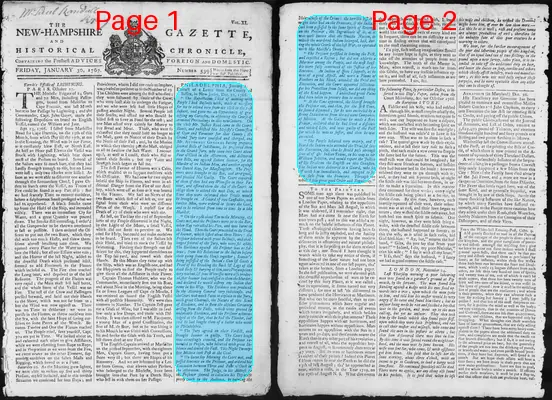
The New Hampshire Gazette And Historical Chronicle
Portsmouth, Greenland, Rockingham County, New Hampshire
What is this article about?
In Sussex County, New Jersey, December 1766, Robert Seamor was tried and executed for murdering an Oneida Indian man, amid concerns for frontier relations. David Ray pleaded guilty to manslaughter and was punished. An Indian observer witnessed the justice and planned to report it positively.
Merged-components note: Continuation of the trial story in New Jersey across pages 1 and 2, sequential reading order.
Clippings
1 of 2
OCR Quality
Full Text
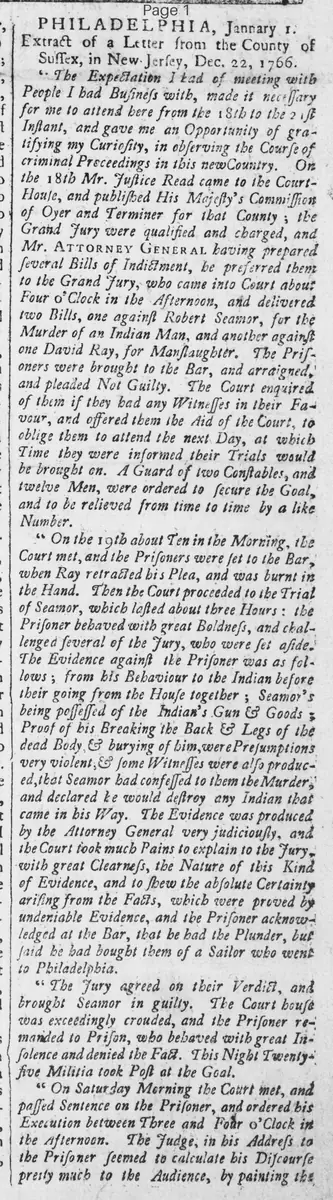
Extract of a Letter from the County of Sussex, in New Jersey, Dec. 22, 1766.
The Expectation I had of meeting with People I had Business with, made it necessary for me to attend here from the 18th to the 21st Instant, and gave me an Opportunity of gratifying my Curiosity, in observing the Course of criminal Proceedings in this new Country. On the 18th Mr. Justice Read came to the Court-House, and published His Majesty's Commission of Oyer and Terminer for that County ; the Grand Jury were qualified and charged, and Mr. Attorney General having prepared several Bills of Indictment, he preferred them to the Grand Jury, who came into Court about Four o'Clock in the Afternoon, and delivered two Bills, one against Robert Seamor, for the Murder of an Indian Man, and another against one David Ray, for Manslaughter. The Prisoners were brought to the Bar, and arraigned, and pleaded Not Guilty. The Court enquired of them if they had any Witnesses in their Favour, and offered them the Aid of the Court. to oblige them to attend the next Day, at which Time they were informed their Trials would be brought on. A Guard of two Constables, and twelve Men, Were ordered to secure the Goal, and to be relieved from time to time by a like Number.
On the 19th about Ten in the Morning, the Court met, and the Prisoners were set to the Bar, when Ray retracted his Plea, and was burnt in the Hand. Then the Court proceeded to the Trial of Seamor, which lasted about three Hours : the Prisoner behaved with great Boldness, and challenged several of the Jury, who were set aside. The Evidence against the Prisoner was as follows ; from his Behaviour to the Indian before their going from the House together ; Seamor's being possessed of the Indian's Gun & Goods ; Proof of his Breaking the Back & Legs of the dead Body.& burying of him,were Presumptions very violent:& some Witnesses were also produced,that Seamor had confessed to them the Murder. and declared he would destroy any Indian that came in his Way. The Evidence was produced by the Attorney General very judiciously. and the Court took much Pains to explain to the Jury. with great Clearness, the Nature of this Kind of Evidence, and to show the absolute Certainty arising from the Facts, which were proved by undeniable Evidence, and the Prisoner acknowledged at the Bar, that he had the Plunder, but said he had bought them of a Sailor who went to Philadelphia.
The Jury agreed on their Verdict, and brought Seamor in guilty. The Court house was exceedingly crowded, and the Prisoner remanded to Prison, who behaved with great Insolence and denied the Fact. This Night Twenty-five Militia took Post at the Goal.
On Saturday Morning the Court met. and passed Sentence on the Prisoner, and ordered his Execution between Three and Four o'Clock in the Afternoon. The Judge; in his Address to the Prisoner Seemed to calculate his Discourse pretty much to the Audience, by painting the
Heinousness of the Crime: the terrible Effect it might have had on the Frontiers, if the Indians had been possessed by the same Spirit of Revenge on the Prisoner; the Ingratitude of it, as it was well known that the Oneida Nation, to which the murdered Indian belonged, had during the whole Course of the last War, co-operated with His Majesty's Troops.
The Prisoner persisted in denying the Fact, and expected a Rescue; but did not observe a Murmur among the People, and the most Sensible were fully convinced of the Justice of his Sentence. An Indian of Note (I suppose, as he was of a good Aspect, and wore a Plume of Feathers on his Head) attended the Trial and Execution, and the Court appeared solicitous for his Protection from Insult, nor did any thing of the Kind happen. I understood great Pains had been taken to procure him to attend.
At the Time appointed, the Sheriff brought the Prisoner out, and then, for the first Time, he seemed dismayed; for he was encircled by a strong Detachment from the adjacent Companies of Militia. At the Gallows he made a short Prayer, declared that he had lived a dissolute and wicked Life, and was guilty of the Fact for which he was to suffer, and then he was executed.
The People behaved very orderly, and I heard the Indian who attended the Trial, & saw the Execution, say, that he should pass through several of the Indian Towns, in his way to Sir William Johnson, and would report the Justice of his Brethren the English on this Occasion. The Indian was delivered to a Guard, who set off with him immediately, and engaged to see him safe from the Frontiers. Through the whole I saw great good Order and Regularity.
What sub-type of article is it?
What keywords are associated?
What entities or persons were involved?
Where did it happen?
Domestic News Details
Primary Location
County Of Sussex, New Jersey
Event Date
December 18 21, 1766
Key Persons
Outcome
robert seamor executed by hanging for murder; david ray burnt in the hand for manslaughter; oneida indian man murdered (back and legs broken, buried).
Event Details
Court of Oyer and Terminer in Sussex County tried Robert Seamor for murdering an Indian man and David Ray for manslaughter. Seamor found guilty based on evidence of possession of victim's goods, breaking and burying the body, and confessions; sentenced and executed publicly with militia guard. Ray pleaded guilty. Indian observer attended and approved the justice.