Thank you for visiting SNEWPapers!
Sign up free
Story
November 13, 1857
The Liberator
Boston, Suffolk County, Massachusetts
What is this article about?
In the Cincinnati Slave Case, three slaves owned by Virginia's Mr. Withers were arrested via habeas corpus while in transit but swiftly returned to him by Judge Carter's second writ, bypassing ongoing Probate Court proceedings under Judge Burgoyne, sparking jurisdictional outrage and debate over slavery laws.
Clipping
OCR Quality
98%
Excellent
Full Text
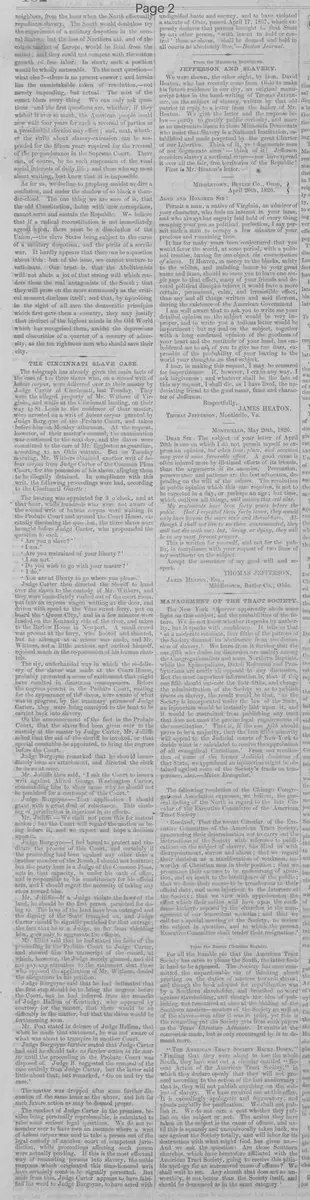
THE CINCINNATI SLAVE CASE.
The telegraph has already given the main facts of the case of the three slaves who, on a second writ of habeas corpus, were delivered over to their master by Judge Carter of Cincinnati, last Tuesday. They were the alleged property of Mr. Withers of Virginia, and while at the Cincinnati landing, on their way to St. Louis to the residence of their master, were arrested on a writ of habeas corpus granted by Judge Burgoyne of the Probate Court, and taken before him on Monday afternoon. At the request, however, of their master's counsel, the examination was continued to the next day, and the slaves were committed to the care of Mr. Eggleston as guardian, according to an Ohio statute. But on Tuesday morning, Mr. Withers obtained another writ of habeas corpus from Judge Carter of the Common Pleas Court, for the possession of his slaves, alleging them to be illegally detained. In compliance with this writ, the following proceedings were had, according to the Cincinnati Gazette:
The hearing was appointed for 3 o'clock, and at that hour, while hundreds who were not aware of the second writ of habeas corpus were waiting in the Probate Court and around the Court House, excitedly discussing the question, the three slaves were brought before Judge Carter, who propounded the question to each:
Are you a slave?
I am.
Are you restrained of your liberty?
I am not.
Do you wish to go with your master?
I do.
You are at liberty to go where you please.
Judge Carter then directed the Sheriff to hand over the slaves to the custody of Mr. Withers, and they were immediately rushed out of the court room, put into an express wagon waiting at the door, and driven with speed to the Vine street ferry, put on board the 'Queen City,' and in a few minutes were landed on the Kentucky side of the river, and taken to the Barlow House in Newport. A small crowd was present at the ferry, who hooted and shouted, but no attempt at a rescue was made, and Mr. Withers, not a little anxious and excited himself, rejoiced much in the re-possession of his human chattels.
The sly, underhanded way in which the re-delivery of the slaves was made at the Court House, probably prevented a scene of excitement that might have resulted in disastrous consequences. Before the negroes present in the Probate Court, waiting for the appearance of the slaves, were aware of what was in progress, by the summary process of Judge Carter, they were being conveyed to the boat to be carried back into slavery.
On the announcement of the fact in the Probate Court, that the slaves had been given over to the custody of the master by Judge Carter, Mr. Jolliffe asked that the aid of the sheriff be invoked, or that special constables be appointed, to bring the negroes before the Court.
Judge Burgoyne remarked that he should immediately issue an attachment, and directed the clerk to do so at once.
Mr. Jolliffe then said, I ask the Court to issue a writ against Alfred George Washington Carter, commanding him to show cause why he should not be punished for a contempt of this Court.
Judge Burgoyne—That application I should grant with a great deal of reluctance. This clashing of jurisdiction is injurious in its effects.
Mr. Jolliffe—We shall not press this for instant action; but the Court will regard the motion as being before it, and we expect and hope a decision upon it.
Judge Burgoyne—I feel bound to protect and vindicate the process of this Court, and certainly if the proceeding had been against any other than a brother member of the Bench, I should not hesitate; but the party here is a Judge of the Common Pleas, acts in that capacity, is under his oath of office, and is responsible to his constituency for his official acts, and I should regret the necessity of taking any steps toward him.
Mr. Jolliffe—If a Judge violate the laws of the land, he should be the first person punished for doing so. The laws of the land have been outraged and the dignity of the State trampled on, and Judge Carter should be signally punished for that outrage; the fact that he is a Judge, so far from shielding him, goes only to aggravate the offence.
Mr. Elliot said that he had stated the facts of the proceeding in the Probate Court to Judge Carter, and showed him the transcript of the record, at which, however, the Judge merely glanced, and did not pay any attention to the statement that those who opposed the application of Mr. Withers, denied the allegations in his petition.
Judge Burgoyne said that he had intimated that the first step should be to bring the negroes before the Court, but he had inferred from the remarks of Judge Hallem of Kentucky, who appeared by courtesy for the master, that there would be no difficulty in the matter, but that the slaves would be forthcoming soon.
Mr. Peat stated in defence of Judge Hallem, that when he made that statement, he was not aware of what was about to transpire in another Court.
Judge Burgoyne further stated that Judge Carter had said he should take no further action in the matter until the proceeding in the Probate Court was disposed of. Judge B. suggested the removal of the case entirely from Judge Carter, but the latter said little about that, but remarked, 'Go on and try the case.'
The matter was dropped after some further discussion of the same tenor as the above, and left for such future action as may be deemed proper.
The conduct of Judge Carter in the premises, besides being personally reprehensible, is calculated to raise some serious legal questions. We do not remember ever to have seen an instance where a writ of habeas corpus was used to take a person out of the legal custody of another court of competent jurisdiction, while proceedings affecting such person were actually pending. If this is the most effectual way of remanding persons into slavery, the noble purposes which originated this time-honored writ have certainly come to be signally perverted. But aside from this, Judge Carter appears to have falsified his word to Judge Burgoyne, to have acted with undignified haste and secrecy, and to have violated a statute of Ohio, passed April 17, 1857, which expressly declares that persons brought to that State by any other person, 'with intent to hold or control' them as slaves, 'shall be deemed and held in all courts as absolutely free.'—Boston Journal.
The telegraph has already given the main facts of the case of the three slaves who, on a second writ of habeas corpus, were delivered over to their master by Judge Carter of Cincinnati, last Tuesday. They were the alleged property of Mr. Withers of Virginia, and while at the Cincinnati landing, on their way to St. Louis to the residence of their master, were arrested on a writ of habeas corpus granted by Judge Burgoyne of the Probate Court, and taken before him on Monday afternoon. At the request, however, of their master's counsel, the examination was continued to the next day, and the slaves were committed to the care of Mr. Eggleston as guardian, according to an Ohio statute. But on Tuesday morning, Mr. Withers obtained another writ of habeas corpus from Judge Carter of the Common Pleas Court, for the possession of his slaves, alleging them to be illegally detained. In compliance with this writ, the following proceedings were had, according to the Cincinnati Gazette:
The hearing was appointed for 3 o'clock, and at that hour, while hundreds who were not aware of the second writ of habeas corpus were waiting in the Probate Court and around the Court House, excitedly discussing the question, the three slaves were brought before Judge Carter, who propounded the question to each:
Are you a slave?
I am.
Are you restrained of your liberty?
I am not.
Do you wish to go with your master?
I do.
You are at liberty to go where you please.
Judge Carter then directed the Sheriff to hand over the slaves to the custody of Mr. Withers, and they were immediately rushed out of the court room, put into an express wagon waiting at the door, and driven with speed to the Vine street ferry, put on board the 'Queen City,' and in a few minutes were landed on the Kentucky side of the river, and taken to the Barlow House in Newport. A small crowd was present at the ferry, who hooted and shouted, but no attempt at a rescue was made, and Mr. Withers, not a little anxious and excited himself, rejoiced much in the re-possession of his human chattels.
The sly, underhanded way in which the re-delivery of the slaves was made at the Court House, probably prevented a scene of excitement that might have resulted in disastrous consequences. Before the negroes present in the Probate Court, waiting for the appearance of the slaves, were aware of what was in progress, by the summary process of Judge Carter, they were being conveyed to the boat to be carried back into slavery.
On the announcement of the fact in the Probate Court, that the slaves had been given over to the custody of the master by Judge Carter, Mr. Jolliffe asked that the aid of the sheriff be invoked, or that special constables be appointed, to bring the negroes before the Court.
Judge Burgoyne remarked that he should immediately issue an attachment, and directed the clerk to do so at once.
Mr. Jolliffe then said, I ask the Court to issue a writ against Alfred George Washington Carter, commanding him to show cause why he should not be punished for a contempt of this Court.
Judge Burgoyne—That application I should grant with a great deal of reluctance. This clashing of jurisdiction is injurious in its effects.
Mr. Jolliffe—We shall not press this for instant action; but the Court will regard the motion as being before it, and we expect and hope a decision upon it.
Judge Burgoyne—I feel bound to protect and vindicate the process of this Court, and certainly if the proceeding had been against any other than a brother member of the Bench, I should not hesitate; but the party here is a Judge of the Common Pleas, acts in that capacity, is under his oath of office, and is responsible to his constituency for his official acts, and I should regret the necessity of taking any steps toward him.
Mr. Jolliffe—If a Judge violate the laws of the land, he should be the first person punished for doing so. The laws of the land have been outraged and the dignity of the State trampled on, and Judge Carter should be signally punished for that outrage; the fact that he is a Judge, so far from shielding him, goes only to aggravate the offence.
Mr. Elliot said that he had stated the facts of the proceeding in the Probate Court to Judge Carter, and showed him the transcript of the record, at which, however, the Judge merely glanced, and did not pay any attention to the statement that those who opposed the application of Mr. Withers, denied the allegations in his petition.
Judge Burgoyne said that he had intimated that the first step should be to bring the negroes before the Court, but he had inferred from the remarks of Judge Hallem of Kentucky, who appeared by courtesy for the master, that there would be no difficulty in the matter, but that the slaves would be forthcoming soon.
Mr. Peat stated in defence of Judge Hallem, that when he made that statement, he was not aware of what was about to transpire in another Court.
Judge Burgoyne further stated that Judge Carter had said he should take no further action in the matter until the proceeding in the Probate Court was disposed of. Judge B. suggested the removal of the case entirely from Judge Carter, but the latter said little about that, but remarked, 'Go on and try the case.'
The matter was dropped after some further discussion of the same tenor as the above, and left for such future action as may be deemed proper.
The conduct of Judge Carter in the premises, besides being personally reprehensible, is calculated to raise some serious legal questions. We do not remember ever to have seen an instance where a writ of habeas corpus was used to take a person out of the legal custody of another court of competent jurisdiction, while proceedings affecting such person were actually pending. If this is the most effectual way of remanding persons into slavery, the noble purposes which originated this time-honored writ have certainly come to be signally perverted. But aside from this, Judge Carter appears to have falsified his word to Judge Burgoyne, to have acted with undignified haste and secrecy, and to have violated a statute of Ohio, passed April 17, 1857, which expressly declares that persons brought to that State by any other person, 'with intent to hold or control' them as slaves, 'shall be deemed and held in all courts as absolutely free.'—Boston Journal.
What sub-type of article is it?
Historical Event
Crime Story
What themes does it cover?
Justice
Misfortune
What keywords are associated?
Cincinnati Slave Case
Habeas Corpus
Judge Carter
Slavery
Jurisdictional Clash
Ohio Statute
What entities or persons were involved?
Mr. Withers
Judge Carter
Judge Burgoyne
Mr. Jolliffe
Mr. Eggleston
Where did it happen?
Cincinnati, Ohio
Story Details
Key Persons
Mr. Withers
Judge Carter
Judge Burgoyne
Mr. Jolliffe
Mr. Eggleston
Location
Cincinnati, Ohio
Event Date
Last Tuesday
Story Details
Three slaves owned by Mr. Withers of Virginia were arrested in Cincinnati via habeas corpus by Judge Burgoyne but returned to their master by Judge Carter's second writ, leading to jurisdictional conflict and criticism for violating Ohio's anti-slavery statute.