Thank you for visiting SNEWPapers!
Sign up free
Editorial
January 29, 1962
The Daily News Of The Virgin Islands
Charlotte Amalie, Saint Thomas County, Virgin Islands
What is this article about?
Editorial lauding the role of a good newspaper as the 'conscience of the community,' citing Pennsylvania's governor. It describes newspapers' duties to report facts, explain reasons, criticize ethics, remind leaders of commitments, innovate, and shape community futures objectively.
Clipping
OCR Quality
98%
Excellent
Full Text
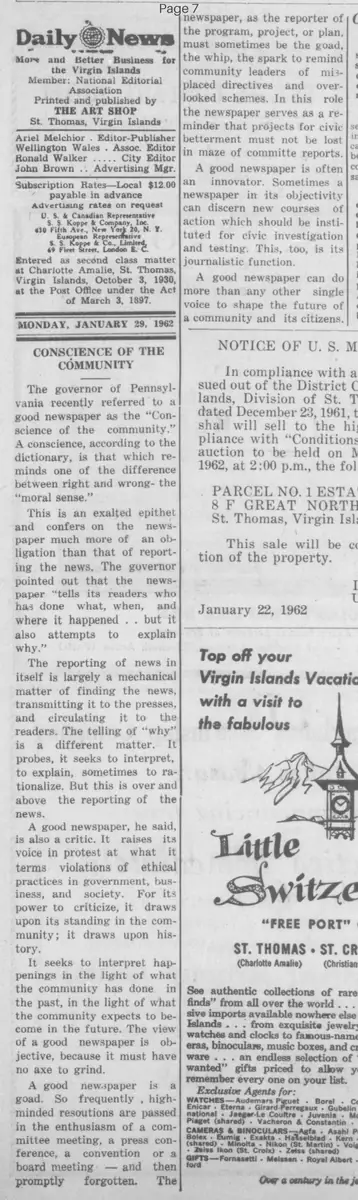
CONSCIENCE OF THE COMMUNITY
The governor of Pennsylvania recently referred to a good newspaper as the "Conscience of the community."
A conscience, according to the dictionary, is that which reminds one of the difference between right and wrong- the "moral sense."
This is an exalted epithet and confers on the newspaper much more of an obligation than that of reporting the news. The governor pointed out that the newspaper "tells its readers who has done what, when, and where it happened . . but it also attempts to explain why."
The reporting of news in itself is largely a mechanical matter of finding the news, transmitting it to the presses, and circulating it to the readers. The telling of "why" is a different matter. It probes, it seeks to interpret, to explain, sometimes to rationalize. But this is over and above the reporting of the news.
A good newspaper, he said, is also a critic. It raises its voice in protest at what it terms violations of ethical practices in government, business, and society. For its power to criticize, it draws upon its standing in the community; it draws upon history.
It seeks to interpret happenings in the light of what the community has done in the past, in the light of what the community expects to become in the future. The view of a good newspaper is objective, because it must have no axe to grind.
A good newspaper is a goad. So frequently high-minded resolutions are passed in the enthusiasm of a committee meeting, a press conference, a convention or a board meeting - and then promptly forgotten.
The newspaper, as the reporter of the program, project, or plan, must sometimes be the goad, the whip, the spark to remind community leaders of misplaced directives and overlooked schemes. In this role the newspaper serves as a reminder that projects for civic betterment must not be lost in maze of committee reports.
A good newspaper is often an innovator. Sometimes a newspaper in its objectivity can discern new courses of action which should be instituted for civic investigation and testing. This, too, is its journalistic function.
A good newspaper can do more than any other single voice to shape the future of a community and its citizens.
The governor of Pennsylvania recently referred to a good newspaper as the "Conscience of the community."
A conscience, according to the dictionary, is that which reminds one of the difference between right and wrong- the "moral sense."
This is an exalted epithet and confers on the newspaper much more of an obligation than that of reporting the news. The governor pointed out that the newspaper "tells its readers who has done what, when, and where it happened . . but it also attempts to explain why."
The reporting of news in itself is largely a mechanical matter of finding the news, transmitting it to the presses, and circulating it to the readers. The telling of "why" is a different matter. It probes, it seeks to interpret, to explain, sometimes to rationalize. But this is over and above the reporting of the news.
A good newspaper, he said, is also a critic. It raises its voice in protest at what it terms violations of ethical practices in government, business, and society. For its power to criticize, it draws upon its standing in the community; it draws upon history.
It seeks to interpret happenings in the light of what the community has done in the past, in the light of what the community expects to become in the future. The view of a good newspaper is objective, because it must have no axe to grind.
A good newspaper is a goad. So frequently high-minded resolutions are passed in the enthusiasm of a committee meeting, a press conference, a convention or a board meeting - and then promptly forgotten.
The newspaper, as the reporter of the program, project, or plan, must sometimes be the goad, the whip, the spark to remind community leaders of misplaced directives and overlooked schemes. In this role the newspaper serves as a reminder that projects for civic betterment must not be lost in maze of committee reports.
A good newspaper is often an innovator. Sometimes a newspaper in its objectivity can discern new courses of action which should be instituted for civic investigation and testing. This, too, is its journalistic function.
A good newspaper can do more than any other single voice to shape the future of a community and its citizens.
What sub-type of article is it?
Moral Or Religious
Social Reform
What keywords are associated?
Newspaper Role
Community Conscience
Moral Sense
Civic Criticism
Journalistic Innovation
Ethical Practices
Objective Reporting
What entities or persons were involved?
Governor Of Pennsylvania
Newspaper
Editorial Details
Primary Topic
Newspapers As Conscience Of The Community
Stance / Tone
Praiseful And Exhortative
Key Figures
Governor Of Pennsylvania
Newspaper
Key Arguments
Newspapers Serve As Moral Conscience By Distinguishing Right From Wrong
Beyond Reporting Facts, They Explain Why Events Occur
They Criticize Ethical Violations In Government, Business, And Society
They Interpret Events In Historical And Future Community Context Objectively
They Act As A Goad To Remind Leaders Of Forgotten Civic Projects
They Innovate By Suggesting New Actions For Community Improvement
They Shape The Community's Future More Than Any Other Voice