Thank you for visiting SNEWPapers!
Sign up free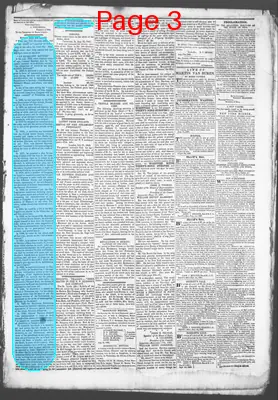
Editorial
September 3, 1840
Democratic Standard
Georgetown, Brown County, Ohio
What is this article about?
An editorial critiquing General William Henry Harrison's political record, highlighting inconsistencies on abolition, federalism, tariffs, banking, and military matters to undermine his 1840 presidential candidacy.
Clipping
OCR Quality
98%
Excellent
Full Text
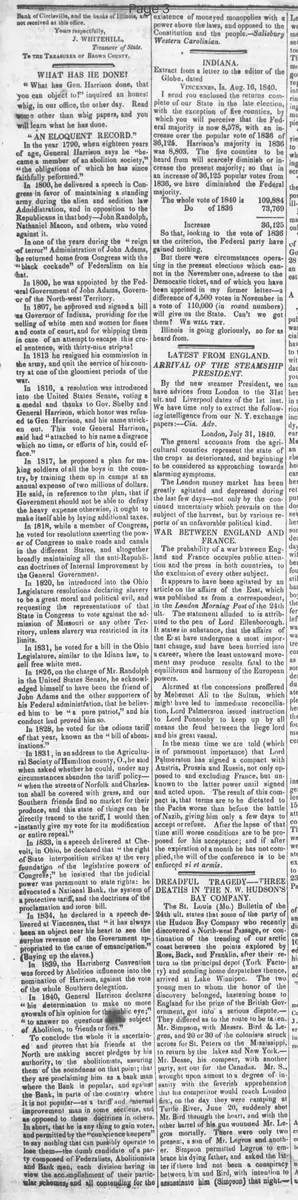
WHAT HAS HE DONE?
"What has Gen. Harrison done, that you can object to?" inquired an honest whig, in our office, the other day. Read some other than whig papers, and you will learn what he has done.
"AN ELOQUENT RECORD."
In the year 1790, when eighteen years of age, General Harrison says he "became a member of an abolition society," "the obligations of which he has since faithfully performed."
In 1800, he delivered a speech in Congress in favor of maintaining a standing army during the alien and sedition law Administration, and in opposition to the Republicans in that body—John Randolph, Nathaniel Macon, and others, who voted against it.
In one of the years during the "reign of terror" Administration of John Adams, he returned home from Congress with the black cockade of Federalism on his hat.
In 1800, he was appointed by the Federal Government of John Adams, Governor of the North-west Territory.
In 1807, he approved and signed a bill as Governor of Indiana, providing for the selling of white men and women for fines and costs of court, and for whipping them in case of an attempt to escape this cruel sentence, with thirty-nine stripes!
In 1813 he resigned his commission in the army, and quit the service of his country at one of the gloomiest periods of the war.
In 1816, a resolution was introduced into the United States Senate, voting a medal and thanks to Gov. Shelby and General Harrison, which honor was refused to Gen Harrison, and his name stricken out. This vote General Harrison said had "attached to his name a disgrace which no time, or efforts of his, could efface."
In 1817, he proposed a plan for making soldiers of all the boys in the country, by training them up in camps at an annual expense of two millions of dollars. He said, in reference to the plan, that if Government should not be able to defray the heavy expense otherwise, it ought to make itself able by laying additional taxes.
In 1818, while a member of Congress, he voted for resolutions asserting the power of Congress to make roads and canals in the different States, and altogether broadly maintaining all the anti-Republican doctrines of Internal Improvement by the General Government.
In 1820, he introduced into the Ohio Legislature resolutions declaring slavery to be a great moral and political evil, and requesting the representatives of that State in Congress to vote against the admission of Missouri or any other Territory, unless slavery was restricted in its limits.
In 1831, he voted for a bill in the Ohio Legislature, similar to the Indiana law, to sell free white men.
In 1826, on the charge of Mr. Randolph in the United States Senate, he acknowledged himself to have been the friend of John Adams and the other supporters of his Federal administration, that he believed him to be "a pure patriot," and his conduct had proved him so.
In 1828, he voted for the odious tariff of that year, known as the "bill of abominations."
In 1831, in an address to the Agricultural Society of Hamilton county, O., he said when asked whether he could, under any circumstances abandon the tariff policy— "when the streets of Norfolk and Charleston shall be covered with grass, and our Southern friends find no market for their produce, and this state of things can be directly traced to the tariff, I would then instantly give my vote for its modification or entire repeal."
In 1833, in a speech delivered at Chillicothe, in Ohio, he declared that "the right of State interposition strikes at the very foundation of the legislative powers of Congress;" he insisted that the judicial power was paramount to state rights: he advocated a National Bank, the system of a protective tariff, and the doctrines of the proclamation and force bill.
In 1834, he declared in a speech delivered at Vincennes, that "it has always been an object near his heart to see the surplus revenue of the Government appropriated to the cause of emancipation." (Buying up the slaves.)
In 1839, the Harrisburg Convention was forced by Abolition influence into the nomination of Harrison, against the vote of the whole Southern delegation.
In 1840, General Harrison declares "his determination to make no more avowals of his opinion for the public eye;" "to answer no questions on the subject of Abolition, to friends or foes."
To conclude the whole it is ascertained and proven that his friends at the North are making secret pledges by his authority, to the abolitionists, assuring them of the soundness on that point; that they are proclaiming him as a bank man where the Bank is popular, and against the Bank, in parts of the country where it is not popular—as a tariff and internal improvement man in some sections, and as opposed to these doctrines in others.
In short, that he is any thing to gain votes, and permitted by the "conscience keepers" to say nothing that can possibly operate to lose them—the dumb candidate of a party composed of Federalists, Abolitionists and Bank men, each division having in view the accomplishment of their particular schemes and all contending for the existence of moneyed monopolies with a power above the laws, and opposed to the Constitution and the people.—Salisbury Western Carolinian.
"What has Gen. Harrison done, that you can object to?" inquired an honest whig, in our office, the other day. Read some other than whig papers, and you will learn what he has done.
"AN ELOQUENT RECORD."
In the year 1790, when eighteen years of age, General Harrison says he "became a member of an abolition society," "the obligations of which he has since faithfully performed."
In 1800, he delivered a speech in Congress in favor of maintaining a standing army during the alien and sedition law Administration, and in opposition to the Republicans in that body—John Randolph, Nathaniel Macon, and others, who voted against it.
In one of the years during the "reign of terror" Administration of John Adams, he returned home from Congress with the black cockade of Federalism on his hat.
In 1800, he was appointed by the Federal Government of John Adams, Governor of the North-west Territory.
In 1807, he approved and signed a bill as Governor of Indiana, providing for the selling of white men and women for fines and costs of court, and for whipping them in case of an attempt to escape this cruel sentence, with thirty-nine stripes!
In 1813 he resigned his commission in the army, and quit the service of his country at one of the gloomiest periods of the war.
In 1816, a resolution was introduced into the United States Senate, voting a medal and thanks to Gov. Shelby and General Harrison, which honor was refused to Gen Harrison, and his name stricken out. This vote General Harrison said had "attached to his name a disgrace which no time, or efforts of his, could efface."
In 1817, he proposed a plan for making soldiers of all the boys in the country, by training them up in camps at an annual expense of two millions of dollars. He said, in reference to the plan, that if Government should not be able to defray the heavy expense otherwise, it ought to make itself able by laying additional taxes.
In 1818, while a member of Congress, he voted for resolutions asserting the power of Congress to make roads and canals in the different States, and altogether broadly maintaining all the anti-Republican doctrines of Internal Improvement by the General Government.
In 1820, he introduced into the Ohio Legislature resolutions declaring slavery to be a great moral and political evil, and requesting the representatives of that State in Congress to vote against the admission of Missouri or any other Territory, unless slavery was restricted in its limits.
In 1831, he voted for a bill in the Ohio Legislature, similar to the Indiana law, to sell free white men.
In 1826, on the charge of Mr. Randolph in the United States Senate, he acknowledged himself to have been the friend of John Adams and the other supporters of his Federal administration, that he believed him to be "a pure patriot," and his conduct had proved him so.
In 1828, he voted for the odious tariff of that year, known as the "bill of abominations."
In 1831, in an address to the Agricultural Society of Hamilton county, O., he said when asked whether he could, under any circumstances abandon the tariff policy— "when the streets of Norfolk and Charleston shall be covered with grass, and our Southern friends find no market for their produce, and this state of things can be directly traced to the tariff, I would then instantly give my vote for its modification or entire repeal."
In 1833, in a speech delivered at Chillicothe, in Ohio, he declared that "the right of State interposition strikes at the very foundation of the legislative powers of Congress;" he insisted that the judicial power was paramount to state rights: he advocated a National Bank, the system of a protective tariff, and the doctrines of the proclamation and force bill.
In 1834, he declared in a speech delivered at Vincennes, that "it has always been an object near his heart to see the surplus revenue of the Government appropriated to the cause of emancipation." (Buying up the slaves.)
In 1839, the Harrisburg Convention was forced by Abolition influence into the nomination of Harrison, against the vote of the whole Southern delegation.
In 1840, General Harrison declares "his determination to make no more avowals of his opinion for the public eye;" "to answer no questions on the subject of Abolition, to friends or foes."
To conclude the whole it is ascertained and proven that his friends at the North are making secret pledges by his authority, to the abolitionists, assuring them of the soundness on that point; that they are proclaiming him as a bank man where the Bank is popular, and against the Bank, in parts of the country where it is not popular—as a tariff and internal improvement man in some sections, and as opposed to these doctrines in others.
In short, that he is any thing to gain votes, and permitted by the "conscience keepers" to say nothing that can possibly operate to lose them—the dumb candidate of a party composed of Federalists, Abolitionists and Bank men, each division having in view the accomplishment of their particular schemes and all contending for the existence of moneyed monopolies with a power above the laws, and opposed to the Constitution and the people.—Salisbury Western Carolinian.
What sub-type of article is it?
Partisan Politics
Slavery Abolition
Economic Policy
What keywords are associated?
Harrison Critique
Political Record
Abolition Inconsistencies
Federalism
Tariff Support
National Bank
Internal Improvements
What entities or persons were involved?
Gen. Harrison
John Adams
John Randolph
Nathaniel Macon
Gov. Shelby
Abolitionists
Federalists
Bank Men
Editorial Details
Primary Topic
Critique Of William Henry Harrison's Political Inconsistencies
Stance / Tone
Strongly Critical And Accusatory
Key Figures
Gen. Harrison
John Adams
John Randolph
Nathaniel Macon
Gov. Shelby
Abolitionists
Federalists
Bank Men
Key Arguments
Joined Abolition Society At 18 And Claims To Uphold Its Obligations
Supported Standing Army During Adams' Alien And Sedition Era
Wore Federalist Cockade And Appointed Governor By Adams
Signed Bill Allowing Sale And Whipping Of Whites For Debts
Resigned Army Commission During War Of 1812 Low Point
Denied Medal And Thanks In Senate Alongside Gov. Shelby
Proposed Military Training For Boys With Tax Funding
Voted For Federal Internal Improvements Like Roads And Canals
Introduced Anti Slavery Resolutions In Ohio Legislature
Voted For 1828 Tariff And Defended Protective Tariffs
Advocated National Bank And Against State Interposition
Supported Using Surplus Revenue For Emancipation
Nominated Against Southern Wishes Due To Abolition Influence
Refuses To State Opinions On Abolition Publicly
Campaign Adapts Positions Regionally To Gain Votes