Thank you for visiting SNEWPapers!
Sign up free
Foreign News
September 22, 1958
The Nome Nugget
Nome, Nome County, Alaska
What is this article about?
Soviet Foreign Ministry expels AP correspondent Roy Essoyan from Moscow for violating press censorship over an August dispatch critical of Khrushchev's Middle East proposal. He is the fourth US journalist ousted since April 1956.
Clipping
OCR Quality
98%
Excellent
Full Text
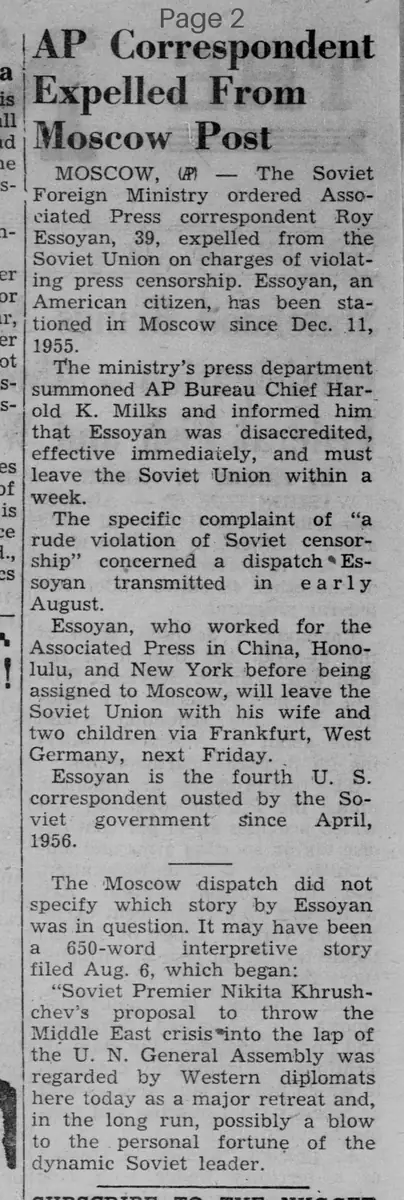
AP Correspondent Expelled From Moscow Post
MOSCOW, (AP) - The Soviet Foreign Ministry ordered Associated Press correspondent Roy Essoyan, 39, expelled from the Soviet Union on charges of violating press censorship. Essoyan, an American citizen, has been stationed in Moscow since Dec. 11, 1955.
The ministry's press department summoned AP Bureau Chief Harold K. Milks and informed him that Essoyan was 'disaccredited, effective immediately, and must leave the Soviet Union within a week.
The specific complaint of "a rude violation of Soviet censorship" concerned a dispatch Essoyan transmitted in early August.
Essoyan, who worked for the Associated Press in China, Honolulu, and New York before being assigned to Moscow, will leave the Soviet Union with his wife and two children via Frankfurt, West Germany, next Friday.
Essoyan is the fourth U. S. correspondent ousted by the Soviet government since April, 1956.
The Moscow dispatch did not specify which story by Essoyan was in question. It may have been a 650-word interpretive story filed Aug. 6, which began:
"Soviet Premier Nikita Khrushchev's proposal to throw the Middle East crisis into the lap of the U. N. General Assembly was regarded by Western diplomats here today as a major retreat and, in the long run, possibly a blow to the personal fortune of the dynamic Soviet leader."
MOSCOW, (AP) - The Soviet Foreign Ministry ordered Associated Press correspondent Roy Essoyan, 39, expelled from the Soviet Union on charges of violating press censorship. Essoyan, an American citizen, has been stationed in Moscow since Dec. 11, 1955.
The ministry's press department summoned AP Bureau Chief Harold K. Milks and informed him that Essoyan was 'disaccredited, effective immediately, and must leave the Soviet Union within a week.
The specific complaint of "a rude violation of Soviet censorship" concerned a dispatch Essoyan transmitted in early August.
Essoyan, who worked for the Associated Press in China, Honolulu, and New York before being assigned to Moscow, will leave the Soviet Union with his wife and two children via Frankfurt, West Germany, next Friday.
Essoyan is the fourth U. S. correspondent ousted by the Soviet government since April, 1956.
The Moscow dispatch did not specify which story by Essoyan was in question. It may have been a 650-word interpretive story filed Aug. 6, which began:
"Soviet Premier Nikita Khrushchev's proposal to throw the Middle East crisis into the lap of the U. N. General Assembly was regarded by Western diplomats here today as a major retreat and, in the long run, possibly a blow to the personal fortune of the dynamic Soviet leader."
What sub-type of article is it?
Diplomatic
Political
What keywords are associated?
Soviet Expulsion
Ap Correspondent
Press Censorship
Moscow Journalist
Khrushchev Criticism
What entities or persons were involved?
Roy Essoyan
Harold K. Milks
Nikita Khrushchev
Where did it happen?
Moscow
Foreign News Details
Primary Location
Moscow
Event Date
Early August
Key Persons
Roy Essoyan
Harold K. Milks
Nikita Khrushchev
Outcome
essoyan disaccredited and must leave within a week; fourth us correspondent ousted since april 1956
Event Details
Soviet Foreign Ministry ordered expulsion of AP correspondent Roy Essoyan for violating censorship with an early August dispatch, possibly a critical story on Khrushchev's Middle East proposal filed Aug. 6.