Thank you for visiting SNEWPapers!
Sign up free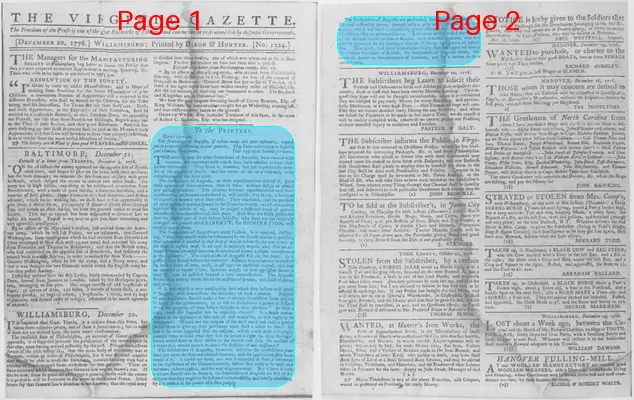
The Virginia Gazette
Richmond, Williamsburg, Richmond County, Virginia
What is this article about?
The freeholders of Augusta defend their prior political statements against criticism, rejecting blind obedience to unjust laws as tyrannical and affirming the right to resist such laws by any means, citing Dr. Price's essay on political liberty.
Merged-components note: Continuation of the letter to the editor across pages, same topic and sequential reading order.
Clippings
1 of 2
OCR Quality
Full Text
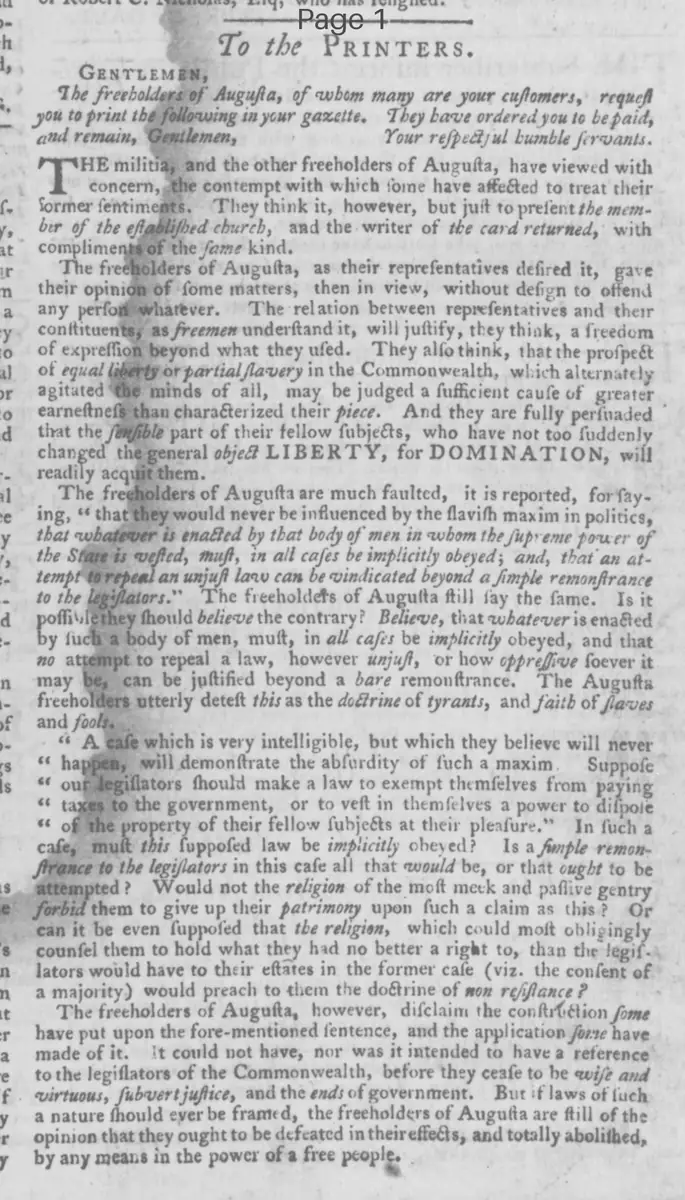
GENTLEMEN,
The freeholders of Augusta, of whom many are your customers, request you to print the following in your gazette. They have ordered you to be paid, and remain, Gentlemen, Your respectful humble servants.
[Signed by the freeholders, but content follows as the letter]
With concern, the contempt with which some have affected to treat their former sentiments. They think it, however, but just to present the member of the established church, and the writer of the card returned, with compliments of the same kind.
The freeholders of Augusta, as their representatives desired it, gave their opinion of some matters, then in view, without design to offend any person whatever. The relation between representatives and their constituents, as freemen understand it, will justify, they think, a freedom of expression beyond what they used. They also think, that the prospect of equal liberty or partial slavery in the Commonwealth, which alternately agitated the minds of all, may be judged a sufficient cause of greater earnestness than characterized their piece. And they are fully persuaded that the sensible part of their fellow subjects, who have not too suddenly changed the general object LIBERTY, for DOMINATION, will readily acquit them.
The freeholders of Augusta are much faulted, it is reported, for saying, "that they would never be influenced by the slavish maxim in politics, that whatever is enacted by that body of men in whom the supreme power of the State is vested, must, in all cases be implicitly obeyed; and, that an attempt to repeal an unjust law can be vindicated beyond a simple remonstrance to the legislators." The freeholders of Augusta still say the same. Is it possible they should believe the contrary? Believe, that whatever is enacted by such a body of men, must, in all cases be implicitly obeyed, and that no attempt to repeal a law, however unjust, or how oppressive soever it may be, can be justified beyond a bare remonstrance.
The Augusta freeholders utterly detest this as the doctrine of tyrants, and faith of slaves and fools
A case which is very intelligible, but which they believe will never happen, will demonstrate the absurdity of such a maxim
Suppose "our legislators should make a law to exempt themselves from paying "taxes to the government, or to vest in themselves a power to dispose
"of the property of their fellow subjects at their pleasure." In such a
case, must this supposed law be implicitly obeyed? Is a simple remon-
strance to the legislators in this case all that would be, or that ought to be
attempted? Would not the religion of the most meek and passive gentry
forbid them to give up their patrimony upon such a claim as this? Or
can it be even supposed that the religion, which could most obligingly
counsel them to hold what they had no better a right to, than the legisl
lators would have to their estates in the former case (viz. the consent of
a majority) would preach to them the doctrine of non-resistance?
The freeholders of Augusta, however, disclaim the construction some
have put upon the fore-mentioned sentence, and the application others have
made of it. It could not have, nor was it intended to have a reference
to the legislators of the Commonwealth, before they cease to be wise and
virtuous, subvert justice, and the ends of government. But if laws of such
a nature should ever be framed, the freeholders of Augusta are still of the
opinion that they ought to be defeated in their effects, and totally abolished,
by any means in the power of a free people.
The freeholders of Augusta are persuaded, that the Gentlemen of the General Assembly know, though others may not, that the above sentence, which has most unexpectedly given offence, was taken from Dr. Price's essay on political liberty. A sentence which passed the review of the virtual censors of Great Britain, with deserved applause, and will ever be approved by the intelligent friends of liberty, and haters of oppression. That nicer, and more irritable sensibility than has appeared among the jealous statesmen of Britain, the freeholders of Augusta think, will never do honour to the advocates of freedom, nor be a virtue in their countrymen.
What sub-type of article is it?
What themes does it cover?
What keywords are associated?
What entities or persons were involved?
Letter to Editor Details
Author
The Freeholders Of Augusta
Recipient
The Printers
Main Argument
the freeholders reject blind obedience to all laws, especially unjust ones, as the doctrine of tyrants, and affirm that free people should resist and abolish such laws by any means, while disclaiming intent to criticize current virtuous legislators.
Notable Details